

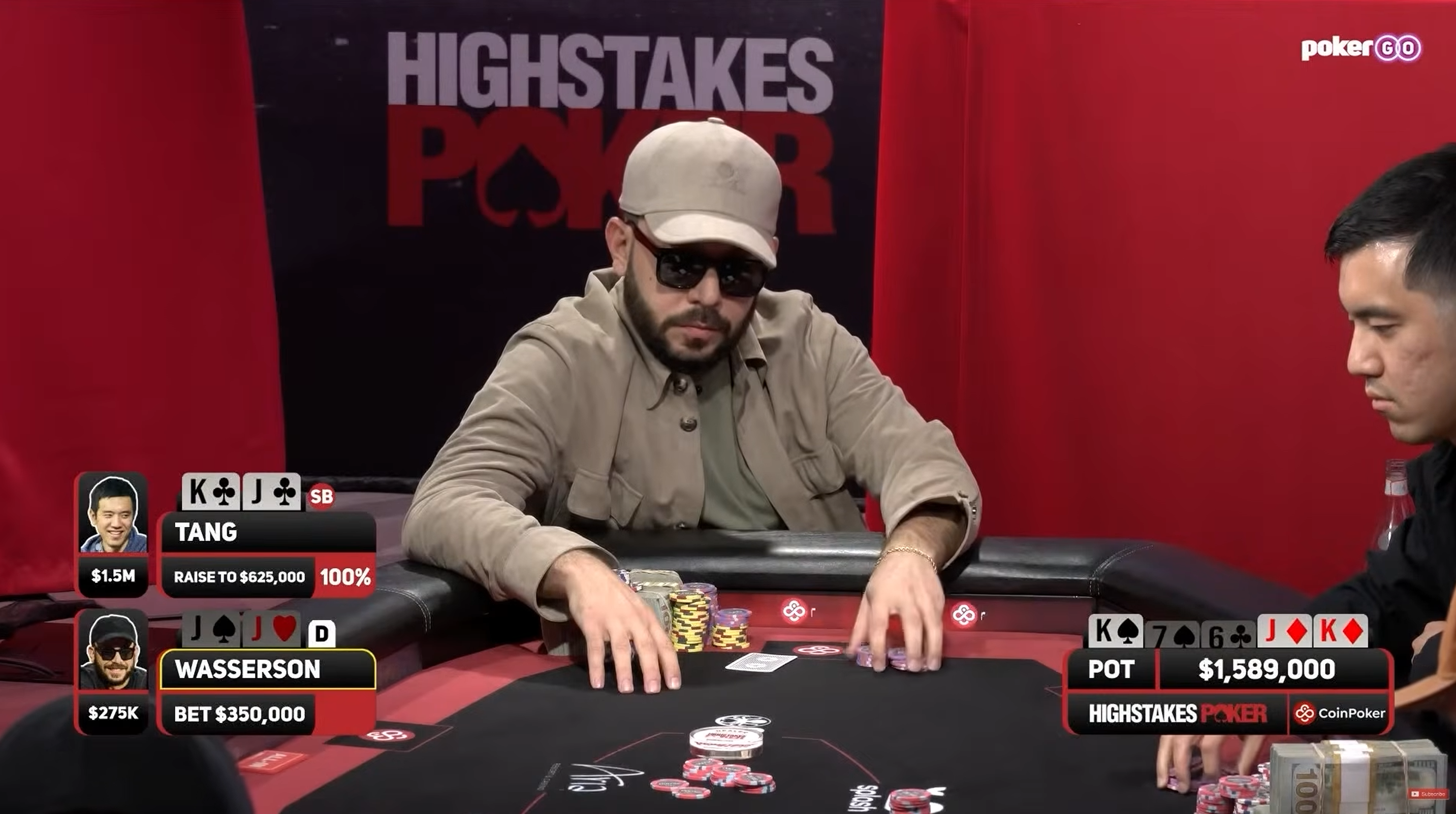
At stakes of $500/$1,000/$2,000/$4,000, a seemingly innocuous hand can quickly transform into a pot worth seven figures. This is exactly what happened to Eric Wasserson and Stanley Tang in one of the most discussed hands in High Stakes Poker history.
Wasserson kicked off the action with a raise to $12k holding J s J h. The call came from three players — Tang with K c J c, Elamaway with A d T s, and Texas Mike with Q c 2 c. A relatively calm flop of K s 7 s 6 c saw all players check. Everything changed on the turn with J d. Wasserson hit a set, Tang had top two pairs, and this is where one of the most talked-about hands in the show's history began.
Why Wasserson Wisely Checked Pocket Jacks on the Flop
An analysis by respected coach Jonathan Little first examined the checked flop. At first glance, Wasserson's check with pocket jacks might seem overly passive. However, in a multiway pot, his hand is often significantly behind a king or gains only minor value against weaker hands. A bet also opens up the possibility of an unpleasant check-raise.
Wasserson chose the simpler route and checked behind. If significant aggression arose on the turn, he could easily step away. If everyone checked again, he would have more reasons to believe his hand was still ahead. Then came the game-changing card.
The Jack on the Turn Set the Perfect Trap
The turn brought the J d. Wasserson now had a set, and Tang had KJ with top two pairs on a board filled with draws. Tang checked again. Wasserson bet $30,000 into a roughly $54,000 pot, and Tang responded with a check-raise to $100,000. Here, the hand shifted from a typical high-stakes scenario to a situation where nearly the entire stack could end up in the middle.
Wasserson opted for a re-raise to $280,000. With such deep stacks, his decision makes sense. Tang's check-raise doesn't necessarily indicate just a strong hand. The board hosts numerous straight and flush draws, and Wasserson can extract value from hands that still hold decent equity against a set. Tang merely called, pushing the pot to over $600,000.
Against the set of jacks, Tang was practically drawing dead. Practically. The deck held one remaining king that could give him a better full house. And that’s exactly what came. The river K d gave Tang a higher full house than Wasserson's. Tang checked, and Wasserson still held a hand that, in most similar situations, would be an absolute monster.
Wasserson bet $350,000. The sizing choice is an intriguing part of the hand. With such a strong hand and remaining stacks, one could argue for a significantly larger bet or even a shove. Wasserson, however, chose around a half-pot size. Then came the response he didn’t want to see—Tang moved all-in.
Full House, Huge Pot Odds, and Nearly No Bluffs
Wasserson found himself in a spot illustrating the difference between his hand's strength and the opponent's range strength. A full house is an absolute monster, but the problem is what Tang can realistically represent after such action.
He called preflop, checked the flop, check-raised the turn, called Wasserson's re-raise, and check-raised all-in on a rivered king. This line carries very few natural bluffs. During his tank, Wasserson gradually analyzed potential value hands: Sixes. Sevens. K6. K7. And eventually, KJ itself.
Mathematically, he was getting an extremely favorable price to call. That's what made the decision so brutal. “I think this will be the worst fold of all time.” If Tang is bluffing, Wasserson folds one of the strongest hands he could have in this spot. But if Tang is almost never bluffing, pot odds stop being the only argument.
One of the most important lessons from this hand is the power of the river check-raise. At lower and higher stakes, a river check-raise in large pots is often extremely value-heavy. Players simply lack enough natural bluffs, especially after previous aggression on the turn.
After a long tank, Wasserson folded his jacks. Commentators and the players at the table reacted with surprise. With such pot odds and holding a full house, most players wouldn't resist the call.
Yet Wasserson managed to separate the strength of his hand from the reality of his opponent's range. That’s what makes this hand far more intriguing than just a bad beat. Tang hit the only card that could save him. Wasserson did something perhaps even less likely. He found the fold. What do you think? Could you fold such a strong hand in his place?
Sources: YouTube

