

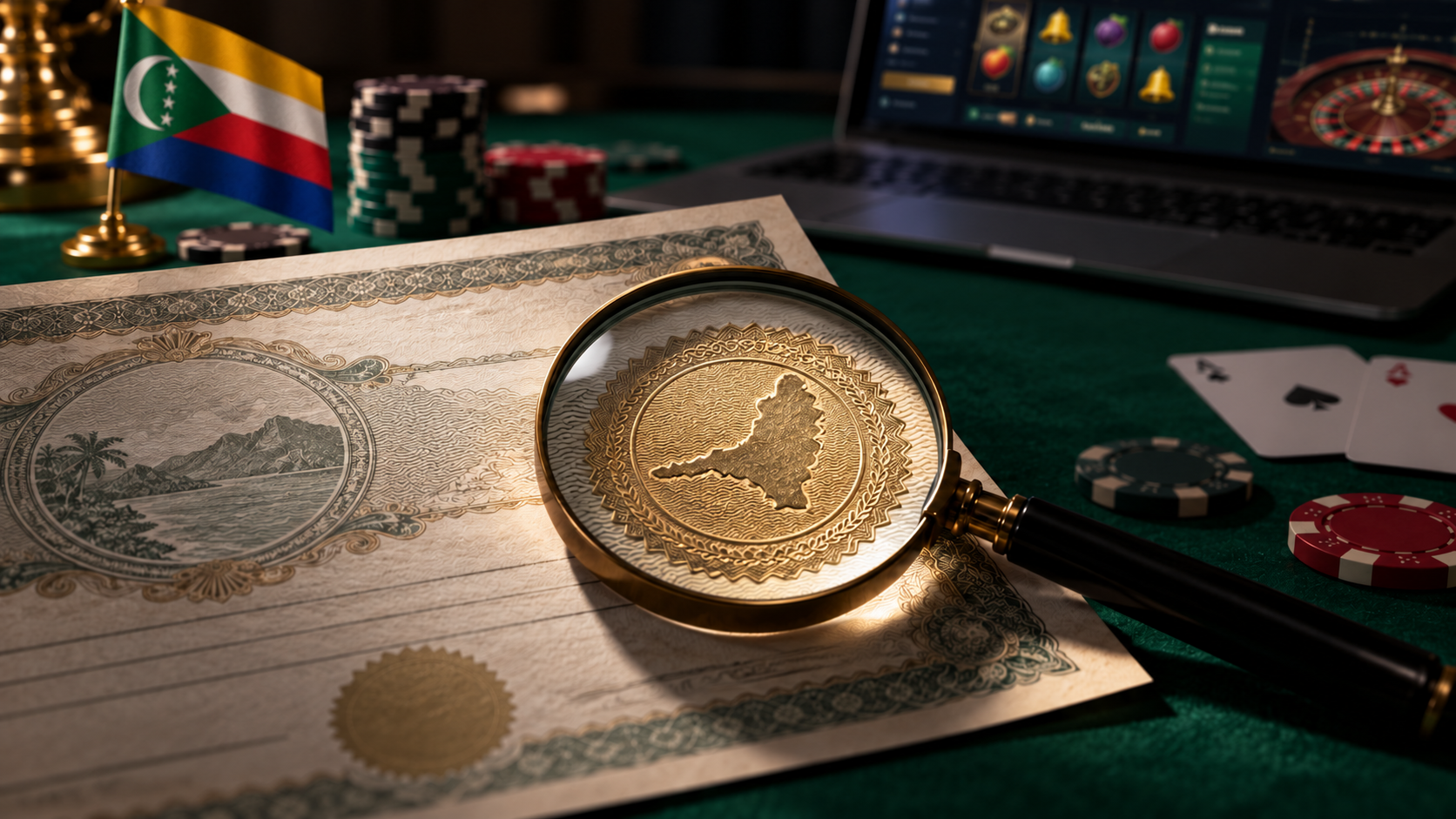
For years, Anjouan has been marketed as a fast, affordable and flexible alternative to established gambling jurisdictions such as Malta, Gibraltar, the Isle of Man and Curaçao. Its licence has appeared on hundreds of online casinos, crypto gambling platforms and poker-related websites targeting players around the world. The legitimacy of that system is now facing its most serious challenge yet.
According to an investigation published by The Guardian, the national authorities of Comoros dispute the legality of the offshore gambling licensing network operating under the name of Anjouan, one of the islands that form the Union of the Comoros. A public register examined by the newspaper contained almost 1,500 licence holders, many of them connected to crypto casinos and gambling websites operating internationally. The Central Bank of Comoros reportedly described the licensing system as unauthorised and accused those behind it of using the country’s name to create an appearance of legitimacy. The Comorian government is now preparing judicial action and has reportedly requested international cooperation, including assistance from British authorities.
A Licensing Regime the National Government Says It Never Approved
The dispute centres on whether private organisations had the legal authority to issue gambling licences on behalf of Anjouan. Anjouan is an autonomous island within Comoros, but the national government maintains that the offshore gambling regime was never officially authorised. The issue is further complicated by the country’s penal code, which prohibits games of chance.
A previous investigation by Le Monde reported that the Central Bank had already warned in 2022 that the organisation presented as the Anjouan Offshore Financial Authority did not represent a legitimate public regulator. Despite those warnings, the Anjouan licence continued to grow rapidly. It became particularly attractive to operators that wanted to launch quickly, accept cryptocurrency or serve markets where stricter regulators would impose significantly higher costs and compliance requirements.
The British Connection
The latest investigation also points to connections between the licensing ecosystem and companies registered in the United Kingdom. Based on corporate records and promotional material, The Guardian linked parts of the network to London-based businesses including ACS Global Custodian and Sherm Group. Members of the Sorsky family were identified in connection with the companies.
Harold Sorsky rejected the newspaper’s interpretation of the evidence. He said ACS Global Custodian had not sold or issued gambling licences since he acquired the company in 2023 and argued that independent service providers were responsible for processing licence applications. He also maintained that ACS and Sherm were separate businesses despite sharing some directors.
These denials are important. No court has yet delivered a final judgment on the legality of the licensing structure, and the claims remain disputed. The investigation nevertheless raises serious questions about who controlled the system, where the money went and whether operators were entitled to describe themselves as regulated.
Why Anjouan Became So Popular
SpadePoker previously examined why so many new poker and casino sites were choosing Anjouan. The explanation was relatively straightforward: Anjouan promised speed, low costs and operational flexibility. At the time of our previous report, the public register contained approximately 1,430 licences. The advertised cost was €17,828 for the initial licence and the same amount for annual renewal, with additional domains reportedly available for €500 each.
Compared with the cost and scrutiny involved in obtaining a licence from a major European regulator, the offer was highly attractive. One authorisation could reportedly cover both business-to-consumer and business-to-business operations, while applications could be completed much faster than in more established jurisdictions.
The licence therefore allowed a new casino or poker platform to display a regulatory badge without facing the same barriers associated with stricter markets. Even then, however, the conclusion was clear: the presence of an Anjouan licence should be treated as the beginning of a player’s due diligence, not proof that a website is safe. The latest findings make that warning considerably more urgent.
What This Means for Players
A gambling licence is supposed to do more than decorate the bottom of a website. It should identify the company responsible for the operation, establish rules for protecting player funds, provide a process for complaints and give the regulator the authority to investigate misconduct or impose sanctions. If the body issuing the licence does not possess recognised legal authority, those protections may be extremely difficult to enforce.
That becomes especially important when a player encounters delayed withdrawals, a frozen account, disputed bonus terms or an operator that suddenly disappears. A licence is only valuable if the regulator behind it is independent, reachable and capable of acting against the company it licensed. The investigation also identified Anjouan-licensed casinos that promoted themselves as alternatives for British players registered with GamStop, the United Kingdom’s national self-exclusion system.
Offshore sites operating outside the UK regulatory framework are not necessarily connected to GamStop, creating another potential risk for vulnerable players attempting to restrict their gambling. One operator tested by The Guardian allegedly continued sending a large volume of calls and promotional messages after the player stopped gambling. The website reportedly defended its operation by referring to its own internal rules rather than an external regulator.
Pressure on Operators, Banks and Payment Providers
The consequences could extend beyond individual players. Operators using the Anjouan licence may need to reassess whether they can continue presenting themselves as regulated. Banks, cryptocurrency payment companies, software suppliers and affiliate partners could also reconsider relationships that were approved partly because the operator displayed an apparently valid licence.
The central question is no longer simply whether Anjouan offers weaker protection than Malta or the United Kingdom. It is whether the entire licensing framework had the legal authority it claimed to possess. If the Comorian government succeeds in formally challenging the system, hundreds of gambling websites could be forced to find another jurisdiction, change their payment arrangements or suspend operations in certain markets.
What Happens Next?
Comorian authorities are reportedly preparing domestic legal proceedings while seeking cooperation from foreign governments and law-enforcement agencies. Any investigation involving British individuals or UK-registered companies could bring additional scrutiny to the corporate structure behind the licences. For now, the status of individual Anjouan-licensed operators has not been settled by a court. The companies connected to the system dispute significant parts of the investigation, and it would be premature to conclude that every operator holding such a licence has acted unlawfully.
However, the findings have fundamentally changed the conversation around Anjouan. What was previously viewed as a cheap and permissive offshore licensing option is now at the centre of a dispute over whether its regulator existed with valid governmental authority at all. Until that question is resolved, players should not assume that the Anjouan badge provides meaningful protection when something goes wrong.
Sources - TheGuardian, X, LeMonde

