

Playing poker can be a lot of fun, but you don't want to look like a rookie squinting at a hand ranking chart to figure out what you've got and whether you won. Luckily, there are simple ways to learn the hands to play poker with confidence and look like a pro doing it. This guide is about hand rankings, not the best starting poker hands to play before the flop (that's a different skill for another day), but knowing your rankings cold is the foundation everything else builds on.
Key Takeaways:
- Five easy ways to remember poker hands: learn the order, group similar ones, and practice with real examples.
- Know your hand strength fast so you can bet with confidence, not doubt.
- This helps in real games and online tournaments, where you must decide quickly.
- Knowing the rankings helps you make better choices, but it doesn’t mean you’ll always win.
Use a Simple Memory Trick for the Hand Order
Humans are pattern-recognition machines. Our brains spot familiar things inside new information and connect them to structures already sitting in memory, so fast and so instinctively we barely notice it. That's the key to one of the tricks that makes memorizing hands genuinely easy.
The ten poker hands in order can feel overwhelming, but split them into groups of three that follow a pattern, and the brain has a much easier time holding on to them.
The first group is matching hands to play poker, cards that repeat: Pair, Two Pair, Three of a Kind. The logic is simple. The more cards you repeat of the same value, the stronger the hand, so your brain just has to follow a progression that already makes sense instead of memorizing an arbitrary order.
The second group is sequence and suit hands: Straight and Flush. Instead of repetition, you're looking for continuity (five consecutive cards) or uniformity (five cards of the same suit). The brain processes these as recognizable visual categories, so they're easy to spot.
The third group is the superior combinations: Full House, Four of a Kind, Straight Flush, and Royal Flush. These are basically mixes and extreme versions of the first two groups. A Full House combines Three of a Kind with a Pair. A Straight Flush combines a Straight with a Flush. A Royal Flush is just a Straight Flush using the highest cards possible. Understand the first two groups, and these almost explain themselves.
Once you lock in these patterns, there's no going back. Your brain starts visualizing them automatically in every hand you play, and it gets easier every time you sit down.
Which Hand Wins? Make Yourself Guess
Trying to learn each hand the way you'd cram for an exam doesn't work especially well. It's more effective to force your brain to learn through a bit of trial and error, since actively trying to recall information produces meaningfully better retention than passively rereading it.
Design small challenges for yourself, quick mini games where you guess what hand you're looking at and which one wins. Start with the easiest comparisons, then work up to the ones that trip up even experienced players.
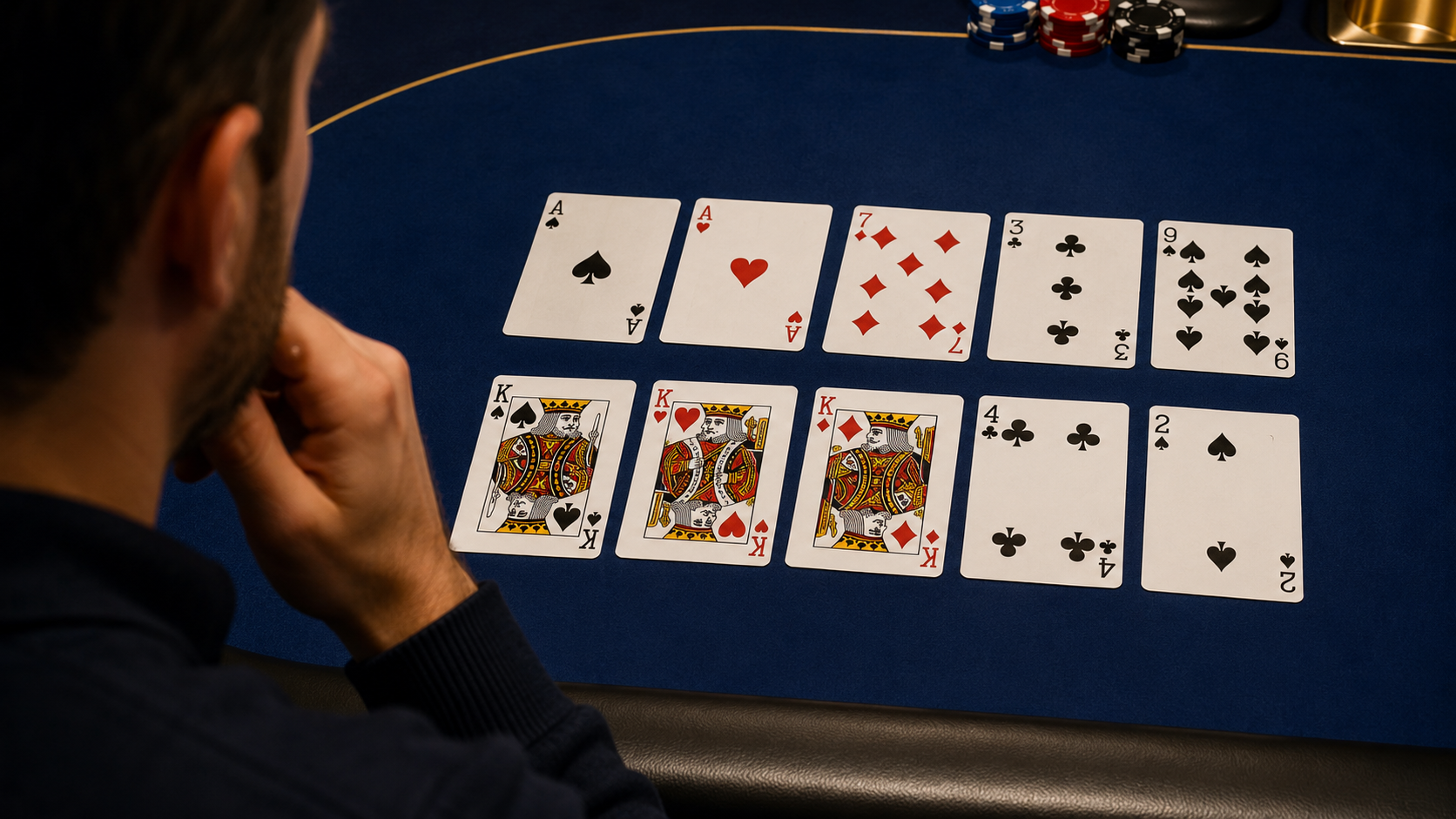
For example, which of these two hands wins?
Hand A: A♠ A♥ 7♦ 3♣ 9♠ Hand B: K♠ K♥ K♦ 4♣ 2♠
Three Kings beats a Pair of Aces. Category rank always matters more than the value of individual cards. A pair, no matter how high, always loses to three of a kind.
Give Your Memory a Quick Practice Round
Professional athletes prepare physically and mentally before competing, and the same idea applies to poker. You don't have to be a pro taking part in online poker tournaments to build a short routine that gets your brain into the right state before a session.
- The two-minute blackout. Grab a poker hand chart and look at it for thirty seconds. Then flip it over or close it completely. Now try to recite all ten hands in order, low to high, out loud or written down; that, and the best starting poker hands, too.
Saying them out loud isn't a small detail. Dual coding, processing information both verbally and visually at once, has been documented since Allan Paivio's research in the 197s as one of the most effective ways to lock in long-term memory. Say "Pair, Two Pair, Three of a Kind" instead of just thinking it, and you're building two access routes to the same memory instead of one.
- Mark your blind spots. Once you finish reciting, open the chart and compare. What matters isn't how many you got right. It's which ones you missed or hesitated on, since those are exactly what needs reinforcing before that weak point shows up during a hand that actually matters. Keep missing the same comparison, say you're always unsure whether a Full House beats Four of a Kind, and that's the one pair you actually need to review.
Look for Cards That Run in Sequence
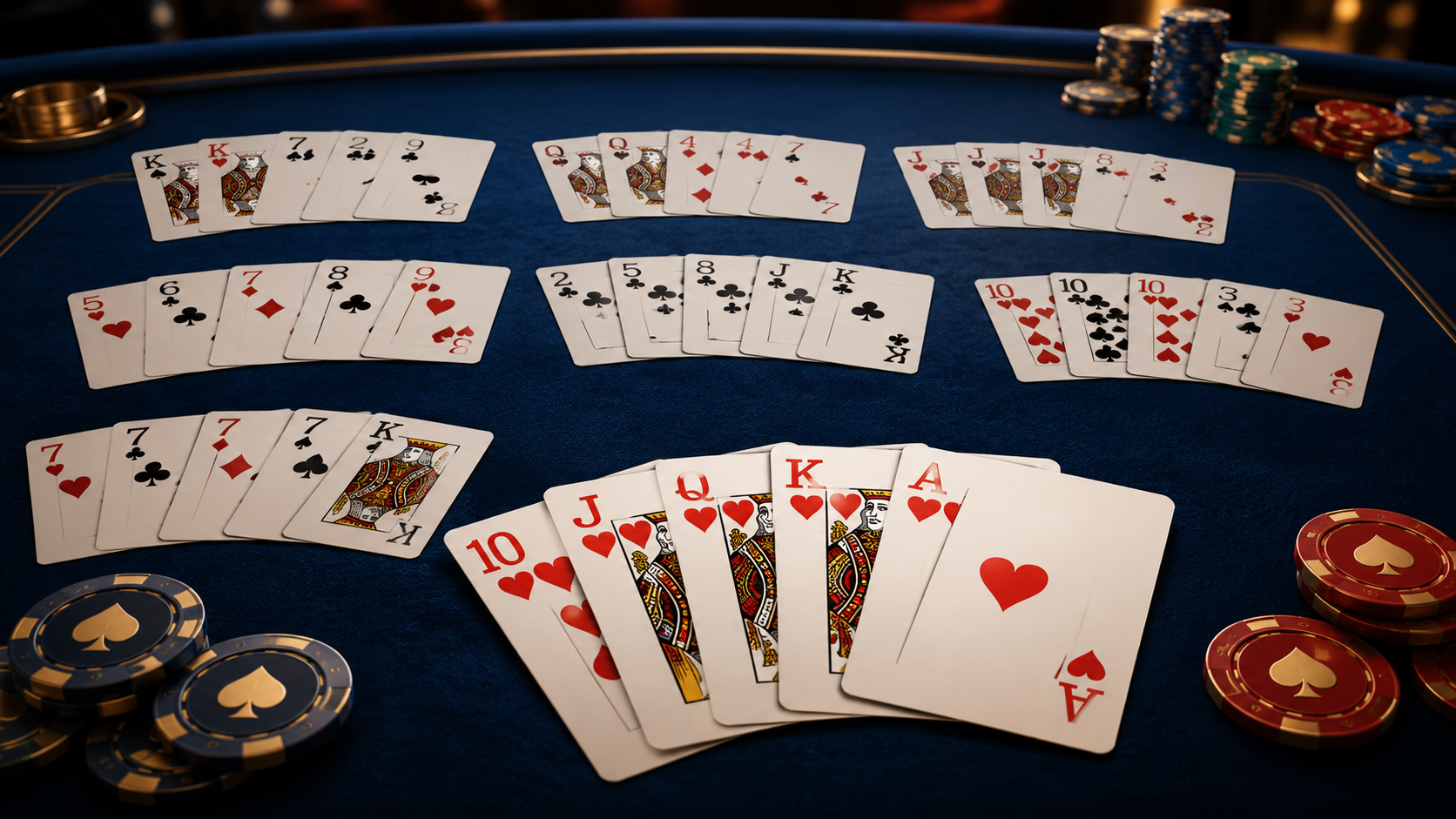
If you can count, you can play poker, at least when it comes to two of the game's most elegant hands, both built on sequence. A Straight is any combination of five cards with consecutive values, regardless of suit. 4♠ 5♥ 6♦ 7♣ 8♠ is a Straight. So is 9♥ 10♦ J♠ Q♣ K♥.
Suit doesn't matter here, which makes a good hand simple to recognize on sight. The one thing worth keeping in mind is the Ace, since it can act as either the highest or lowest card in a straight depending on the situation.
The other hand that fits this pattern is the Straight Flush, where the five cards also share the same suit. No math degree or photographic memory required to spot that one either.
Let the Rare Hands Stand Out
The von Restorff effect describes how, when a series of elements contains something that breaks the pattern, that one element gets remembered far more easily than the rest. Your brain doesn't treat all information equally. It tends to isolate whatever feels unusual.
Poker's rarest hands work exactly this way. Four of a Kind, Straight Flush, and Royal Flush aren't just the strongest poker hands. They're also the most visually distinctive, the ones that immediately feel different the moment they land on the table. That distinctiveness turns them into fixed reference points you can build the rest of the ranking around, with almost no extra effort.
Four matching cards is one of the most instantly recognizable combinations in any card game. A♠ A♥ A♦ A♣ 9♠ is exactly the kind of crazy poker hand that leaves zero ambiguity the moment you see it. The pattern is so complete and symmetrical that your brain identifies it almost instantly, often before you've consciously processed what you're looking at.
The real value in these rare hands isn't just knowing them. It's using them as scaffolding for everything else, like plotting a map with a few fixed landmarks before drawing the roads that connect them.
FAQs
How to quickly memorize poker hands?
Split the ten hands into the three groups above, matching hands, sequence hands, and the top-tier combinations, instead of learning them as one long list. Then test yourself with quick guessing games and a short recite-from-memory drill before you sit down to play.
What hand wins most often in poker?
At showdown, a Pair or Two Pair shows up as the winning hand more often than any other category, simply because they're the most common combinations that can form from five cards. The rarer hands win far less often precisely because they're statistically rare.
How to analyze your poker hands?
Compare category rank first, then card values within that category. A Pair of anything loses to Three of a Kind of anything, full stop, and only after the category is settled does the specific card value matter. Side-by-side comparisons, like the Aces versus Kings example above, train this instinct until it's automatic.
How do I know I have a good hand in poker?
Recognize which of the three groups your hand falls into. Matching hands are solid, but common; sequence hands like a Straight or Flush are a clear step up, and anything from the top-tier group, Full House or better, means you're holding something the table doesn't see very often.

