


New Zealand is moving towards a fully regulated online gambling market, but two of the biggest names in online poker currently have no confirmed direct route into it. The Department of Internal Affairs has announced the results of an auction determining which companies may apply for the country’s 15 available online casino gambling licences. Eleven entities secured application rights, with several winning the opportunity to pursue more than one licence.
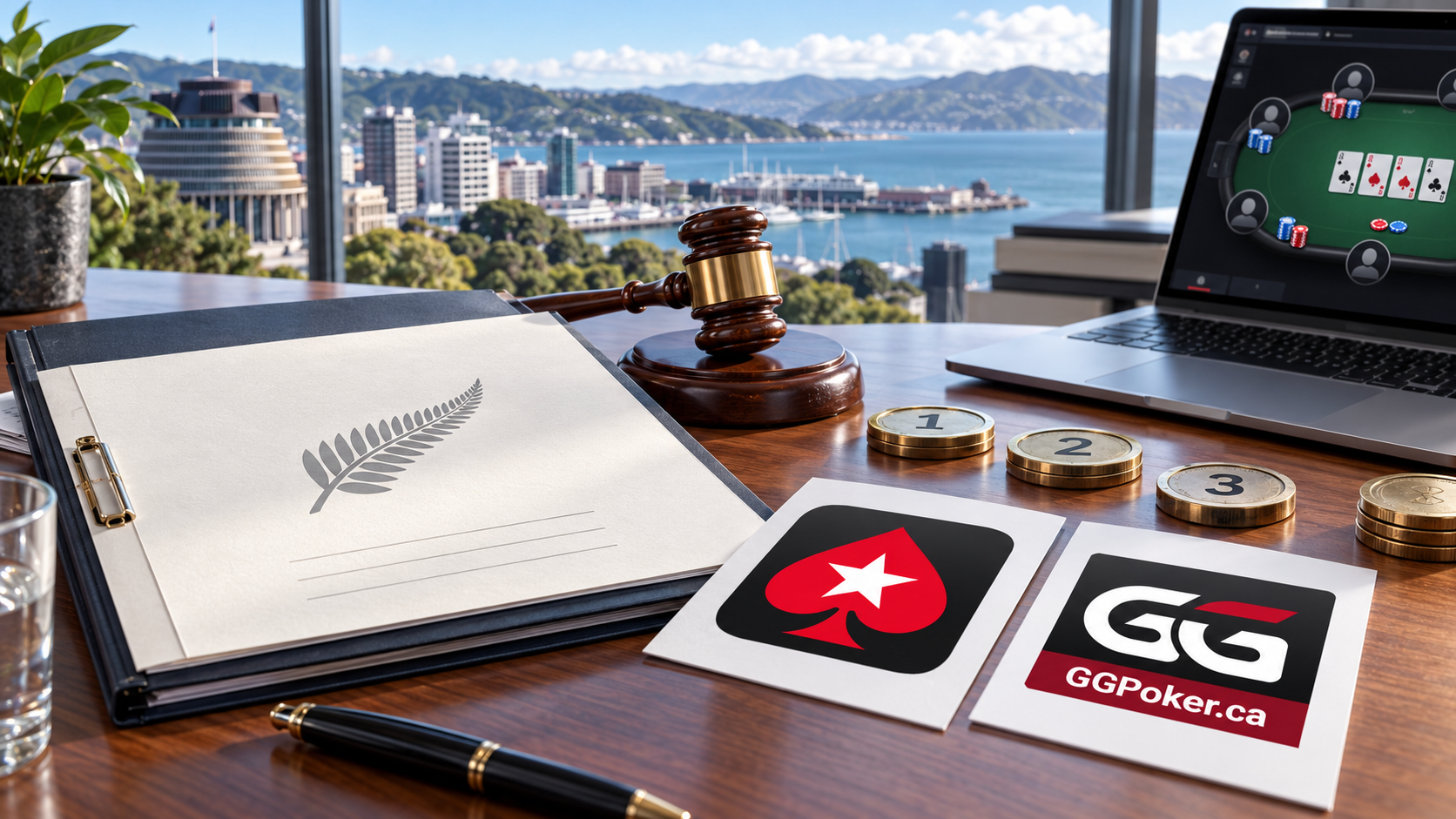
PokerStars and GGPoker are conspicuously absent from the published list. That does not mean either operator has definitively abandoned New Zealand. It does, however, mean that both may need to find an alternative route into the regulated market if they intend to continue serving local players.
Licences reach 15 million NZD each
The auction ran from September 29 to October 12 and attracted 32 bidders across ten rounds. The final price reached 15 million NZD for each licence, approximately 8.4 million US dollars. Up to 15 licences are available. Each will initially remain valid for up to three years, with the possibility of renewal for another five. A single licence will cover one approved brand, while no operator may receive more than three licences.
The following companies secured the right to proceed to the application stage:
| Company | Rights to apply |
| Baytree Interactive Limited | 3 |
| Christchurch Online NZ Limited | 1 |
| One Casino Limited | 1 |
| Playvia Gaming (NZ) Limited | 2 |
| Rock Swift Group Limited | 2 |
| Rush Entertainment Limited | 1 |
| Skill On Net Limited | 1 |
| SkyCity NZ Online NO1 Limited | 1 |
| SkyCity NZ Online NO2 Limited | 1 |
| Stake New Zealand Limited | 1 |
| TAB New Zealand | 1 |
Winning the auction does not automatically guarantee a licence. Each company must now submit a full application, business plan and detailed strategies addressing consumer protection, advertising, compliance and the prevention of gambling-related harm.
The Department of Internal Affairs will assess whether every applicant is suitable and capable of meeting the regulatory requirements before issuing any licences.
Why the announcement matters to poker players
Although the process is officially described as an online casino licensing regime, poker is included within the legislation. This means offshore poker operators cannot assume they will be permitted to continue serving New Zealand simply because they offer peer-to-peer games rather than conventional casino products. Stake is the only successful bidder whose existing brand already includes peer-to-peer poker. Neither PokerStars nor GGPoker has a publicly confirmed direct application right.
The government has also clarified that the names of the eventual licensed brands have not yet been finalised. Successful companies may alter their proposed brands during the application process, and the final approved names will only appear in a public register after licences are issued. This distinction leaves room for additional partnerships or platform agreements, but also creates significant uncertainty for players.
December 1 becomes the critical deadline
The most important date is December 1, 2026. From that point, online gambling companies that have not submitted a licence application must cease operating in New Zealand. Providers with an application under consideration may continue operating during the assessment period, but they will not be allowed to advertise. If an application is subsequently rejected, the operator must leave the market.
The fully licensed system is expected to become operational during 2027. Until then, the country will move through a transitional period in which existing providers may continue under specific conditions while regulators assess the successful applicants. For PokerStars and GGPoker, the problem is straightforward: neither company currently appears to control one of the rights required to submit a direct application.
An indirect route may still be possible
A departure is not yet inevitable. One possible solution would be for either poker room to enter through a commercial agreement with one of the successful companies. The licence holders could potentially operate a locally approved brand using technology and liquidity supplied by an international poker network.
Such an arrangement would be particularly logical for PokerStars. The Flutter-owned operator recently opened its poker network to external business-to-business partners, allowing other brands to access its platform, tournament engine, game-integrity systems and shared liquidity where regulations permit. GGPoker may also attempt to secure a local partnership, although no such arrangement has been announced.
The identity of the successful legal entities also does not necessarily reveal which consumer-facing brands will ultimately enter the market. The government has explicitly stated that those brands may change during the application process. For now, therefore, it would be premature to claim that PokerStars and GGPoker are definitively leaving New Zealand. The more accurate conclusion is that neither has a confirmed direct path into the regulated market and the time available to establish an alternative is running short.
Shared liquidity could become the next major question
Even if one or both platforms find a licensing partner, obtaining market access would solve only part of the problem. Online poker depends heavily on liquidity. A larger shared player pool creates more active cash-game tables, wider stake selection and tournament fields capable of supporting stronger guarantees. An isolated New Zealand pool would face the same structural challenges already seen in smaller regulated markets.
The government has not yet confirmed how internationally shared poker liquidity would operate under the new regime. Any potential partner would therefore need clarity not only on licensing, but also on whether New Zealand players could participate in games against customers located abroad. That question could determine whether the country receives a competitive poker offering or a small, segregated market with limited traffic.
A high-stakes decision for the world’s largest poker rooms
New Zealand’s auction has produced an unusual situation. The country is preparing to introduce a regulated online gambling system, yet the two biggest international poker operators have not secured a visible direct place within it. PokerStars and GGPoker still have possible routes forward, but each would require cooperation with a successful applicant and approval from the regulator. Without such an agreement, both could be required to withdraw when the new operating restrictions take effect on December 1.
For New Zealand’s poker community, the next several weeks may determine whether regulation brings greater protection and stability or dramatically reduces access to the international online tables players currently use.
Sources: New Zealand Department of Internal Affairs, Government Electronic Tenders Service, Poker Industry PRO.

