

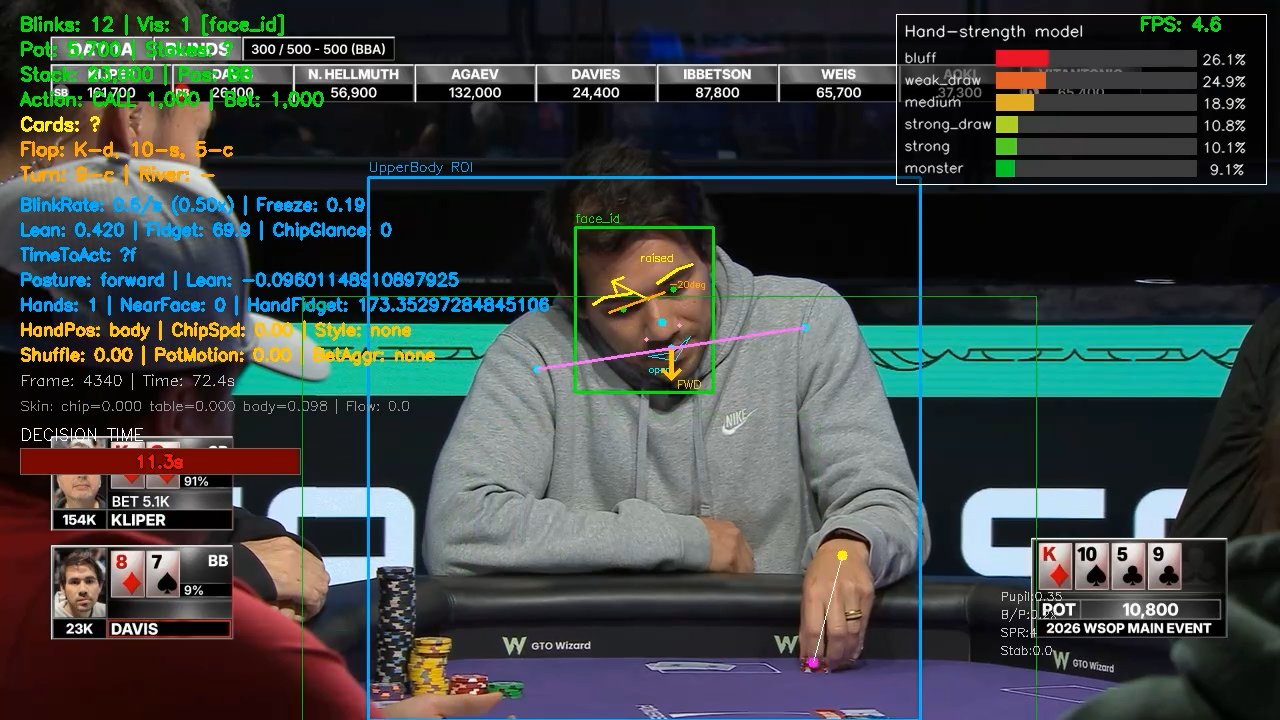
AI as an Unyielding Detective at the Table
The tool, developed by independent AI engineer and avid poker player Luke Geel, is more than just a simple algorithm. Geel, who otherwise works on artificial intelligence for the U.S. Air Force, spent six months developing a model that can identify moments when a player is likely bluffing or holding the best hand.
This system operates based on computer vision, analyzing subtle details that are nearly imperceptible to the human eye:
-
Blink frequency and eye gaze direction.
-
Smile symmetry – according to Geel, a symmetric smile is usually more genuine.
-
Speed of hand and chip movements during betting.
-
Muscle tension and overall body posture.
-
Vocal expressions and speech tone.
Geel tested his prototype on well-known players like Nik Airball, using OCR technology to read the game cards, pot sizes, and bets directly from the screen.
Cautious Launch for Game Integrity
Although the technology sounds like a "superweapon", Omaha Productions plans to implement it with utmost caution. To avoid accusations of influencing the game, AI analysis will only appear in broadcasts after a player has been eliminated from the tournament. This way, they aim to provide viewers with deeper analytical insights without compromising real-time fairness.
Interestingly, the system's creator himself doubts its effectiveness against the absolute world's elite. "If I deployed it on a top professional like Daniel Negreanu, the system would probably find no signals. I assume he's worked hard to eliminate them," Geel remarked.

The Future Beyond Poker?
Not everyone in the poker community welcomes the innovation with enthusiasm, with some calling it a "solution to a non-existent problem." Critics argue that strategy based on mathematics and board composition is far more crucial than eye movements, which can often be misleading.
Nonetheless, Dan Gati from Omaha Productions believes this could be the way to bring poker back to prime-time television, replicating the success of the "Moneymaker boom." According to system creator Luke Geel, the current form of the software is just the beginning. With advanced cameras and larger data sets, the technology could eventually track involuntary biometric cues such as heart rate or skin flushes caused by stress.
Poker professionals have already shown interest in using this tool to analyze their own physical habits or study future opponents.

However, the potential applications extend far beyond casinos. Similar computer vision-based models can already identify the direction of a penalty in soccer before the foot touches the ball, or detect subtle movements in a baseball pitch that reveal the type of throw.
The technology could help uncover human behavior in retail or services as well. For example, car salespeople could identify which specific features of a vehicle evoke the greatest excitement in customers.
While its current use on ESPN serves primarily as an exciting addition for viewers, the evolution of monitoring technologies will likely compel all players to mask their intentions more thoroughly and change their playing tendencies.
Source: ESPN, Sportico

