

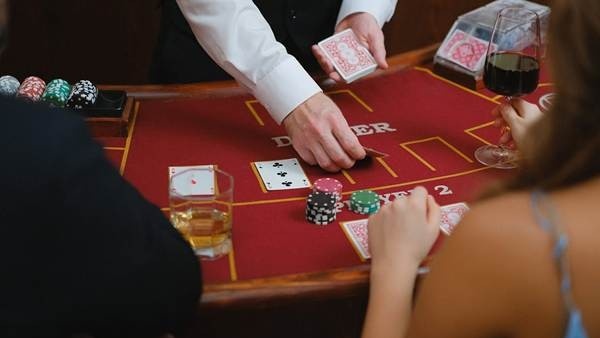
Dealer dealing blackjack table cards
That distinction matters because strong blackjack memory is less about reciting facts and more about recognizing structures quickly. However, soft 18 can be challenging for you to deal with because the hand may keep showing up in different forms. Sometimes it arrives as ace-7. Sometimes it shows up after a hit. Sometimes the dealer’s card makes the right move feel counterintuitive. If your memory is tied to one visual snapshot, you freeze. If your memory is tied to the pattern, the decision comes faster and cleaner.
Where the Hand Starts Making Sense
The cleanest way to understand soft 18 is to stop treating it as a trivia question and start seeing it in live context. A good online blackjack casino can help because it lets you watch the same soft-hand logic appear across blackjack variants, instead of staring at a static chart. On this blackjack page, the available lineup includes Classic Blackjack, Double Deck Blackjack, Single Deck Blackjack, European Blackjack, Perfect Pairs, Zappit Blackjack, and 21 Burn Blackjack, and the games are also offered in demo mode. That’s ideal for learning.
This card combination becomes difficult when you must recognize it at speed, under slightly different conditions, without re-reading the chart every round. Seeing that flow in an online blackjack setting gives the hand a shape and rhythm, helping you turn the rule into recognition, rather than hesitation.
The next step is to make that recognition stick. A short video on memorizing blackjack basic strategy could prove useful at this point because it helps you tackle the same problem: how to stop freezing on borderline hands. It uses soft 18 as an example, groups tricky decisions into memorable phrases, recommends flashcards for the spots that sit on the edge between two actions, and suggests working down to a 3-second decision window. The goal is not to memorize every square at once. The goal is to make the handful of unstable hands feel familiar enough that they stop interrupting your pace.
The Real Problem Is the Borderline Family
Soft 18 becomes much easier to deal with once you realize it belongs to a family of hands that all create the same kind of doubt. Hard 12 against a weak-looking dealer card, pair of 6s against a 7, and soft 18 against a strong upcard all tempt players to rely on gut feeling. That is usually where memory bends. The hand looks close enough to safe that people protect it, even when the better play is more active. Players often misfile it as “already strong” because the number 18 feels settled, even though the ace is what gives the hand its tactical value.
In practical terms, soft 18 is a flexible total, not a finished one. Because the ace can still shift from 11 to 1, the hand has room to improve in spots where a hard 18 would simply stand pat. The exact correct action can change with deck structure and table rules, which is why the small print matters more than many players expect.
Why Understanding This Hand Improves the Rest of Your Strategy
There is a reason soft 18 feels more revealing than many other hands. If you can learn to spot why it changes, you usually improve your feel for the whole chart. You stop memorizing blackjack as a pile of disconnected instructions and start seeing it as a set of repeating relationships between your total, the dealer’s upcard, and the room your hand still has to grow.
What changes with practice is not only speed. It is the quality of the decision itself. You begin to notice the same pressure pattern in different clothes: a hand that looks solid, a dealer card that changes the equation, and a moment where passive play feels safer than it really is. Once you recognize that structure, blackjack strategy starts to feel less like recall and more like fluent reading.
That is why the best study approach is usually narrower, not bigger. Instead of grinding the entire chart in one sitting, train small clusters of hands that flip when the dealer card changes by one point. Revisit them, mix their card combinations, and answer them under light time pressure. Repetition matters, but the spacing of that repetition matters too. That broader principle is supported by open-access research showing that spaced learning enhances recognition memory.

