

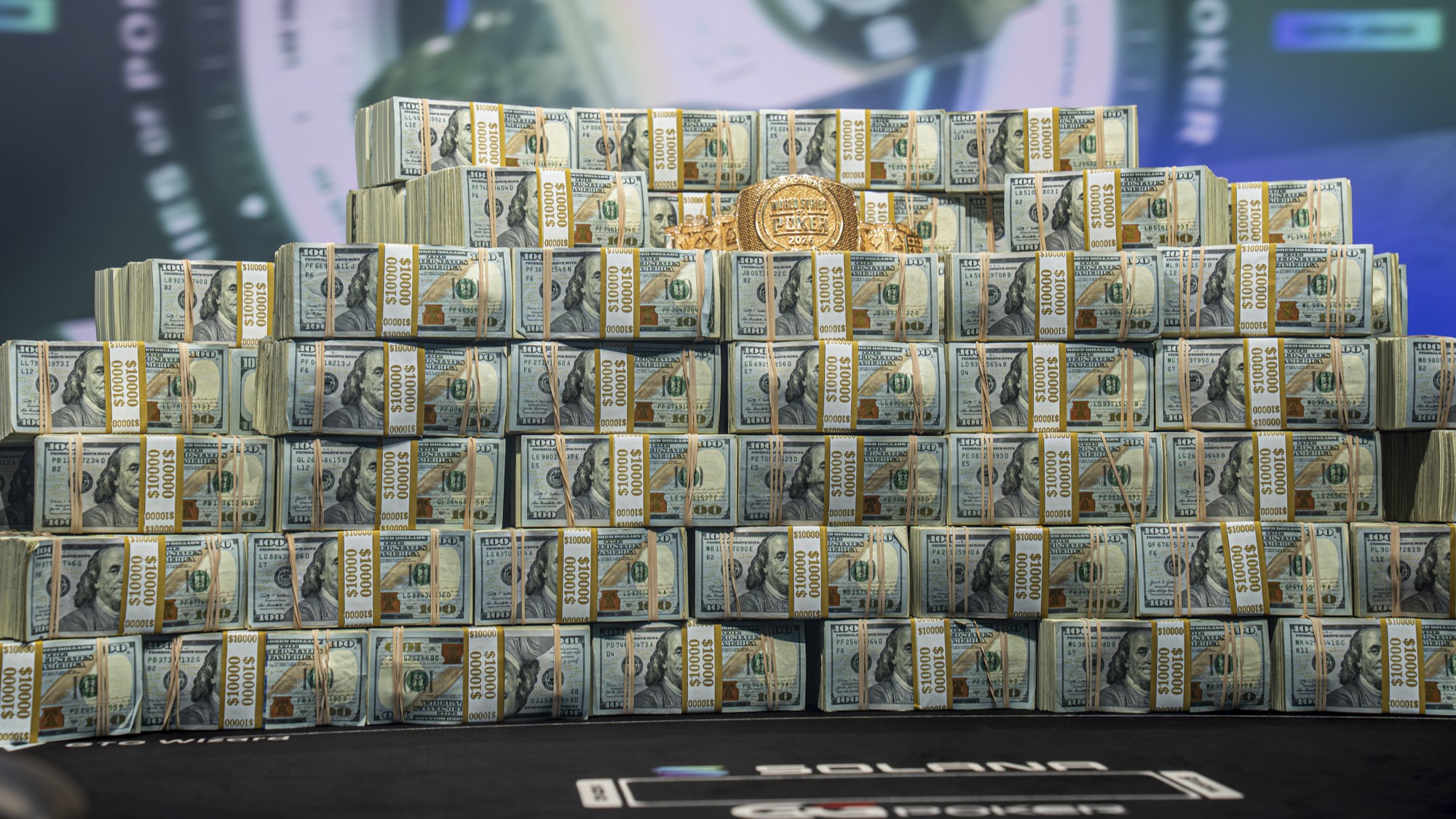
In total, nine finalists shared $30,250,000, yet more than $12.2 million (40.58%) will end up in the hands of government institutions. Here's a detailed look at who fared worst and who got lucky with the 'tax break'.
Jumalon's $10 Million Check is Actually Worth $6 Million
Tournament victor Lucas Jumalon hails from Spokane, Washington. Although his home state currently has no income tax, Jumalon is required to pay hefty federal income tax and self-employment tax as a professional player.
In total, the authorities will collect approximately $3,990,826, leading to a tax burden of nearly 40%.

Jamie Shaevel Loses More Than Half His Winnings
If anyone might feel aggrieved, it’s California pro Jamie Shaevel. California's tax laws, some of the strictest in the U.S., hit Shaevel harder than any other finalist. On top of the federal tax exceeding $598,000, he owes California another $157,127.
This brings his total tax rate to a staggering 50.37%, meaning that from his $1.5 million win, he retains just $744,500.

European Tax Trap: Spain and France Show No Mercy
Finishing second was Finland’s Lauri Saaskilahti, who currently resides in Barcelona. While exempt from U.S. taxes due to a treaty between the U.S. and Spain, the Spanish authority, Agencia Tributaria, taxes him at a rate of 47%. Over $2.7 million of his $6 million prize vanishes in Spain.
Similarly, eighth-place Mario Boos wasn’t spared. France considers professional poker winnings largely untaxed only to a point, but with such a large prize, Boos faces a progressive tax and a special surcharge for high earners. He pays approximately $543,701 (43.5%) to the French tax office, DGFiP.

Canadians Keep the Most
The Canadian duo stood out differently from the rest of the final table. Greg Mueller, a three-time bracelet winner, is dubbed a 'semi-retired' player by the media. If Canada’s tax authority, CRA, doesn’t classify him as an active professional, he only pays the 30% mandatory tax to the IRS in the U.S.
Fellow countryman Rami Hammoud, an amateur player, faces the same scenario—30% handed over in Las Vegas at the cashier, bringing a net of $1,228,000 home to Montreal.
A New Threat for Americans: OBBBA Law in Action
For U.S. players (Jumalon, Gagliano, Feng, Shaevel), 2026 brought additional woes with the One Big Beautiful Bill Act (OBBBA). This law drastically changes how poker losses are written off.
Previously, players could deduct losses up to the amount of their winnings, but from 2026, this deduction is limited to 90% of total losses, meaning players might pay tax on money they didn’t really win (so-called phantom income), further increasing their tax burden.
Winnings vs. Taxes at the WSOP 2026 Main Event Final Table
|
Position |
Player |
Country |
Winnings |
Post-Tax Winnings |
Tax % |
|
1. |
Lucas Jumalon |
USA (WA) |
$10,000,000 |
$6,009,174 |
39.91% |
|
2. |
Lauri Saaskilahti |
Finland |
$6,000,000 |
$3,227,000 |
47.00% |
|
3. |
Greg Mueller |
Canada |
$3,750,000 |
$2,628,000 |
30.00% |
|
4. |
Michael Gagliano |
USA (NJ) |
$2,750,000 |
$1,419,317 |
48.39% |
|
5. |
Han Feng |
USA (TX) |
$2,250,000 |
$1,360,247 |
39.54% |
|
6. |
Rami Hammoud |
Canada |
$1,750,000 |
$1,228,000 |
30.00% |
|
7. |
Jamie Shaevel |
USA (CA) |
$1,500,000 |
$744,500 |
50.37% |
|
8. |
Mario Boos |
France |
$1,250,000 |
$706,299 |
43.50% |
|
9. |
Evagoras Evagorou |
Cyprus |
$1,000,000 |
$653,500 |
35.00% |
|
TOTAL |
$30,250,000 |
$17,976,037 |
40.58% |
While Jumalon walks away with roughly $6 million, various tax authorities collectively claim over $12.2 million, making them the true winners of this year's series.
Sources: WSOP, TaxableTalk

