

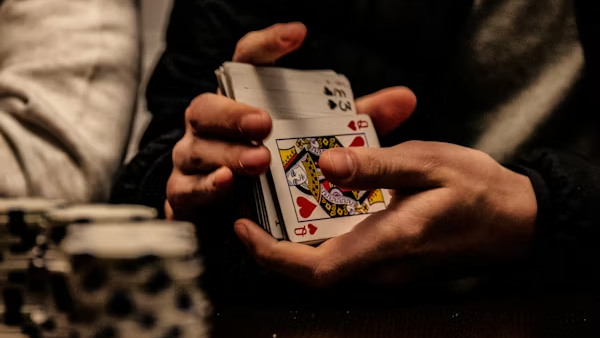
One thing predictable about poker is that there is no mathematical advantage. In any other situation, when you are playing against the house, you are doomed to fail most of the time. In poker, your opponents are men of flesh and blood, and the flow of the game is determined by your choices, even if during a single online round in the Mostbet app.
The Architecture of the Perfect Bluff: Is It Real?
How do you imagine the act of bluffing in real life? It is frequently portrayed as a chaotic act of insane courage—the moment when a poker-faced player pushes all their chips into the center of the table to intimidate their opponent. What you need to know is that at the pinnacle of professionalism, such "junk" bluffs aren't viable. A true-to-life bluff is a flawlessly constructed narrative, wrapped in logical order from the very beginning to the end.
In poker theory, there's a concept called "telling a story." Every action you take throughout the hand (preflop bet size, flop check, turn surprise raise) is a sentence. If at the final stage (river) you represent with an immense bet that you have the strongest hand (for example, a flush), your opponent will mentally replay the entire hand.
Moreover, if in the previous stages you acted as if you had a weak or average hand, your "story" will fall apart. A poker expert will scan this inconsistency and instantaneously expose the deception. This is why the superior bluffs are made not with absolute trash, but with semi-bluffs—when you have a chance to make a strong hand on the following cards if your opponent decides to call.
The main paradox of bluffing lies in the statement that the most superior bluff is the one that is out of sight. If you forced your opponent to fold the best hand and quietly handed your cards to the dealer without showing them off, it is your perfect tactical move to shine.
Psychological Warfare: "Levels of Thinking"
When masters gather at the table, the game moves to the level of so-called "Levels of Thinking." This concept is responsible for determining the outcomes of the analysis that a player can delve into:
-
Level 0: The player just knows their own cards. ("I have a pair of kings, that's good.").
- Level 1: The player tries to guess their opponent's cards. ("What could they possibly have on hand?").
- Level 2: The player carefully interprets what their opponent thinks about their cards. ("They see my aggression; what card are they assigning to me?").
- Level 3: The player analyzes what their opponent thinks about how they view their opponent's cards.
If you look deeper at the third and fourth levels, you will see a subtle psychological warfare unfolding before our eyes. Once, a high-stakes incident of the same nature occurred between poker legends Tom Dwan and Phil Ivey.
Dwan launched a massive attack with a hand that had no chance of conquering the game. He bet colossal amounts at every stage, creating the image of a player holding the rarest nuts (the absolute best hand). Phil Ivey, with his awe-inspiring intuition and a pair of sixes, knew that Dwan was capable of a crazy bluff. However, Dwan took this into account.
He was aware of how Ivey understood his bluffing ability, and with his final bet of $270,000 into a pot exceeding $400,000, he made Ivey believe, "This time he wouldn't have risked going this far without a monster hand". Consequently, Ivey folded the best card, and Dwan scooped the huge pot, demonstrating mental superiority, which is so much needed for this intellectual type of entertainment.
The Mathematics of Chaos: Variance and "Range"
Many newcomers quit poker after a few painful losses, calling the game unfair. They encounter the concept of variance—the mathematical deviation from the expected outcome. Imagine you have a pair of aces (the best starting hand in Texas Hold'em), and your opponent holds a random $7 and $2 of unsuited hands (the worst starting hand).
The math dictates you'll win about 88% of the time, but that means your opponent will win 12 times out of 100. If these 12 events occur in a row, an unprepared person will go on tilt—an emotional breakdown that leads to a total loss of control.
Professional poker players think of a long-term perspective. For them, the outcome of a single hand or even a separate tournament doesn't matter. They know that if they continue to make decisions with positive expected value ($+EV$), then over a period of 10,000, 50,000, or 100,000 hands, the law of large numbers will smooth out any vagaries of luck, and they will inevitably end up in the black.
The Magic of Poker Reflected in Body Language
Poker is a one-of-a-kind field where you can do everything as planned and still lose at a given moment, but this very quality makes it an ideal training ground for developing strategic thinking applicable to large corporations and investments.
In live (offline) play, unconscious physical behavioral markers reveal the strength of a hand and become pivotal. The sudden dilation of the pupils upon seeing the flop. The subtle pulsation of a vein in the neck. The way a player takes their chips (confidently or slightly fidgetily).
Interestingly, when poker moved online, physical tells faded into oblivion, but timing tells took their place. A keen analyst on the other side of the screen calculates how many seconds it takes you to take a plunge. Ultimately, poker can be defined as a unique blend of rigorous mathematical discipline, forensic observation, and the ability to adapt. It's a never-ending equation with many unknowns, where human nature always remains the primary factor.
