

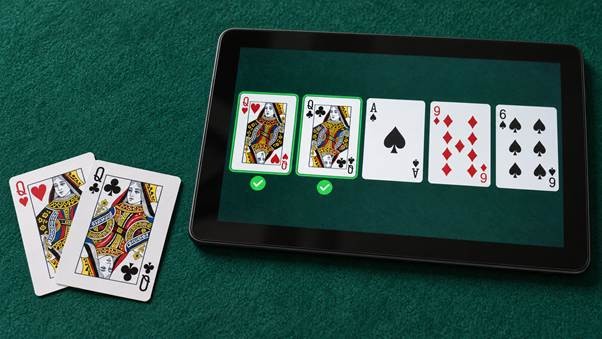
At a poker table, you might call with a pair of queens, raise with it, or fold it. The decision depends on the betting, the other players, and, in games such as Texas hold'em, the community cards. Standard video poker gives you a different job: decide which of your five cards to keep before one exchange. There is no opposing hand to beat. Your finished cards are assessed against a paytable listing the combinations that qualify for a payout.
The usual poker hand rankings put a full house above a flush and a flush above a straight in standard high-hand games. How those five cards come together varies. In Texas hold'em, the best combination can use both private cards, just one, or neither, together with the community cards. In standard draw-style video poker, every card belongs to your own hand. After the exchange, all five count toward the result. There is no shared board and no spare card to leave out of the final combination.
Choosing Cards to Keep
After the deal, marking a card to hold keeps it in your hand through the exchange. Cards left unheld will be replaced. The initial bet is already set, so the decision now concerns the cards themselves. When you're playing video poker games online, keeping a pair leaves three cards to replace; keeping four cards leaves one. You can change your mind about which cards to hold before confirming the draw.
Once the draw happens, the replacement cards stay, even if they do not complete the hand you had in mind. There is no second exchange in this standard format. Holding all five preserves the original hand, while holding none replaces every card. Discarding everything does not fold the hand or cancel its bet. Retained cards and replacements count together in the final five-card hand. The paytable determines whether that hand qualifies for a payout and lists the amount for the bet placed before the deal.
At a five-card draw table, the number of cards someone exchanges can give other players information about their hand. The solo play described in this video has nobody watching for that signal. Keeping two cards and replacing three changes your hand without concealing anything from an opponent.
Reading the Hand
Four hearts and a club are not a flush. If the hearts are kept and the club is exchanged, another heart completes the flush. A replacement spade leaves four hearts in the final hand. Depending on the card ranks, the final hand could still contain a qualifying pair or a straight.
Keeping a pair can mean breaking up a possible flush. Let's say you have the queen, jack, ten, and nine of hearts, plus the queen of clubs. There is already a pair of queens. There are also four consecutive hearts. Keeping both queens preserves the pair and leaves three replacements. Keeping the four hearts instead leaves one replacement and gives up the club queen.
Video poker variants can pay different amounts for the same combination. Some also include wild cards, which substitute for other cards. A holding instruction written for one version may not suit another, even when the dealt cards look exactly the same.
Even the lowest qualifying hand varies. In Jacks or Better, a single pair must be jacks or higher to qualify. A final pair of tens does not qualify for a payout. Tens alongside a second pair do, because two pair is a separate qualifying category.
Playing Without Opponents
At a multiplayer table, acting later can reveal other players' decisions before your turn. A check, call, or raise may affect what you do with the same cards. Video poker has no corresponding position against other players and no opposing bet to interpret before choosing holds.
In Texas hold'em, further community cards can be followed by further betting. A player can reconsider as the board and other players' actions develop. The standard video poker draw completes the five-card hand in one exchange. The replacement cards do not start another betting round between players.
Five-card draw shares the exchange of unwanted cards, but keeps the multiplayer contest around it. Players bet around the draw, and a hand can finish when everyone except one player folds. Video poker does not have that route to ending a hand.
What an Extra Ace Changes
Suppose a video poker deal contains two queens, an ace, a nine, and a six, with mixed suits. Holding only the queens leaves three replacements. Keeping the ace alongside them leaves two.
At an ordinary poker showdown, an ace can serve as a kicker, an unpaired card that separates otherwise matching hands. A pair of queens with an ace beats a pair of queens with a king when neither hand contains a stronger combination. If the highest kickers match, the remaining unpaired cards are compared in descending order.
A standard Jacks or Better paytable does not use that kicker comparison. An ace alongside a final pair of queens does not move the hand into a higher payout category. That makes it particularly important to carefully study the paytable if you are familiar with poker rules and making the swap to video poker. Both games contain similar decision-making, but video poker eliminates some of the complexities that standard poker offers.
