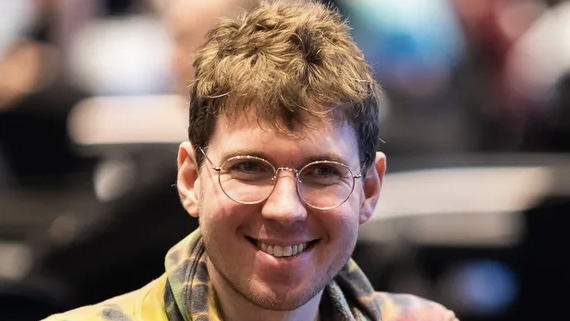
Andrew Lichtenberger
Andrew Lichtenberger is an American professional poker player, World Series of Poker bracelet winner and one of the most recognisable competitors on the high roller circuit. Known as “LuckyChewy,” he combines a long record of tournament success with an unusually thoughtful public approach to competition, intuition and personal development.
His career includes a WPT Alpha8 championship, a WSOP gold bracelet, consecutive podium finishes in the Super High Roller Bowl and third place in the 2023 WPT World Championship. These achievements cover very different tournament environments, from enormous open fields to small groups of elite professionals.
The Hendon Mob record consulted for this profile lists 24.863.993 $ in live tournament earnings and a best recorded cash of 2.798.700 $. His financial record is substantial, but his place in poker also rests on how he studies, teaches and talks about the game.
Lichtenberger belongs to the online generation that developed rapidly during the 2000s. He has remained competitive as poker moved from forum discussions and individual experimentation toward extensive databases, mathematical models and professional training platforms.

Born in East Northport, New York
Andrew Lichtenberger was born on September 20, 1987, and grew up in East Northport, New York. His early development occurred far from the Las Vegas poker rooms that would later become central to his career.
He came of age during the expansion of online poker. Young players could observe professionals, discuss hands on internet forums and find games without travelling to major casinos. The barrier to starting was low, although the barrier to succeeding remained considerable.
Public profiles place his first live tournament cash in 2007. By then, the screen name LuckyChewy was becoming part of a professional identity that eventually followed him into televised tournaments and international competition.
Discovering Poker Online
Lichtenberger began playing online after turning 18, initially developing his game through cash tables. The internet offered repeated decisions, rapid feedback and access to opponents with different styles.
Cash games provided an important foundation. A player could examine the same strategic situations repeatedly, compare alternative bet sizes and discuss difficult hands after a session. That process encouraged understanding rather than reliance on a few memorable tournament results.
His eventual move toward tournaments required another layer of learning. Increasing blinds, changing stack depths and uneven payouts alter the value of risk. Knowledge developed in cash games remained useful, but it had to be adapted to a format in which elimination ends the opportunity to play.
The LuckyChewy Identity
LuckyChewy became Lichtenberger’s best-known poker nickname. The name appears in live coverage, player records and conversations among professionals who first encountered him online.
An online alias can become a lasting professional signature. Opponents may recognise the name before they recognise the face, especially when a player moves from internet games into a live tournament circuit.
For Lichtenberger, that continuity matters. LuckyChewy connects the early period of study and experimentation with the experienced competitor now appearing at major final tables. The nickname has survived changes in appearance, tournament schedules and the methods players use to study.
From Cash Games to Tournament Competition
His transition was not an immediate, uninterrupted rise. In interviews, Lichtenberger has described finding tournament poker challenging at first before establishing a stronger understanding of the format.
That experience helps explain the breadth of his later outlook. Tournament success demands more than a collection of profitable plays considered in isolation. The same hand can require a different decision depending on position, effective stacks and the cost of being eliminated.
Learning to recognise those differences gave his cash-game background a second application. Rather than abandoning one discipline for another, he developed a professional career with tournaments increasingly at its centre.
The 2009 WSOP Breakthrough
Lichtenberger made a major impression during his first WSOP summer in 2009. He finished second in the 5.000 $ No-Limit Hold’em Shootout for 215.402 $, coming close to a bracelet early in his live career.
A shootout presents a distinctive challenge: players must win their individual tables to advance. It rewards the ability to adjust as the number of opponents shrinks and eventually turns each stage into a short-handed contest.
The result showed that his ability extended beyond online cash games. It also began a recurring theme in his career: reaching important heads-up matches against strong opposition, sometimes winning the title and sometimes leaving with a substantial runner-up prize.
Deep in the 2009 Main Event
Later that summer, Lichtenberger finished 18th in the WSOP Main Event and earned 500.557 $. The tournament drew 6.494 entries, making the run a significant early demonstration of endurance in a large field.
His elimination came when pocket jacks ran into Darvin Moon’s pocket kings. He fell short of the November Nine, the delayed final table used during that period, but had already established himself as a player capable of surviving deep into poker’s most prominent tournament.
The Main Event and the shootout tested different skills. One required sustained navigation of a vast field; the other required repeatedly overcoming a single table. Together, they gave his breakthrough considerably more substance than one isolated finish.
The 2010 Caesars Palace Circuit Championship
In 2010, Lichtenberger won the WSOP Circuit Main Event at Caesars Palace in Las Vegas. He defeated Dan Casetta heads-up and collected 190.137 $ along with a Circuit ring.
The championship attracted 150 players. Although much smaller than the WSOP Main Event, it supplied something his previous major runs had not: a completed title victory.
A Circuit ring and a WSOP bracelet are separate honours. The ring marked his success on the travelling Circuit, while the bracelet he would win six years later belonged to the summer World Series. Both form important parts of his progression from promising newcomer to established professional.
Establishing a Career in Las Vegas
Lichtenberger eventually made Las Vegas his professional base. The city offered access to major festivals, high roller tournaments and a community of players engaged in the same demanding pursuit.
That environment supports continuity. A professional can study between events, maintain relationships with other competitors and return regularly to familiar venues while facing opponents who continue to improve.
For someone whose career crosses cash games, open tournaments and elite invitation-style settings, proximity to that ecosystem is valuable. Las Vegas became the setting for many of his defining achievements, including his Alpha8 title, WSOP bracelet and Super High Roller Bowl appearances.
A Major Epic Poker League Result
Lichtenberger finished second in the third Epic Poker League Main Event in 2011 for 514.480 $. Chris Klodnicki won the tournament.
The league was short-lived, but its events brought together accomplished professionals and created another demanding setting in which Lichtenberger could test his developing game.
Historical results do not lose their competitive meaning because a tournament brand disappears. This finish belongs to the years when he was building a stronger live record, well before the much larger scores that would later make him familiar to a broader audience.
Winning WPT Alpha8 at Bellagio
In December 2014, Lichtenberger won the 100.000 $ WPT Alpha8 event at Bellagio. He defeated Tom Marchese heads-up in a tournament that attracted 55 entries.
The event represented a clear move into the most expensive tier of live tournament poker. A six-figure entry fee concentrates both financial exposure and competitive difficulty, with experienced high roller regulars occupying much of the field.
Contemporary reports announced a first-place prize of 2.104.245 $. The current Hendon Mob record credits 1.770.692 $ to the result. Those figures should not be silently treated as interchangeable; the results table below uses the database’s recorded amount.
The Alpha8 victory is also distinct from a WPT Main Tour championship. It established him as an Alpha8 champion without requiring his record to be described as a Main Tour title.

His First WSOP Bracelet
Lichtenberger won his first WSOP bracelet in 2016 in Event #52, the 3.000 $ No-Limit Hold’em tournament. He outlasted 1.125 entries and defeated Craig Blight heads-up to earn 569.158 $.
The victory arrived seven years after his first WSOP runner-up finish. By then, he had already won important titles elsewhere, but the bracelet supplied a recognised milestone within the series that had helped launch his live reputation.
The field size matters. This was a substantial open tournament, demonstrating that his success in expensive events had not narrowed his ability to compete across a wider range of opponents.
The result linked two phases of his career: the young player who nearly won a bracelet in 2009 and the established professional who finally completed the task in 2016.
| Year | WSOP bracelet event | Entries | Prize |
| 2016 | 3.000 $ No-Limit Hold’em — Event #52 | 1.125 | 569.158 $ |
The 2018 Five Diamond Final Table
Lichtenberger returned to another major Bellagio final table in 2018, finishing third in the WPT Five Diamond World Poker Classic for 802.973 $.
This was a Main Tour event rather than an Alpha8 high roller. The distinction gives his Bellagio record additional variety: he had succeeded both in a concentrated super high roller field and in a major open championship.
A strong record at one venue does not make success automatic. Every event begins with different opponents, table draws and chip distributions. Returning to a deep final table years later showed that his earlier Bellagio victory had not been his only opportunity to perform there.
Another Bracelet Near Miss in 2019
At the 2019 WSOP, Lichtenberger finished second in the 50.000 $ High Roller and earned 917.232 $. The result added another major score to his record while leaving a second bracelet just beyond reach.
High roller tournaments place familiar opponents together repeatedly. Players must account for what others know about their tendencies and decide when a standard approach needs adjustment.
The runner-up finish also illustrates the limitations of counting titles alone. First and second place are different outcomes, but reaching the final match in such a demanding event remains an important competitive achievement. Lichtenberger’s career contains several results of that kind.
Winning the 2022 Hard Rock High Roller
In April 2022, Lichtenberger won the 50.000 $ High Roller at the Seminole Hard Rock Poker Showdown. He defeated Alex Foxen heads-up and earned 638.223 $.
The tournament attracted 39 entries and generated a 1,9 million $ prize pool. Winning against Foxen supplied another title against an opponent firmly established at the highest levels of tournament poker.
The result extended his success beyond Las Vegas. Although Nevada remained his base, his competitive record also included important performances at major festivals elsewhere in the United States.
A Poker Masters Title in 2022
Lichtenberger won a 25.000 $ event at the 2022 Poker Masters for 465.750 $. The tournament drew 69 entries.
Poker Masters places several high roller events close together, creating a setting where competitors must maintain decision quality across a demanding schedule. Winning one event is a distinct achievement from winning the overall series championship.
His result belonged to a productive stretch that also included a Super High Roller Bowl podium finish. Taken together, those performances showed that he was still producing major results more than a decade after his original WSOP breakthrough.
The 2022 Super High Roller Bowl
Lichtenberger finished third in the 2022 Super High Roller Bowl for 1.152.000 $. With a 300.000 $ buy-in, the event occupied the extreme end of tournament poker’s financial scale.
The size of the buy-in changes the practical stakes, but the cards do not acquire different probabilities. Players still need to manage uncertainty and make decisions with incomplete information while facing opponents prepared to exploit small mistakes.
His podium finish offered strong evidence of competitiveness in that environment. It would become even more significant when he returned the following year and advanced one position further.
Runner-Up in the 2023 Super High Roller Bowl
In 2023, Lichtenberger finished second in Super High Roller Bowl VIII and collected 1.680.000 $. Isaac Haxton won the championship.
The result gave him consecutive podium finishes in one of poker’s most demanding events. Repeated success cannot eliminate the influence of fortunate cards, but it provides a fuller picture than a single expensive tournament cash.
This was another major heads-up appearance in a career already containing several. Lichtenberger had reached the last match against elite competition and added a seven-figure result before the year’s biggest open-field achievement was still to come.
The 2023 WPT World Championship
Lichtenberger finished third in the 2023 WPT World Championship at Wynn Las Vegas for 2.798.700 $, his largest recorded live tournament cash.
The 10.400 $ championship attracted 3.835 entries and carried a 40 million $ guaranteed prize pool. Its scale contrasted sharply with the small super high roller fields in which he had also succeeded.
An enormous championship demands adjustment across many stages. Early tables, the money bubble and the last few eliminations present different incentives, while fatigue accumulates over several days.
His third-place finish showed that experience in small elite events could coexist with the skills required to navigate a vast field. It became the financial high point of a career that had already produced major results for well over a decade.
Selected Major Tournament Results
Lichtenberger’s record includes both titles and large runner-up finishes. The following selection highlights important performances rather than attempting to reproduce every cash in his career.
The Alpha8 amount follows the current Hendon Mob entry. Earlier contemporary reporting used a different advertised first-place figure, as explained above.
| Year | Tournament | Result | Recorded prize |
| 2023 | WPT World Championship | 3rd | 2.798.700 $ |
| 2014 | WPT Alpha8 Bellagio | 1st | 1.770.692 $ |
| 2023 | Super High Roller Bowl VIII | 2nd | 1.680.000 $ |
| 2022 | Super High Roller Bowl VII | 3rd | 1.152.000 $ |
| 2019 | WSOP 50.000 $ High Roller | 2nd | 917.232 $ |
| 2018 | WPT Five Diamond World Poker Classic | 3rd | 802.973 $ |
| 2022 | Hard Rock 50.000 $ High Roller | 1st | 638.223 $ |
| 2016 | WSOP 3.000 $ No-Limit Hold’em | 1st | 569.158 $ |
| 2011 | Epic Poker League Main Event #3 | 2nd | 514.480 $ |
| 2009 | WSOP Main Event | 18th | 500.557 $ |
| 2022 | Poker Masters 25.000 $ No-Limit Hold’em | 1st | 465.750 $ |

Continuing to Compete in 2025 and 2026
Lichtenberger again finished second in a WSOP 50.000 $ High Roller in 2025, this time behind Jason Koon. His continued presence in these events shows that his career is not simply a collection of results from an earlier poker era.
In March 2026, he won the final event of the PokerGO Cup, a 15.100 $ No-Limit Hold’em tournament with 52 entries. He defeated Sam Soverel after a heads-up deal and earned 236.566 $.
The victory was his ninth PGT title. It also placed him fifth on that PokerGO Cup’s series leaderboard, a separate distinction from winning the final event.
These later performances give his biography an active present. He remains a competitor while also developing interests in coaching, writing and poker education.
Tournament Earnings and Their Meaning
The 24.863.993 $ career total in the consulted Hendon Mob record represents gross recorded live tournament cashes. It does not represent verified lifetime profit or personal wealth.
Buy-ins, unsuccessful entries, expenses, staking arrangements and taxes affect the amount a player actually retains. Private cash-game results and much of online poker also sit outside a live tournament database.
The useful conclusion is therefore competitive rather than financial: Lichtenberger has accumulated a substantial public tournament record over many years. The number measures recorded prizes, while the pattern of events helps explain the level and variety of his opposition.
| Career measure | Recorded figure |
| Live tournament earnings | 24.863.993 $ |
| Largest recorded live cash | 2.798.700 $ |
| WSOP bracelets | 1 |
| WPT Alpha8 Bellagio titles | 1 |
| PGT titles after March 2026 PokerGO Cup victory | 9 |
Playing Style and the Role of Intuition
Lichtenberger frequently discusses intuition, but his public comments also emphasise the value of a sound strategic foundation. His approach brings technical knowledge and close attention to the experience of playing into the same conversation.
That distinction matters. An instinctive decision can come from accumulated experience, but it can also come from fear, wishful thinking or a mistaken assumption. Recognising the difference is part of disciplined competition.
His long tournament career gives this discussion a practical setting. At the table, a player must decide before all uncertainty disappears. Preparation can improve those decisions without turning every difficult hand into an obvious answer.
Yoga of Poker and a Broader Philosophy
Lichtenberger wrote Yoga of Poker, connecting the game with his interest in awareness and personal development. His public identity extends beyond analysing individual hands or celebrating prize money.
The book belongs to a broader conversation about how competitors experience pressure. A player may understand the strategy of a situation yet struggle to apply it when tired, distracted or emotionally invested in a particular outcome.
Lichtenberger’s perspective invites attention to that gap between knowledge and performance. It should be understood as his personal philosophy, rather than as proof that any spiritual practice guarantees tournament success.
Emotional Control at the Table
In his writing about tilt, Lichtenberger addresses the loss of emotional control that can follow frustration at the table. His emphasis is on recognising the response and restoring the ability to make considered decisions.
Poker produces repeated situations in which a sensible choice leads to an unpleasant result. If the next decision becomes an attempt to recover emotionally from the previous hand, a player can compound one unlucky outcome with avoidable mistakes.
Lichtenberger’s calm public manner is part of what makes him distinctive. It does not imply that he never experiences disappointment. It reflects the professional challenge of continuing to play effectively while the result remains uncertain.
Octopi Poker and Teaching the Game
Lichtenberger co-founded Octopi Poker with Nick Schulman and Victoria Livschitz. The project brought his competitive experience into a training and community setting.
Education is a different task from playing. A strong professional may recognise a situation quickly, while a learner needs the assumptions and reasoning made explicit. Explaining why a decision changes with stacks or opponents requires more than announcing a preferred move.
His involvement connects him with the increasingly organised ways players study modern poker. It also continues an interest in sharing ideas that dates back to his early participation in online poker discussions.
Life Beyond Tournament Results
Lichtenberger has spoken publicly about his wife, Alyssa Wampole, and their life in Las Vegas. In 2025, he also shared the news that they had welcomed their first child, a daughter named Sedona.
Family life adds another dimension to a profession whose public records usually contain only finishing positions and money. A tournament schedule occupies a great deal of time, while the decisions about how much to play happen outside the cameras.
His interviews consistently return to the experience of living and competing rather than treating a larger earnings total as the only objective. That outlook helps explain why his public profile includes personal growth alongside championship results.
Andrew Lichtenberger’s Place in Modern Poker
Lichtenberger’s career connects several stages of the modern game: the internet boom, the expansion of super high rollers and the growth of formal poker education.
He was already making major WSOP runs in 2009, won important titles during the following decade and continued reaching expensive final tables in the 2020s. That span required adaptation as the available study tools and the standard of opposition changed.
His strongest argument for lasting relevance is the combination of results and continued participation. A bracelet, an Alpha8 title and major championship podiums establish his competitive record; his teaching and writing reveal another way he contributes to the game.
LuckyChewy remains both a recognisable name at the table and a distinctive voice in discussions about what it takes to perform there. His career shows how technical preparation, experience and an individual philosophy can develop together over many years.
Profile prepared in October 2026. Tournament figures reflect the records consulted and may change. Earnings are gross recorded cashes, not verified profit or net worth. The three planned images are AI-generated illustrations, not photographs documenting particular tournament results.