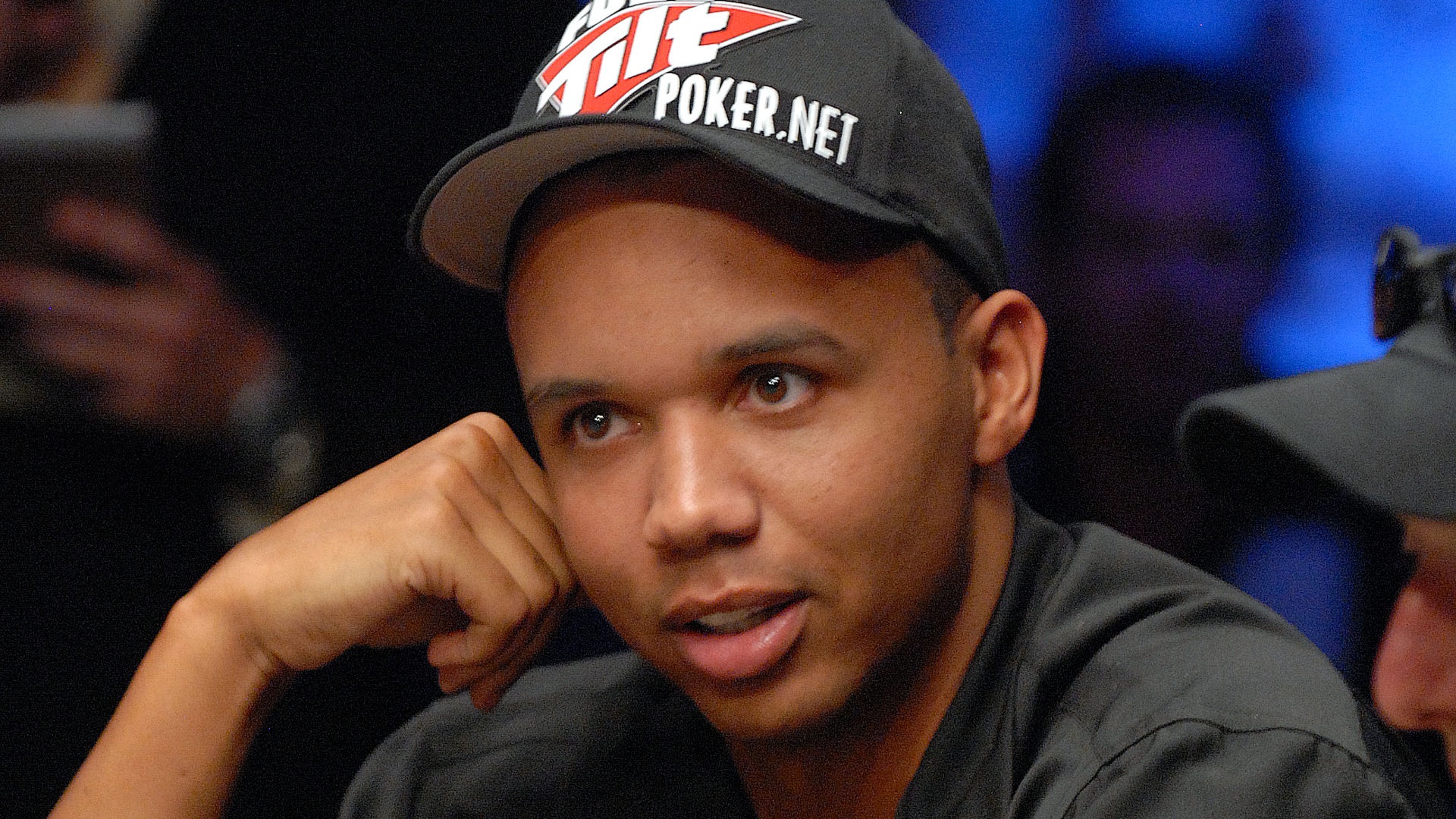
Phil Ivey
Phil Ivey is an American professional poker player, 11-time World Series of Poker bracelet winner and member of the Poker Hall of Fame. Admired for his composure, versatility and ability to compete in almost any form of poker, he is frequently described by fellow professionals as one of the greatest all-around players in the history of the game.
Ivey has accumulated more than 55,6 million $ in recorded live tournament earnings. He owns a World Poker Tour title, has won major tournaments in the United States, Australia and Asia, and has competed successfully in some of the highest-stakes cash games ever played.
Unlike poker personalities who built their public image through table talk or theatrical behaviour, Ivey became famous for revealing almost nothing. His calm expression, intense concentration and willingness to play anyone at almost any stakes helped create an aura that few players have matched.
His reputation also extends beyond tournament results. Ivey has been a feared cash-game player, a successful mixed-game specialist and a participant in legendary private games whose complete results will never appear in public databases.
For many of his peers, the question is not whether Phil Ivey belongs among poker’s greatest players. It is whether anyone else has ever combined natural ability, versatility and competitive instinct quite as effectively.
Early Life in New Jersey
Phillip Dennis Ivey Jr. was born on February 1, 1977, in Riverside, California. His family moved to New Jersey when he was still a child, and it was there that his relationship with poker developed.
Ivey learned the basic rules of the game from his grandfather. As he grew older, poker became more than a family activity. He began organising games with friends and playing with colleagues while working for a telemarketing company in New Brunswick.
His real education took place in Atlantic City.
Before he was legally old enough to enter the casinos, Ivey reportedly used identification bearing the name Jerome Graham. He spent so much time playing in Atlantic City card rooms that regulars began calling him “No Home Jerome.”
The nickname captured the intensity of his routine. Ivey was not making occasional visits to gamble for entertainment. He was playing long sessions, observing experienced opponents and accumulating thousands of hours at the table.
Those years helped shape the qualities that would later define him: patience, concentration, emotional control and an ability to remain engaged through exhausting sessions.
Once he turned 21, he began playing under his real identity and gradually moved into larger games. By the time the wider poker world discovered him, Ivey had already developed skills through a volume of live experience that few young players could match.
First WSOP Bracelet and the Arrival of a New Star
Ivey made an immediate impact at the World Series of Poker in 2000.
After recording his first WSOP cash in a Seven Card Stud event, he reached the final table of the 2.500 $ Pot-Limit Omaha tournament. The lineup included several established professionals, among them poker legend Amarillo Slim Preston.
Ivey defeated Preston heads-up to win 195.000 $ and his first WSOP bracelet.
The victory was significant for more than its prize money. Ivey was only 23, relatively unknown to mainstream audiences and facing a player whose career stretched back to poker’s earliest televised era.
The young Atlantic City grinder had announced himself by defeating a former WSOP Main Event champion.
His rise accelerated two years later. At the 2002 WSOP, Ivey won three bracelets during a single series, capturing titles in Seven Card Stud, Seven Card Stud Hi-Lo and S.H.O.E.
The achievement demonstrated the defining feature of his career. Ivey was not a specialist relying on one tournament format. He could move between different games, structures and styles of opposition without losing his edge.
Eleven WSOP Bracelets Across Multiple Games
Phil Ivey has won 11 WSOP bracelets, placing him second on the all-time list behind Phil Hellmuth’s record of 17.
The number is impressive, but the variety of his victories is even more revealing. Ivey’s bracelets include titles in Pot-Limit Omaha, Seven Card Stud, Seven Card Stud Hi-Lo, S.H.O.E., Pot-Limit Omaha Hi-Lo, No-Limit 2-7 Lowball Draw, H.O.R.S.E., 8-Game Mix and Limit 2-7 Triple Draw.
Remarkably, none of his 11 bracelets has come in No-Limit Hold’em.
That detail separates Ivey from many modern tournament stars. No-Limit Hold’em dominates televised poker and attracts the largest tournament fields, but Ivey built his bracelet collection largely in games requiring expertise across different betting structures and hand-ranking systems.
He won bracelets in 2000, 2002, 2005, 2009, 2010, 2013 and 2014 before entering the longest WSOP title drought of his career.
For nearly a decade, bracelet number eleven remained out of reach. Ivey continued producing deep runs and competing in major events, but the next victory did not arrive until 2024.

Ending the Bracelet Drought in 2024
Ivey returned to the WSOP winner’s circle in the 10.000 $ Limit 2-7 Triple Draw Championship in 2024.
The tournament attracted a specialist field filled with some of the strongest mixed-game players in the world. Ivey defeated Danny Wong heads-up to win 347.440 $ and his eleventh bracelet.
The victory ended a bracelet drought that had lasted approximately ten years. It also moved Ivey clear of Doyle Brunson, Johnny Chan and Erik Seidel, who each had ten bracelets at the time.
Only Hellmuth remained ahead.
The title reinforced Ivey’s status as one of poker’s greatest all-around competitors. He did not end the drought in a large-field No-Limit Hold’em tournament. He did it in a technically demanding draw game against opponents with extensive mixed-game experience.
The result also confirmed that Ivey remained capable of winning at the highest level well into his forties.
Continued Success at the 2026 WSOP
Ivey remained a major presence at the 2026 World Series of Poker.
He reached the final table of the 250.000 $ No-Limit Hold’em Super High Roller, finishing eighth for 553.270 $. The field contained many of the strongest high-stakes tournament players in the world.
His most important result of the series came in the 50.000 $ Poker Players Championship. The tournament rotates through nine poker variants and is widely considered one of the most demanding events on the WSOP schedule.
Ivey advanced to a final table that also included Benny Glaser, Josh Arieh, Jason Mercier, Paul Volpe, Maxx Coleman and Kristopher Tong. He eventually finished third for 600.698 $, while Glaser claimed the title.
The result was Ivey’s best finish in the Poker Players Championship and provided further evidence of his continued strength across multiple games.
As of August 2026, the official WSOP database credited Ivey with 11 bracelets, 68 final-table appearances and more than 22,8 million $ in WSOP-related earnings. Official WSOP profile
Phil Ivey’s Biggest Poker Wins
Ivey has earned more than 55,6 million $ in recorded live tournament prizes. His largest cash came at the 2014 Aussie Millions, where he won the 250.000 A$ Challenge.
| Year | Tournament | Result | Prize |
| 2014 | Aussie Millions 250.000 A$ Challenge | 1st | 4.000.000 A$ / 3.582.753 $ |
| 2012 | Aussie Millions 250.000 A$ Challenge | 1st | 2.000.000 A$ / 2.058.948 $ |
| 2024 | Triton Montenegro 125.000 $ Main Event | 4th | 1.795.000 $ |
| 2008 | WPT L.A. Poker Classic | 1st | 1.596.100 $ |
| 2025 | Triton Montenegro 150.000 $ NLH | 4th | 1.482.000 $ |
| 2009 | WSOP Main Event | 7th | 1.404.014 $ |
| 2020 | partypoker MILLIONS Sochi Super High Roller | 1st | 1.400.000 $ |
| 2018 | Triton Montenegro 250.000 HK$ Short Deck | 1st | 4.749.200 HK$ / 604.992 $ |
The figures illustrate both longevity and international success. Ivey’s major results are spread across traditional WSOP events, WPT tournaments, Australian high rollers and modern Triton competitions.
According to The Hendon Mob, his recorded live tournament earnings stood at 55.697.664 $ in August 2026, placing him eleventh on poker’s all-time money list. The Hendon Mob database
These figures represent gross tournament cashes. They do not include buy-ins, taxes, staking arrangements, expenses, private cash-game results or tournaments in which he did not finish in the money.
Ivey’s actual poker profit and personal net worth are not publicly known.
Three Aussie Millions Super High Roller Victories
The Aussie Millions became one of the most important tournament series of Ivey’s career.
He won the 250.000 A$ Challenge three times, claiming the title in 2012, 2014 and 2015. The event regularly attracted small but extremely strong fields of wealthy recreational players and elite professionals.
His 2014 victory produced the largest recorded tournament cash of his career. Ivey defeated a field of 46 entries and collected 4.000.000 A$, worth approximately 3.582.753 $ at the time.
Winning the same super high roller three times was an extraordinary achievement. Small fields can create the appearance that a tournament is easier to win, but the opposite is often true when nearly every seat belongs to an experienced high-stakes player.
Ivey’s success in Australia strengthened his reputation as a player capable of adjusting to exclusive events, enormous financial pressure and opponents who had already spent years competing at the highest level.
World Poker Tour Career
Ivey’s World Poker Tour career initially became known for repeated near misses.
He reached several WPT final tables without winning a title. Each appearance increased the expectation that one of poker’s best players would eventually convert a deep run into a victory.
That breakthrough came at the 2008 L.A. Poker Classic.
Ivey entered a final table that included Phil Hellmuth, Nam Le and Quinn Do. He defeated a field of 665 entries to win 1.596.100 $ and his first WPT title.
The victory removed one of the few obvious gaps in his tournament résumé.
Ivey’s WPT record is particularly notable because of the number of final tables he reached during the tour’s original television era. His consistency showed that he could succeed not only in specialist mixed games or private cash games, but also in large-field No-Limit Hold’em tournaments.
He later became an ambassador for WPT Global, formally connecting one of poker’s most respected players with the World Poker Tour brand.
The 2009 WSOP Main Event Final Table
Despite his many titles, Ivey has never won the WSOP Main Event.
His closest attempt came in 2009, when he survived a field of 6.494 entries and reached the November Nine. The final table attracted enormous attention because Ivey was already regarded by many professionals as the strongest player remaining.
He entered the final table seventh in chips and faced a difficult path against several much larger stacks.
Ivey eventually finished seventh for 1.404.014 $. His elimination came after moving all-in with ace-king against Darvin Moon’s ace-queen. A queen on the flop gave Moon the winning hand.
The result remains one of the defining near misses of Ivey’s career. Winning the Main Event would have given him poker’s most famous individual title and strengthened an already powerful claim to being the greatest tournament player ever.
Even without the victory, reaching the final nine in a field of almost 6.500 players demonstrated that Ivey’s abilities could translate to the largest and most unpredictable tournament in poker.
High-Stakes Cash Games
Tournament databases reveal only part of Phil Ivey’s career.
For many years, he was a regular participant in the biggest cash games in Las Vegas. He played in Bobby’s Room at the Bellagio, where elite professionals and wealthy businessmen competed in mixed games at stakes rarely available to the public.
Cash-game results are private and generally unaudited, so no reliable total exists for Ivey’s lifetime winnings. Stories from players who shared those games, however, consistently describe him as one of the strongest and most feared competitors in the room.
Ivey was willing to play long sessions, change poker variants and compete against specialists in their preferred games. His ability to maintain concentration and adjust rapidly made him ideally suited to high-stakes mixed games.
His reputation became so strong that the high-limit room at ARIA Resort & Casino was formerly named Ivey’s Room.
The honour reflected more than celebrity. It recognised his association with the highest levels of cash-game poker.
The Andy Beal Match
One of the most famous chapters in Ivey’s career involved billionaire banker Andy Beal.
Beal had spent years challenging a group of elite poker professionals to extremely high-stakes heads-up Limit Hold’em. The professionals formed a collective commonly known as “The Corporation,” sharing the financial risk and taking turns playing against him.
In 2006, Beal returned for matches at the Wynn in Las Vegas with stakes reportedly reaching 50.000 $/100.000 $.
Ivey represented the group during a decisive series of sessions. Over approximately three days, he reportedly won more than 16 million $ from Beal.
The match was private and did not generate an official tournament record. It nevertheless became one of the most celebrated stories in poker history.
The stakes, pressure and strength of the opponent made the victory central to Ivey’s reputation. For many high-stakes professionals, performances like the Beal match carry as much weight as bracelets and televised trophies.
Playing Style and Table Presence
Ivey’s playing style is difficult to reduce to one technical system.
He became successful before modern solvers transformed poker study, but his approach contained many qualities now considered essential. He applied pressure across wide ranges, understood how opponents reacted to different bet sizes and remained capable of changing strategy without making his adjustments obvious.
His greatest strength may be the speed with which he processes information.
Ivey observes betting patterns, physical behaviour, timing and previous decisions while maintaining an unusually calm presence. He rarely explains his reasoning at the table and does not give opponents easy emotional information.
His famous stare contributes to that pressure. Ivey often watches an opponent closely while remaining almost motionless, forcing the other player to make a difficult decision without receiving any visible feedback.
He is also unusually versatile. Many professionals become associated with one or two games. Ivey has competed at an elite level in No-Limit Hold’em, Pot-Limit Omaha, Stud, draw games, mixed games and Short Deck.
That versatility is one of the main reasons other professionals rate him so highly. His reputation was not built by avoiding the strongest competition. It was built by repeatedly seeking it.
Silence as a Poker Identity
Ivey emerged during the same period as highly expressive personalities such as Phil Hellmuth and Daniel Negreanu.
His public image developed in the opposite direction.
He rarely spoke during important hands, avoided unnecessary displays of emotion and generally allowed his decisions to create the story. While Negreanu attracted fans through conversation and Hellmuth through confrontation, Ivey became compelling because of the mystery surrounding him.
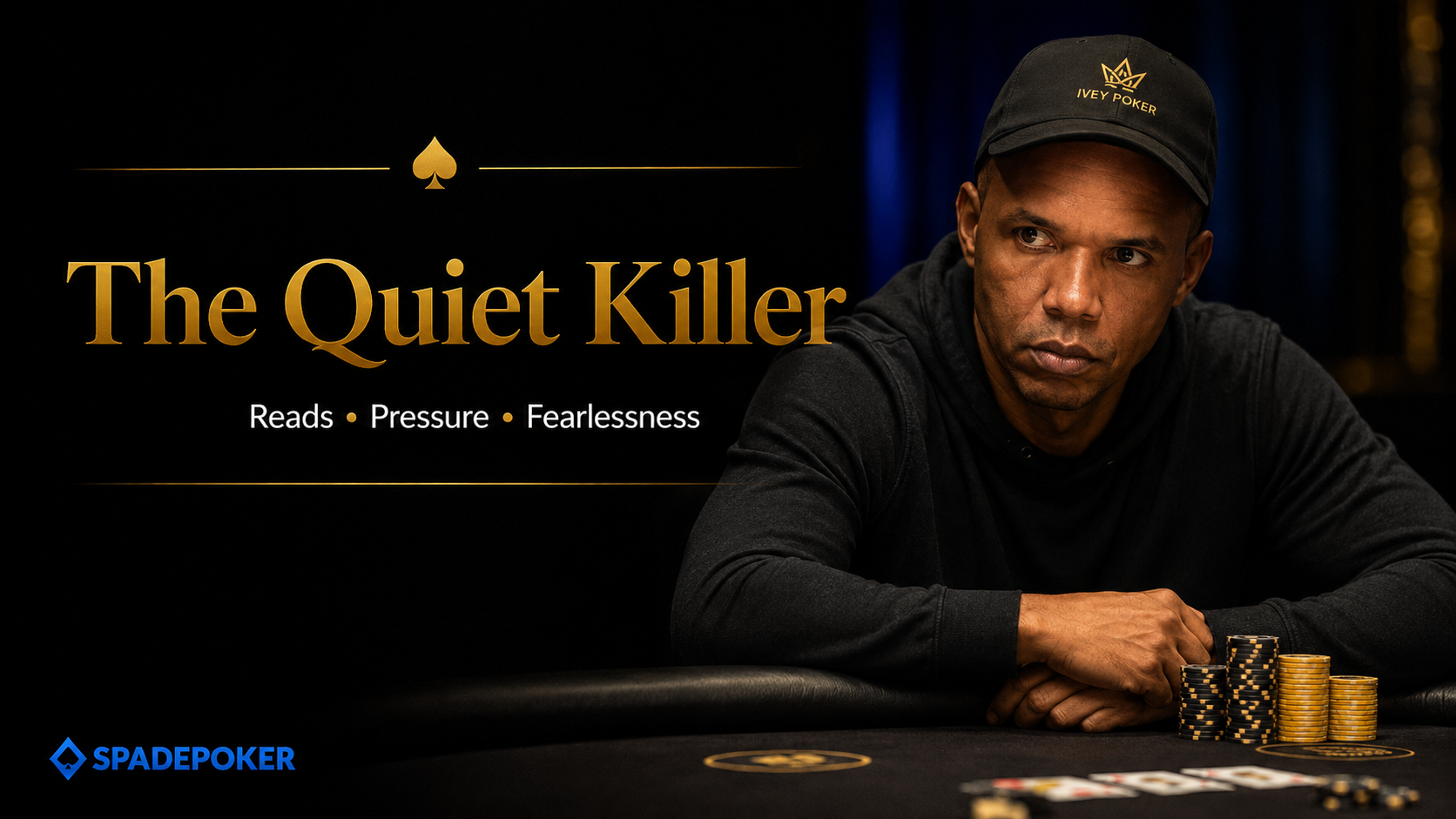
Viewers wanted to know what he was thinking precisely because he revealed so little.
His personality also made his rare moments of humour more memorable. Players who know Ivey personally often describe someone considerably more relaxed and entertaining away from the pressure of the table.
The contrast between his private personality and public intensity helped create one of poker’s most distinctive identities.
Full Tilt Poker
Ivey was one of the most visible professionals associated with Full Tilt Poker during the online poker boom.
The site marketed itself through a roster of elite players and used Ivey’s reputation as evidence that customers could play alongside the best professionals in the world. He became one of the central faces of the brand.
Full Tilt’s collapse after Black Friday in 2011 damaged the reputations of several players associated with the company. Customer funds were unavailable, and investigations revealed severe problems with the way the business had handled player deposits.
Ivey filed a lawsuit against Full Tilt and publicly distanced himself from the company, stating that he was deeply disappointed that players had not been repaid. He also initially announced that he would not participate in the 2011 WSOP.
His exact knowledge of Full Tilt’s financial condition before the collapse has remained a subject of debate. Unlike some other members of the ownership group, however, Ivey was not publicly identified as one of the central executives responsible for the company’s financial decisions.
The episode remains part of his career because his image had been so closely connected with the platform.
The Edge-Sorting Controversy
The most significant controversy of Ivey’s career did not involve poker. It came from high-stakes baccarat sessions in London and Atlantic City.
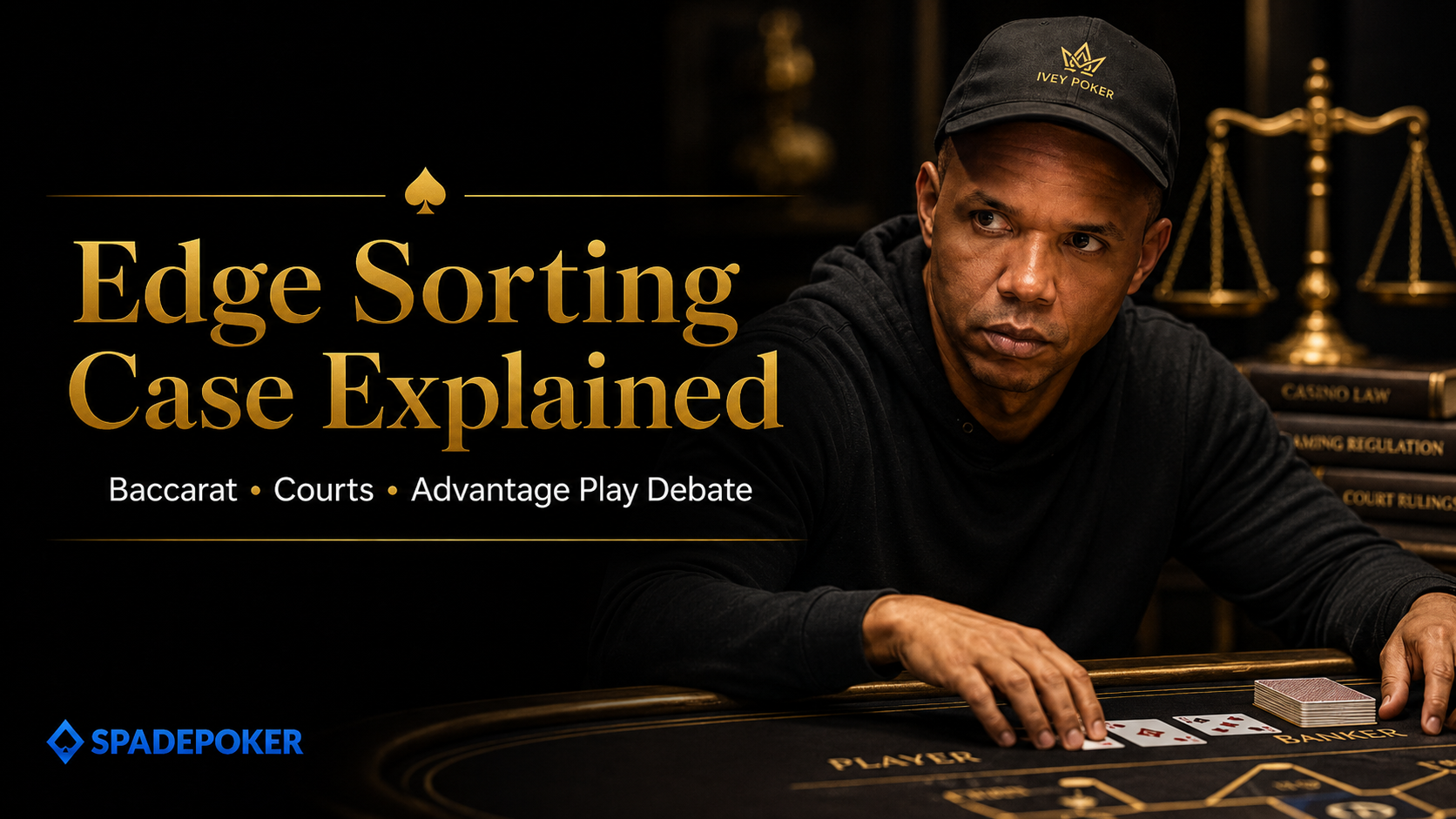
Ivey and playing partner Cheung Yin “Kelly” Sun used a technique known as edge sorting. Certain decks contained tiny asymmetries in the patterns printed on the backs of the cards. By identifying those differences, a skilled observer could distinguish valuable cards from others.
During the games, Ivey and Sun asked dealers to rotate particular cards, presenting the requests as superstition. Because the casino used an automatic shuffling machine that did not change the orientation of the cards, the pair could later identify high-value cards from their backs.
At Crockfords casino in London, Ivey won approximately 7,7 million £. The casino returned his original stake but refused to pay the winnings.
Ivey argued that he had used legitimate advantage-play techniques. He had not touched or altered the cards, and the casino had voluntarily accepted his requests.
The dispute eventually reached the UK Supreme Court. In 2017, the court ruled against Ivey, finding that his actions constituted cheating even though it accepted that he genuinely did not consider himself dishonest. UK Supreme Court judgment
A similar dispute followed sessions at the Borgata in Atlantic City, where Ivey and Sun had won approximately 9,6 million $. The casino successfully pursued legal action to recover the money.
The controversy created a lasting debate about the boundary between advantage play and cheating. Ivey maintained that casinos use every legal advantage available to them and that players should be permitted to do the same.
The courts ultimately disagreed, focusing on the deliberate steps used to change the orientation of the cards and preserve the informational advantage.
The cases damaged Ivey financially and added a complicated chapter to his public reputation. They did not involve manipulation of a poker game or allegations that his poker achievements were fraudulent.
Poker Hall of Fame
Phil Ivey was inducted into the Poker Hall of Fame in 2017, the first year he was eligible after turning 40.
By that point, he had already won ten WSOP bracelets, a WPT title and more than 20 million $ in recorded live tournaments. He had also established a high-stakes cash-game reputation that tournament statistics could not fully measure.
His selection was widely expected. Few modern players had received as much respect from both the public and other elite professionals.
Ivey subsequently added his eleventh bracelet and tens of millions of dollars in tournament cashes, meaning that a substantial portion of his competitive legacy was built after his Hall of Fame induction.
Why Professional Players Respect Phil Ivey
Poker greatness is difficult to measure because public tournament results represent only one part of the game.
Bracelets reward success at the WSOP. Money lists are heavily influenced by buy-in sizes and access to high rollers. Cash-game results are usually private. Online results can involve screen names that are difficult to verify.
Ivey has demonstrated strength in nearly every relevant environment.
He has won bracelets across numerous variants, captured a WPT title, reached the WSOP Main Event final table and accumulated major high-roller results. He has also played in private cash games at stakes beyond the reach of most tournament professionals.
Perhaps most importantly, he earned his reputation by competing against specialists rather than avoiding them.
Many of the strongest players of his generation have described Ivey as the opponent they least wanted to face. That peer recognition is difficult to quantify, but it carries considerable weight in assessing his career.
Phil Ivey’s Place Among the Greatest Players
Phil Hellmuth owns more WSOP bracelets. Daniel Negreanu has built a larger public platform. Modern high-roller regulars have moved above Ivey on the all-time tournament money list.
Ivey’s case for poker greatness rests on completeness.
He has succeeded in tournaments and cash games, in Hold’em and mixed games, in large fields and exclusive high rollers. He competed before the online poker boom, became a star during television’s most influential era and continued reaching major final tables in the solver-driven modern game.
His résumé does contain notable gaps. He has never won the WSOP Main Event, and his biggest achievements in private cash games cannot be independently verified in the same way as tournament results.
However, very few players have combined so many different forms of excellence.
If the question is who owns the greatest single statistical record, the answer may be another player. If the question is who could be placed into almost any poker game against almost any opponent, Ivey remains one of the strongest answers available.
The Poker Legacy of Phil Ivey
Phil Ivey’s legacy is built on respect.
He did not need constant table talk, dramatic entrances or an elaborate public character. His presence became enough. When Ivey joined a tournament or cash game, the other players understood that one of the most dangerous competitors in poker had taken a seat.
His 11 bracelets demonstrate extraordinary range. His WPT victory and Main Event final table show that he could navigate large No-Limit Hold’em fields. His high-roller results prove that he remained competitive as tournament strategy became more technical.
The private games, the Andy Beal match and the testimony of other professionals add another dimension that public statistics cannot capture.
The edge-sorting cases ensure that his wider gambling career will always contain controversy. They raised difficult questions about advantage play, casino responsibility and the legal definition of cheating. Those disputes complicate Ivey’s story without erasing his poker achievements.
More than a quarter of a century after his first bracelet, he remains an active competitor with more than 55 million $ in live tournament cashes and a realistic opportunity to add further major titles.
Some poker legends became famous because audiences loved listening to them. Phil Ivey became a legend because whenever he sat silently at a poker table, everyone else paid attention.
Statistics updated in August 2026. Recorded tournament earnings represent gross cashes and should not be interpreted as career profit.