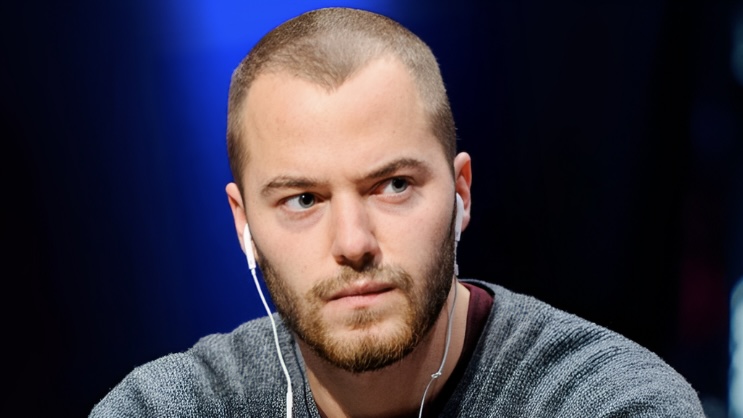
Sean Winter
Sean Winter is an American professional poker player, online tournament champion and high roller regular from Jacksonville, Florida. Known online as “nolez7,” he built his reputation through a combination of internet success, fearless live tournament play and repeated results against the strongest opponents in the modern game. The Hendon Mob listed his recorded live tournament earnings at 41.431.637 $ when checked on 23 September 2026, placing him 23rd on the all-time money list and first among players from Florida.
Winter has produced major results across the World Series of Poker, PokerStars Caribbean Adventure, partypoker Caribbean Poker Party, Triton Poker and the PokerGO Tour. His largest live cash came in 2018, when he finished second in the 250.000 $ Caribbean Poker Party Super High Roller for 2.430.000 $. He also won the 2022 U.S. Poker Open championship after taking down the final two events of the series and has collected high-profile titles at Bellagio, Seminole Hard Rock, PokerGO and Triton festivals.
He was born on December 14, 1990, in Jacksonville, Florida. Winter reached poker’s elite level while still in his twenties and remained there through the expansion of the high roller circuit. His career combines the large volume of an online professional with the adaptability required to compete in no-limit hold’em, pot-limit Omaha, short deck and mixed-format events.
The most unusual gap in his résumé is a World Series of Poker bracelet. Winter has reached numerous WSOP final tables and came within one heads-up match of a bracelet in the 2018 50.000 $ No-Limit Hold’em High Roller. By the end of the 2026 WSOP, he had again accumulated several major final-table finishes without winning the title. That absence does not weaken the scale of his career, but it gives one of the world’s most successful active tournament players a clear remaining target.
Early Life in Jacksonville, Florida
Sean Sexton Winter was born on December 14, 1990, in Jacksonville, Florida. Public profiles identify Jacksonville as both his birthplace and long-term home, and his connection to the state has remained part of his poker identity. The Hendon Mob ranks him first on Florida’s all-time money list.
Winter developed an interest in poker as a teenager, during the period when online poker was making advanced strategy, large tournament fields and constant competition available to a new generation. Players no longer needed to live near a traditional casino or wait for occasional major festivals to gain experience. They could play hundreds of tournaments, study opponents and encounter difficult decisions every week.
That environment suited Winter. He became known for an aggressive, resilient approach and for being willing to compete at increasingly high stakes. His early development took place largely online, where results accumulate quickly but downswings can be severe. The ability to continue making good decisions through those swings later became essential in live high rollers.
Reliable public information about his education and private childhood is limited. Winter has generally been discussed through his tournament career rather than through a highly public personal biography. The confirmed outline is clear: he grew up in Jacksonville, learned the game young and turned an online foundation into one of the largest live tournament records produced by a Florida player.
The Online Player Known as nolez7
Winter played online under the screen name “nolez7.” The nickname became familiar to tournament regulars before many television viewers knew his real name. Online poker gave him access to a faster and more demanding learning environment than a traditional schedule of occasional live events.
A serious internet tournament player must make decisions across many stack depths and field stages. The opening levels reward patience and table selection, while late stages create escalating pressure around payouts, final tables and heads-up play. Multi-tabling adds another challenge because the player must move between different opponents and tournament situations in seconds.
Winter’s online record included major championship performances. In 2016, he finished runner-up to Talal Shakerchi in the high buy-in Spring Championship of Online Poker Main Event and earned 1.048.000 $. The result was not part of his Hendon Mob live total because it took place online, but it was one of the clearest demonstrations of his ability in a large and prestigious digital tournament.
Later that year, he won a World Championship of Online Poker event, taking down the 2.100 $ Progressive Knockout Thursday Thrill for approximately 228.000 $. Those achievements established that Winter was not simply a live high roller with access to expensive events. He had succeeded in the high-volume online environment where technical weaknesses can be tested repeatedly.
Why Online Results and Live Earnings Must Be Separated
The public total attached to Winter’s name on The Hendon Mob measures recorded live tournament cashes. It does not include his SCOOP runner-up finish, his WCOOP title or every other result played under nolez7. This distinction is essential when describing his career.
Online poker databases and live tournament databases collect different sets of information. A player can have millions of dollars in recorded internet prizes that never appear in the headline live total. Conversely, a large live result does not show what happened in private cash games or on sites that do not publish complete records.
Neither figure represents profit. Tournament cashes are gross payouts before entry fees, re-entries, travel, taxes and staking arrangements. An online player can record a large volume of prizes while also paying a large volume of buy-ins. High roller professionals may sell or exchange percentages of their action to control financial risk.
Winter’s career therefore needs two parallel descriptions. His 41,4 million $ Hendon Mob total measures an exceptional live record. His success as nolez7 shows that his competitive experience extends beyond those recorded live events. Combining the categories into one unsupported number would create a misleading estimate.
First Recorded Live Cashes
Winter’s first recorded live tournament cash came in August 2011, shortly before his twenty-first birthday. That timing reflects the legal restrictions governing casino poker in the United States: he could develop online before becoming eligible for the full domestic live circuit.
Early tournament results were modest compared with the seven-figure payouts that later defined his public profile. They nevertheless served an important purpose. Live poker changes the rhythm of decision-making. A player sees fewer hands, sits with the same opponents for longer periods and must manage physical tells, table presence and the pressure of playing one tournament at a time.
Winter began building results in regional events and World Series of Poker Circuit tournaments. In the 2012-13 season, he finished fifth in the Horseshoe Southern Indiana Main Event for 29.559 $ and later cashed the Harrah’s New Orleans Main Event. These were meaningful steps for a young player moving from online experience into the American live schedule.
The results also placed him in environments with longer structures and stronger late-stage opposition. Winter’s willingness to play aggressively translated well, but live tournaments required adjustments in pacing and opponent observation. By 2013, he was ready to produce his first significant World Series of Poker run.
The 2013 WSOP Heads-Up Breakthrough
Winter reached the quarterfinal stage of the 2013 WSOP 10.000 $ Heads-Up No-Limit Hold’em Championship. He finished seventh for 54.024 $, his largest WSOP cash at that point.
Heads-up poker isolates many of the skills that later became associated with Winter’s game. Starting-hand ranges widen, aggression increases and every small blind creates a direct contest between two players. There is no full table to wait behind, and an opponent can adjust rapidly after observing only a few hands.
Reaching the last eight of a championship event gave Winter a visible result against experienced competition. It also demonstrated that the online player’s style was not dependent on anonymous tables or rapid multi-tabling. He could make repeated adjustments in a live match and survive several rounds of direct elimination play.
Winter added two more cashes at the 2013 WSOP, including his first Main Event payout. He finished 436th for 24.480 $. The amount was small beside the Main Event’s top prizes, but cashing poker’s largest annual championship helped establish a pattern that continued over the next several years.
Building a Broader WSOP Record in 2014
The 2014 World Series of Poker showed more of Winter’s range. He cashed a 1.500 $ shootout, a 2.500 $ no-limit hold’em event and the 10.000 $ Pot-Limit Omaha Championship before returning to the Main Event.
His 23rd-place finish in the PLO Championship for 28.290 $ was especially relevant to the later shape of his career. Winter would eventually become a regular in the largest pot-limit Omaha tournaments in Las Vegas and on the Triton circuit. The 2014 cash showed that the variant was already part of his live tournament skill set.
He finished 372nd in the Main Event for 29.400 $, improving on his 2013 placement. Later that year, he travelled to Australia for the WSOP Asia-Pacific and placed 18th in the 10.000 A$ Main Event for 23.441 A$.
None of these results made him a global high roller star by itself. Together, they showed a professional expanding his schedule, playing different formats and producing results outside his home region. The foundation was in place for the tournament that changed his live profile in 2015.
Winning the 2015 Bellagio Cup
Winter won the 2015 Bellagio Cup XI 10.400 $ No-Limit Hold’em championship for 562.772 $. The tournament drew 301 entries and gave him his first major live title.
Bellagio had long been associated with serious high stakes poker, and the Bellagio Cup attracted a strong mix of established professionals and ambitious younger players. Winning a multi-day event of that size required Winter to navigate far more than a compact final table. He had to survive changing opponents, escalating blinds and the pressure of a first prize worth more than half a million dollars.
The victory moved his live career into a new category. Before it, Winter had been a respected online player with encouraging WSOP results. After it, he had a major Las Vegas championship and the bankroll momentum to pursue a more expensive schedule.
The win also confirmed that his aggressive approach could produce a title over a large field. High roller events would later expose him to smaller but more concentrated groups of elite opponents. The Bellagio Cup required a different kind of endurance: many entries, several days and repeated adaptation as tables broke and the field narrowed.
The 2016 PCA High Roller Runner-Up Finish
Winter began 2016 with another major result at the PokerStars Caribbean Adventure. He finished second in the 25.000 $ High Roller for 914.580 $ after a heads-up deal with Nick Maimone.
The PCA was one of the most important international festivals of its era. Its high roller brought together online champions, live professionals and players with experience at the largest buy-ins. Winter’s online identity was already respected, and the Bahamas result gave his real-name live résumé a near seven-figure addition.
Deals are common at the end of large tournaments because the remaining payouts can differ by hundreds of thousands of dollars. The listed prize reflects the published agreement and should be treated as a gross tournament cash. It does not reveal how much of his entry Winter personally funded or retained.
Competitively, the runner-up finish confirmed that the Bellagio title was not an isolated breakthrough. Winter could move from a 301-entry Las Vegas championship into an international high roller and reach heads-up play against another accomplished professional.
SCOOP Main Event and WCOOP Success in 2016
The same year became one of the strongest demonstrations of Winter’s dual online and live ability. Playing as nolez7, he reached heads-up play in the high buy-in SCOOP Main Event. Talal Shakerchi won the title, while Winter earned 1.048.000 $ for second place.
The online payout exceeded his PCA result but belongs to a separate statistical category. It does not appear in the 41.431.637 $ live total. For a complete career biography, however, omitting it would understate an important part of his professional development.
Winter followed that performance by winning a WCOOP title in September 2016. He took down a 2.100 $ progressive knockout tournament for approximately 228.000 $. Knockout structures change strategy because each opponent carries a bounty in addition to the normal tournament chips and payout ladder.
These results reinforced the value of Winter’s online background. He had experience processing large numbers of hands, shifting between formats and playing through deep final stages against professionals familiar with modern theory. When he entered the live high roller circuit, he brought more than confidence and bankroll. He brought a proven record in some of the internet’s most difficult events.
The 2018 WSOP 50.000 $ High Roller Near Miss
Winter came exceptionally close to his first WSOP bracelet in the 2018 50.000 $ No-Limit Hold’em High Roller. He reached heads-up play against Ben Yu and finished second for 1.020.253 $.
The tournament was a major test of short-handed high stakes hold’em. As the field narrowed, every decision carried both tournament and historical significance. Winter had already accumulated respected results, but a bracelet would have placed a universally recognised championship beside them.
The runner-up finish became his first seven-figure live cash. It also introduced a recurring theme. Winter would continue to reach WSOP final tables in hold’em, pot-limit Omaha and mixed-format events without closing one for a bracelet.
Prize money and prestige moved in different directions. The 1.020.253 $ payout was larger than many bracelet winners earn, yet the official result still reads second. That distinction explains why the bracelet remains an important open objective even after Winter passed 41 million dollars in live cashes.
The 2018 Caribbean Poker Party and His Largest Cash
Winter recorded the largest live payout of his career at the 2018 partypoker Caribbean Poker Party in the Bahamas. He finished second to Steffen Sontheimer in the 250.000 $ Super High Roller Championship and earned 2.430.000 $.
The buy-in placed the tournament among the most expensive events on the calendar. The field was limited to 42 entries, but small numbers do not make such a competition easy. The lineup included players accustomed to making decisions for extraordinary stakes and studying one another in repeated high roller encounters.
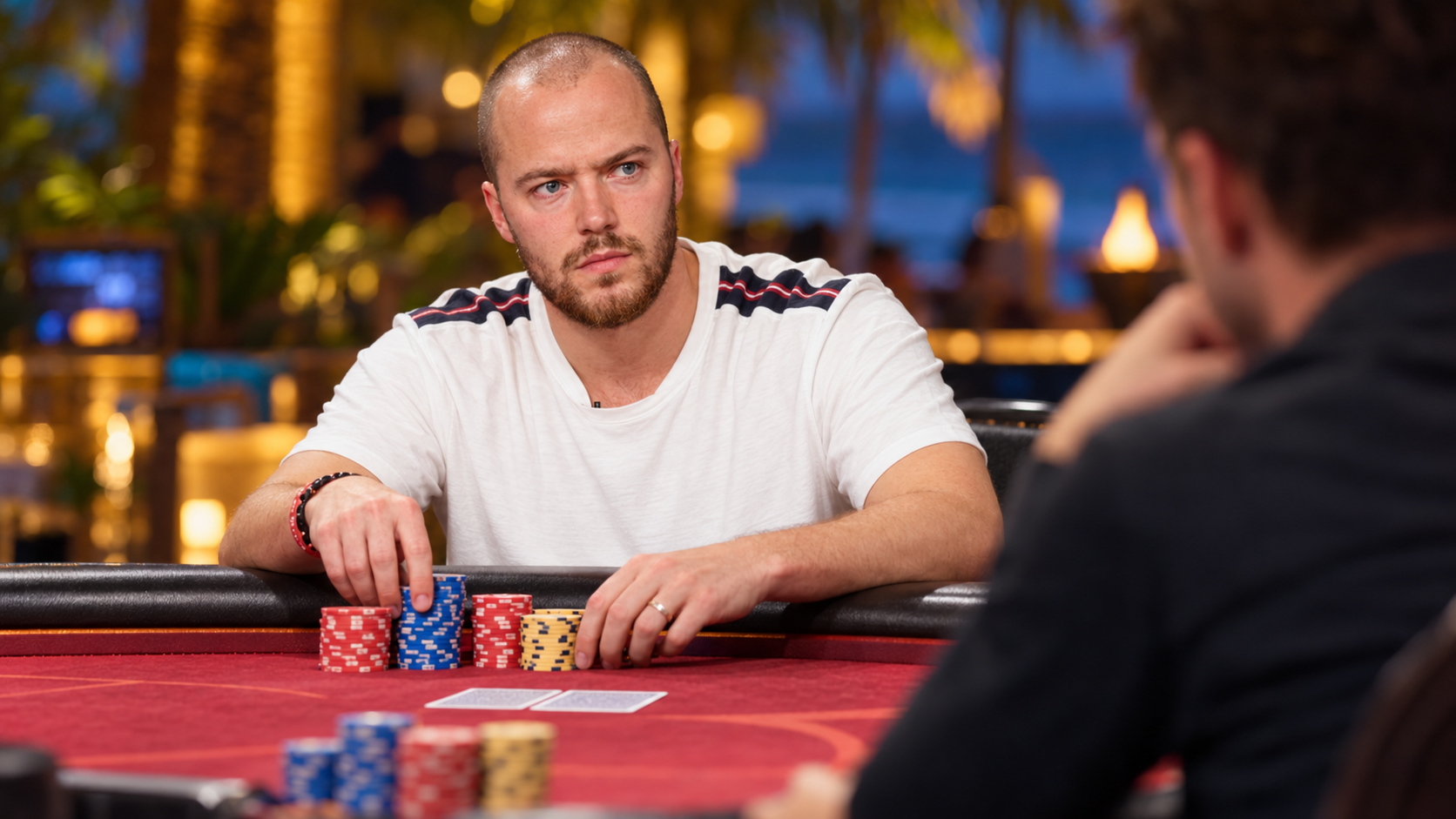
Winter also finished second in the festival’s 50.000 $ Super High Roller for 550.000 $. Across the two results, the series added almost three million dollars to his public live record.
His 2.430.000 $ prize remains the headline cash in his Hendon Mob profile. It should not be confused with net profit: the entry fee was 250.000 $, and private staking or swaps may have changed the amount personally at risk or retained. As a competitive result, it confirmed Winter as one of the most successful high roller players of his generation.
The 2019 U.S. Poker Open Campaign
Winter’s first major run at the U.S. Poker Open came in 2019. He cashed five events, won the 10.000 $ Short Deck tournament for 151.200 $ and reached several additional final tables.
His results included second place in the opening no-limit hold’em event, sixth in pot-limit Omaha, fifth in another no-limit hold’em tournament and third in the 50.000 $ finale for 328.000 $. The combined performance put him in contention for the Golden Eagle Trophy.
David Peters ultimately won the championship, leaving Winter as the series runner-up. That outcome became more significant when it happened again in 2021. Winter was performing consistently enough to challenge for the title but had not yet finished the series at the top of the leaderboard.
The 2019 Short Deck victory also demonstrated his range. Short deck uses a 36-card pack and changes the frequency of pairs, straights and flushes. Success requires recalibrating values rather than applying normal hold’em assumptions without adjustment.
Winning the 2019 PCA Single-Day High Roller
Winter opened 2019 by winning the 25.000 $ Single-Day High Roller at the PokerStars Caribbean Adventure for 495.210 $. The title returned him to the Bahamas, where he had finished second in the PCA High Roller three years earlier.
Single-day high rollers compress an entire tournament into a demanding schedule. Players move quickly from deeper early levels into short-handed and final-table decisions, leaving little time to recover from mistakes or fatigue.
Winter’s victory supplied another example of his ability to convert a final table into first place. His career includes many runner-up finishes, partly because he reaches the late stages of difficult tournaments so often. Titles like this one prevent the near misses from defining the whole record.
He also finished seventh in the PCA 25.000 $ High Roller later in the festival for 152.460 $. The two results continued a pattern of multiple cashes within major series, a skill that later became central to his U.S. Poker Open championship.
The 2019 Seminole Hard Rock Poker Open Championship
Winter won the 2019 Seminole Hard Rock Poker Open 5.250 $ Championship in Hollywood, Florida. He defeated a field of 809 entries for 698.175 $, earning a major title in his home state.
The result differed from his compact high roller successes. An 809-entry championship requires a player to survive many table changes and a broad range of opponent types. Winter entered the final table with the chip lead and controlled the closing stages, never allowing his stack to fall below 120 big blinds according to the official tournament report.
The timing added personal meaning. His first child was due less than three weeks later, and coverage framed the victory as Winter entering fatherhood with one of the largest titles of his career.
Winning in Florida reinforced his place at the top of the state’s tournament rankings. It also answered any suggestion that his success depended on small high roller fields. Winter had now won both a 301-entry Bellagio Cup and an 809-entry SHRPO Championship while remaining a fixture in the highest buy-in events.
Winning the 2021 U.S. Poker Open Finale
Winter won the 50.000 $ finale of the 2021 U.S. Poker Open for 756.000 $. The field drew 42 entries and gave him one of the largest titles of his PokerGO career.
The victory should have been enough to make almost any series memorable. Winter nevertheless finished second in the overall championship race, again behind David Peters. Peters had also denied him the Golden Eagle Trophy in 2019.
Repeated runner-up series finishes created a difficult psychological test. Winter had demonstrated that he could win individual events and accumulate points across a schedule, yet the championship continued to escape him.
The finale victory later became part of a remarkable sequence. In 2022, Winter won the last event of the U.S. Poker Open again, matching the 756.000 $ payout. This time, it completed a two-event comeback and delivered the overall title.
Third Place in the 2021 Super High Roller Bowl
Winter finished third in the 2021 Super High Roller Bowl VI in Las Vegas for 1.008.000 $. The tournament carried a 300.000 $ buy-in and brought together one of the most concentrated high stakes fields of the year.
The seven-figure payout became another major line in his career record. Like all super high roller results, it requires buy-in context. A 1.008.000 $ gross cash from a 300.000 $ tournament is a major competitive result but cannot be treated as one million dollars of profit.
Reaching the final three of the Super High Roller Bowl showed that Winter remained at the top level after the interruption to the live calendar. It also expanded his success beyond U.S. Poker Open and PokerGO Cup events into the tour’s flagship invitational-style championship.
The result helped establish the platform for his 2022 season. Winter entered the next U.S. Poker Open with two runner-up series finishes behind him and a recent seven-figure high roller cash, but his championship run would begin in the least promising way possible.
The 2022 U.S. Poker Open Comeback
Winter failed to cash in the first ten events of the 2022 U.S. Poker Open. With only two tournaments remaining, he appeared to have no realistic route to the series title.
He then won Event 11, a 25.000 $ No-Limit Hold’em tournament, for 440.000 $. The victory gave him enough points to remain mathematically alive, but the conditions were severe. Winter needed to win the 50.000 $ finale and required other leaderboard threats to fall in the correct order.
He reached the final table, survived the bubble and advanced to heads-up play against Masashi Oya. Winter began the duel with a nearly equal stack, fell behind and recovered. On the final hand, his ace-six flopped three sixes against Oya’s pocket queens, and the board held.
The 756.000 $ victory gave Winter back-to-back event titles, 1.196.000 $ in tournament prizes across the final two events and the U.S. Poker Open championship. The series added a 50.000 $ bonus, bringing the published total from the comeback to 1.246.000 $.
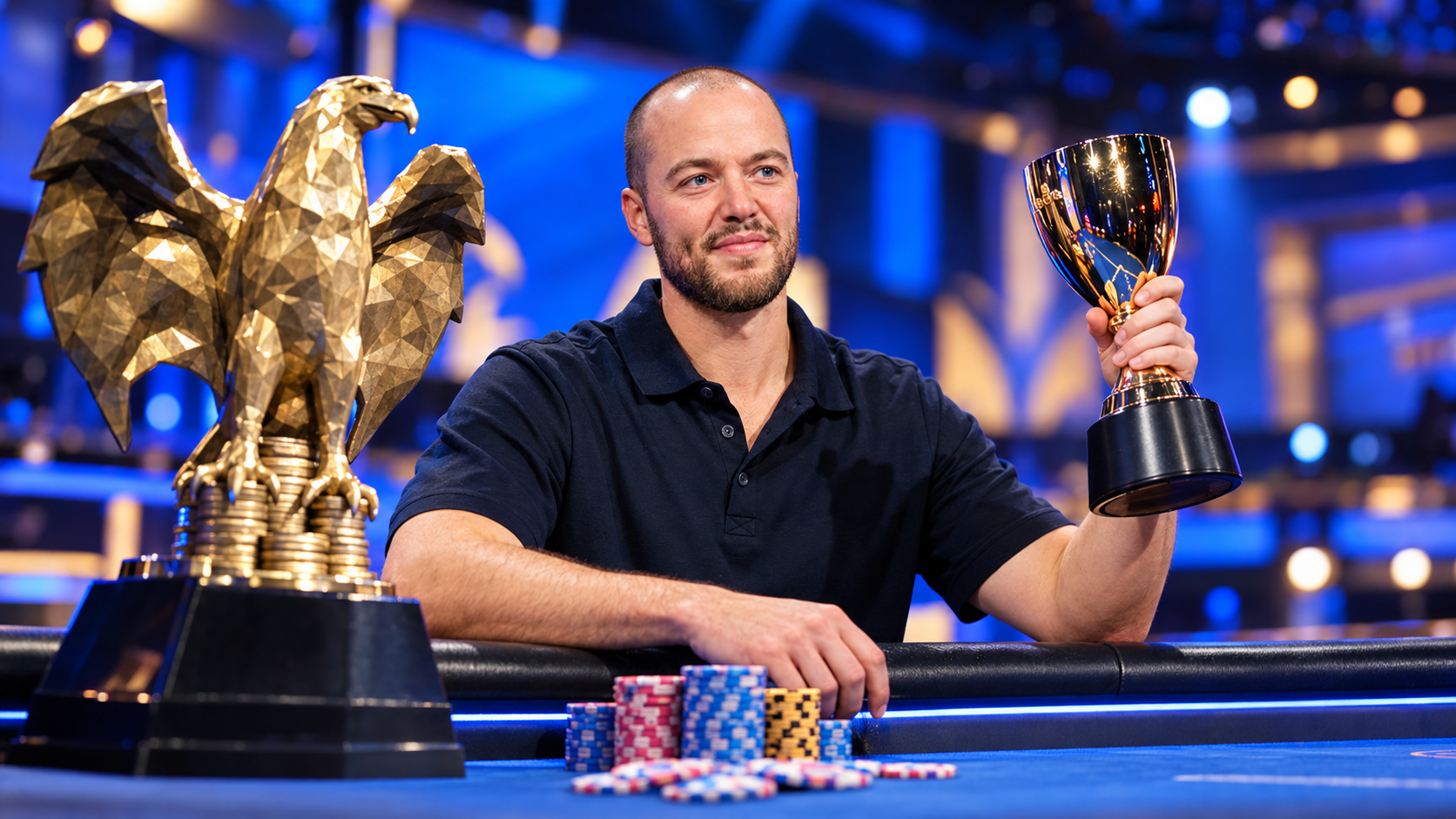
Winning the Golden Eagle Trophy
The 2022 title carried more significance because Winter had finished second in the previous two editions. He had watched David Peters win the championship in both 2019 and 2021 despite Winter producing major results of his own.
The Golden Eagle Trophy is awarded for performance across the full U.S. Poker Open schedule. Winter’s route was unusual because all 718 of his decisive leaderboard points came from the final two events. He moved from no cashes through ten tournaments to the top of the standings in the smallest possible window.
PokerGO reported that Winter needed first place in the finale and only first place. The result therefore combined tournament skill with a clear competitive narrative: there was no ambiguity about what he had to accomplish.
Winning the championship changed the meaning of his earlier runner-up finishes. They became evidence of sustained excellence rather than repeated failure. Winter had been close enough to contend in three editions and finally completed the series under the most dramatic conditions.
WSOP Versatility Without a Bracelet
Winter’s WSOP record includes deep runs in no-limit hold’em, heads-up events, pot-limit Omaha, short deck and mixed no-limit hold’em/PLO. The variety matters because his public reputation is often centred on high stakes hold’em.
In 2022, he finished third in the 3.000 $ Six-Handed Pot-Limit Omaha event for 156.401 $ and fourth in the 10.000 $ Short Deck Championship for 88.168 $. He also reached the final stages of the 25.000 $ Heads-Up Championship and cashed the 50.000 $ High Roller.
These results did not produce the bracelet that the 2018 runner-up finish had nearly delivered. They did show that Winter could return to the series and contend across formats rather than relying on one specialist event.
The bracelet question can overshadow the strength of the underlying record. A player can make correct decisions and still lose the final confrontation because tournament outcomes include substantial variance. Winter’s repeated final tables provide stronger evidence of long-term ability than any one missed river or heads-up match.
Triton Poker and the 2023 Cyprus Results
Winter added two major Triton results in Cyprus in 2023. He finished fourth in the 200.000 $ Luxon Invitational for 1.640.000 $ and sixth in the 100.000 $ Main Event for 595.000 $.
The Luxon Invitational paired elite professionals with recreational invitees in a special format. Its enormous buy-in and prize pool created one of the most valuable final tables of the season. Winter’s fourth-place cash became the second-largest recorded live prize of his career, behind only the 2018 Caribbean Poker Party runner-up finish.
Reaching another final table in the Main Event showed that his Cyprus success was not limited to one invitation tournament. Across the two results, he added 2.235.000 $ to his Hendon Mob total.
Triton fields demand international travel and adaptation to a global group of opponents. Winter’s results demonstrated that his PokerGO and American circuit success transferred to the most expensive festival series outside the United States.
The 2023 WSOP High Roller Runs
Winter opened the 2023 WSOP with third place in the 25.000 $ Six-Handed High Roller for 518.106 $. Only a few days later, he reached the semifinals of the 25.000 $ Heads-Up Championship and finished fourth for 192.513 $.
The two results captured different strengths. Six-handed high rollers reward wide ranges, position and constant pressure. Heads-up championships demand direct adjustment over a sequence of matches.
Winter added further cashes in pot-limit Omaha, bounty and Main Event tournaments. Once again, the series delivered a substantial gross return without the bracelet that would have changed the headline attached to his WSOP profile.
His consistency is particularly notable because the WSOP presents very different fields from regular studio high rollers. Some events attract thousands of entries, while championship tournaments draw specialists from around the world. Winter continued finding deep runs across that spectrum.
Expanding Further Into Pot-Limit Omaha
Pot-limit Omaha became increasingly prominent in Winter’s later schedule. The game gives each player four hole cards and requires exactly two of them to be used with exactly three community cards. The larger number of combinations creates frequent draws and close equity situations.
Players who approach PLO as ordinary hold’em with extra cards quickly make expensive mistakes. Starting-hand connectivity, nut potential and redraws matter greatly, and the pot-limit betting structure changes how stacks enter the middle.
Winter’s results show more than occasional participation. He cashed WSOP PLO championships, reached PGT PLO final tables and competed in Triton’s 100.000 $ PLO Main Events. His willingness to play the variant at six-figure buy-ins demonstrates serious commitment.
The expansion strengthened his overall career profile. Modern high roller schedules increasingly include PLO and hybrid formats. A player capable of moving between them has more opportunities to compete and is harder to categorise as a one-game specialist.
The 2024 Triton PLO Main Event Final Table
Winter finished fourth in the 2024 Triton Monte Carlo 100.000 $ Pot-Limit Omaha Main Event for 836.000 $. The result became one of the largest PLO cashes of his career.
He had already reached eighth place in the 100.000 $ PLO Main Event at Triton Montenegro earlier that year for 298.000 $. Making two final tables at this buy-in confirmed that PLO had become a genuine high-level part of his tournament game.
The Monte Carlo result arrived in a format where equities run close and large pots develop quickly. Deep progress requires controlling variance, selecting hands with strong nut potential and understanding how opponents construct aggressive ranges.
Winter also finished third in the 100.000 € EPT Barcelona Super High Roller in 2024 for 616.600 €. The combination of international hold’em and PLO results kept him near the top of the global earnings rankings even without a tournament victory worth seven figures.
The 2025 Triton Mystery Bounty Victory
Winter won the 2025 Triton Jeju 20.000 $ plus 20.000 $ Mystery Bounty event for a published tournament cash of 935.000 $. The result gave him a prestigious Triton title and another victory outside the United States.
Mystery bounty tournaments divide value between the normal prize pool and randomly awarded bounties collected after eliminating opponents. Strategic decisions can change sharply when a valuable bounty is available, particularly near the stage when bounty envelopes become active.
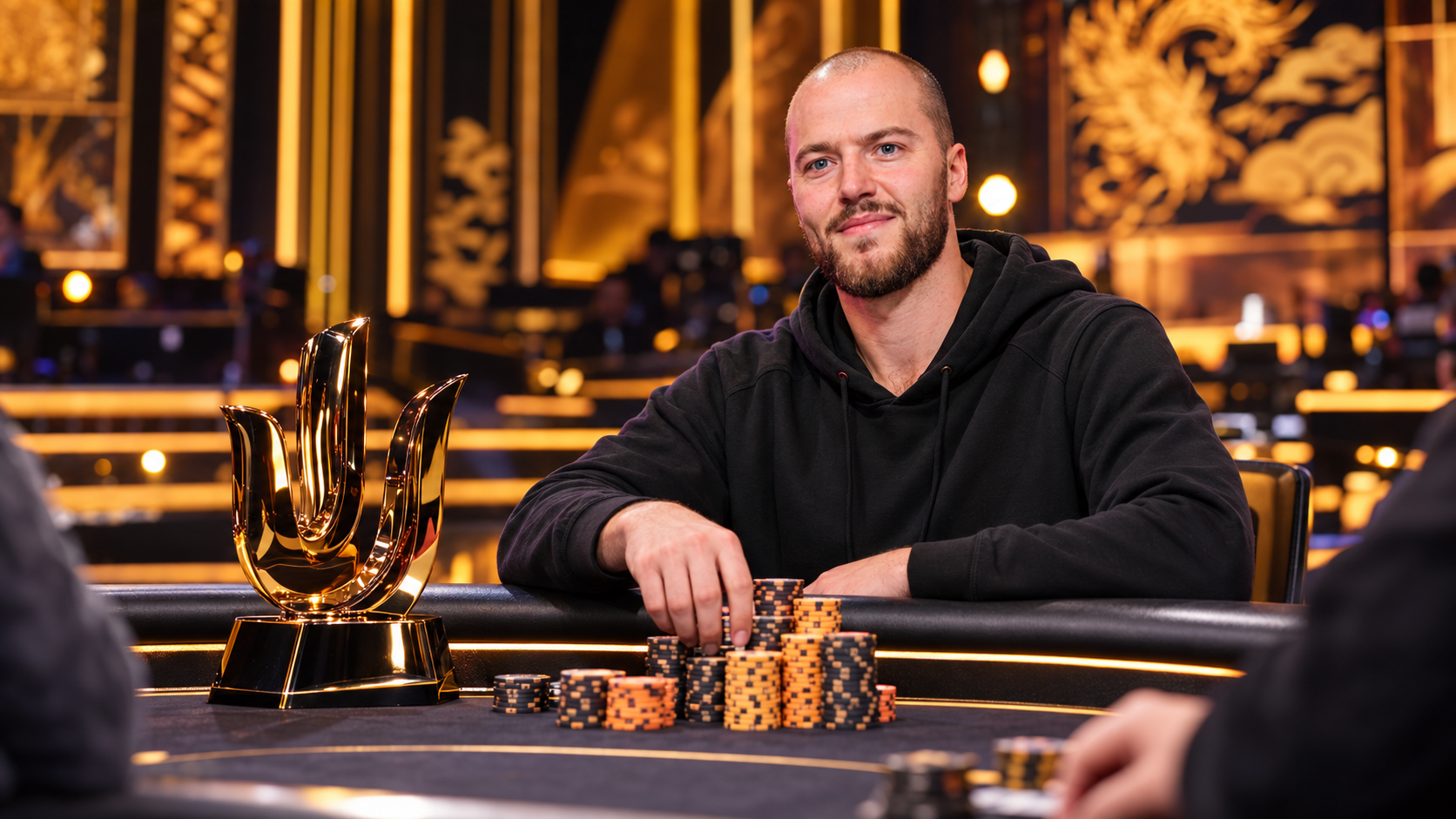
The listed 935.000 $ reflects the published result used by The Hendon Mob. Bounty components and tournament prizes can be reported differently across sources, so the total should be described according to the official event record rather than reconstructed from partial reports.
Competitively, the title added an important missing element. Winter already had multiple Triton final tables and seven-figure cashes. The Jeju victory gave him first place at one of the world’s premier high roller series.
A PLO Title on the 2025 PokerGO Tour
Winter won a 2025 PGT PLO Series II progressive bounty event for 122.300 $. The amount was modest relative to his largest prizes, but the title reinforced his development in pot-limit Omaha.
During the same series, he reached several other final tables, including third, sixth and eighth-place finishes. Repeated cashes across one specialised festival require more than a single favourable run.
The result also illustrates how career totals are built. The public focuses on million-dollar prizes, but hundreds of smaller cashes contribute to longevity and ranking position. Winter’s Hendon Mob profile listed 261 results when checked in September 2026.
For a player who began as a no-limit hold’em online specialist, sustained PLO success represents meaningful evolution. It allowed Winter to remain active in a high roller calendar that had become more varied than the one he entered a decade earlier.
The 2026 PokerGO Cup Victory
Winter won the final 10.000 $ event of the 2026 PokerGO Cup for 210.000 $. He also finished third in another 10.000 $ tournament for 93.150 $ and added two smaller cashes during the series.
The victory came four years after his dramatic U.S. Poker Open championship and showed that he remained capable of closing events at the PokerGO Studio. His long familiarity with the venue and its regular opponents did not make the competition easier; it meant both sides possessed extensive information.
By 2026, Winter was no longer the young online player proving he belonged in live high rollers. He was an established veteran of the circuit whose opponents had years of televised hands to study.
The PokerGO Cup title therefore represented continuity as much as breakthrough. Winter’s game had survived changes in theory, field composition and tournament formats while continuing to generate first-place results.
Triton Jeju Main Event Final Table in 2026
Winter finished sixth in the 2026 Triton Jeju 100.000 $ No-Limit Hold’em Main Event for 870.000 $. He also cashed two other events at the festival, including a 60.000 $ tournament and a mystery bounty event.
The Main Event result extended his strong record in Triton’s flagship tournaments. He had already finished sixth in the 2023 Cyprus Main Event and reached major PLO final tables in Montenegro and Monte Carlo.
Repeated final tables across different Triton stops are significant because the fields assemble many of the best tournament players in the world. Travel, unfamiliar time zones and the financial scale of the events add demands beyond the cards.
The 870.000 $ cash became the first major component of Winter’s exceptional 2026 live earnings. The WSOP would add several more, pushing his recorded total beyond 41 million dollars.
Sean Winter at the 2026 WSOP
Winter produced one of the strongest WSOP series of his career in 2026. He reached four major final tables during June and cashed nine bracelet events in total.
He finished third in the 25.000 $ Six-Handed No-Limit Hold’em High Roller for 597.635 $. Later, he placed fourth in the 250.000 $ Super High Roller for 1.312.037 $, the largest WSOP cash of his season. He also took third in the 25.000 $ mixed no-limit hold’em and pot-limit Omaha high roller for 540.754 $.
Winter added sixth place in the 100.000 $ PLO High Roller for 393.139 $, twelfth in both a 100.000 $ hold’em event and the 50.000 $ PLO High Roller, and 99th in the Main Event for 65.000 $.
The series produced more than 3,2 million dollars in recorded cashes and demonstrated his full range. Yet the bracelet remained absent. Few careers illustrate so clearly the difference between repeated elite performance and the binary outcome of winning a single WSOP title.
Recorded Results in 2026
Through his final listed cash in July, Winter had accumulated 4.727.920 $ in recorded 2026 live tournament prizes. That figure includes the Triton Jeju Main Event, PokerGO Cup events, U.S. Poker Open cash, Wynn result and his extensive WSOP run.
The total is not an estimate of profit. Winter entered numerous expensive events, including tournaments with buy-ins of 100.000 $ and 250.000 $. The cost of unsuccessful entries and any private financial arrangements are not visible in the headline cash total.
As a performance measure, the year was outstanding. Winter combined a PokerGO Cup victory, a Triton Main Event final table and four top-six finishes in major WSOP high rollers.
The results also lifted him to 41.431.637 $ in career live cashes and 23rd place on the all-time money list as of 23 September 2026. He remained 14th among United States players and first among players associated with Florida.
Sean Winter’s Biggest Live Tournament Cashes
The following table presents selected major results rather than every entry in Winter’s 261-result Hendon Mob record.
| Year | Tournament | Result | Recorded prize |
| 2018 | Caribbean Poker Party 250.000 $ Super High Roller | 2nd | 2.430.000 $ |
| 2023 | Triton Cyprus 200.000 $ Luxon Invitational | 4th | 1.640.000 $ |
| 2026 | WSOP 250.000 $ Super High Roller | 4th | 1.312.037 $ |
| 2018 | WSOP 50.000 $ No-Limit Hold’em High Roller | 2nd | 1.020.253 $ |
| 2021 | Super High Roller Bowl VI 300.000 $ | 3rd | 1.008.000 $ |
| 2025 | Triton Jeju Mystery Bounty | 1st | 935.000 $ |
| 2016 | PCA 25.000 $ High Roller | 2nd | 914.580 $ |
| 2026 | Triton Jeju 100.000 $ Main Event | 6th | 870.000 $ |
| 2024 | Triton Monte Carlo 100.000 $ PLO Main Event | 4th | 836.000 $ |
| 2021 | U.S. Poker Open 50.000 $ Finale | 1st | 756.000 $ |
| 2022 | U.S. Poker Open 50.000 $ Finale | 1st | 756.000 $ |
| 2019 | SHRPO 5.250 $ Championship | 1st | 698.175 $ |
The table shows why Winter’s career cannot be reduced to one tournament. His largest cash was a runner-up finish, while several of his most important titles produced smaller payouts. The buy-ins, field sizes and prestige of the events differ substantially.
Major Live Tournament Titles
| Year | Event | Achievement | Recorded prize |
| 2015 | Bellagio Cup XI 10.400 $ Championship | Winner | 562.772 $ |
| 2019 | PCA 25.000 $ Single-Day High Roller | Winner | 495.210 $ |
| 2019 | U.S. Poker Open 10.000 $ Short Deck | Winner | 151.200 $ |
| 2019 | Seminole Hard Rock Poker Open Championship | Winner | 698.175 $ |
| 2021 | U.S. Poker Open 50.000 $ Finale | Winner | 756.000 $ |
| 2022 | U.S. Poker Open Event 11 | Winner | 440.000 $ |
| 2022 | U.S. Poker Open 50.000 $ Finale | Winner | 756.000 $ |
| 2022 | U.S. Poker Open series | Overall champion | 50.000 $ bonus |
| 2025 | Triton Jeju Mystery Bounty | Winner | 935.000 $ |
| 2025 | PGT PLO Series II Progressive Bounty | Winner | 122.300 $ |
| 2026 | PokerGO Cup Event 9 | Winner | 210.000 $ |
The list focuses on notable titles and is not a complete record of every first-place finish. It separates the 2022 U.S. Poker Open series championship from the two tournament prizes that created it.
No World Series of Poker Bracelet Yet
As of September 2026, Winter had not won a WSOP bracelet. The absence is notable because he had 97 WSOP cashes, 37 final tables and more than 11,8 million dollars in WSOP-recorded earnings according to the series’ player profile.
The 2018 50.000 $ High Roller runner-up finish remains his closest publicly recognised near miss. His 2026 series added third-place finishes in two high rollers and fourth place in the 250.000 $ Super High Roller.
A bracelet is not a complete measure of poker ability. Some bracelets are won in fields of thousands, while others come from small championships filled with specialists. Variance can decide whether a player who repeatedly reaches the final table eventually receives the trophy.
Winter’s record makes the missing bracelet more interesting precisely because the rest of his résumé is so strong. If he eventually wins one, it will complete an obvious gap. If he does not, his repeated high-level results will still place him among the most accomplished tournament players never to claim the title.
Playing Style and Competitive Personality
Winter is associated with active, aggressive poker. He is willing to apply pressure, contest pots and make difficult calls rather than wait only for premium hands. That style developed in online tournaments, where passive play is often punished as blinds increase.
Aggression alone does not explain his longevity. High roller opponents adjust quickly to players who bet too often or take unnecessary risks. Winter’s continued success suggests a more flexible approach: recognising stack depths, field incentives and the ways specific opponents respond to pressure.
His public table presence can appear emotional and intensely competitive. The 2022 U.S. Poker Open comeback captured that quality. After failing to cash ten events, he did not retreat from the larger final buy-ins. He won both.
Winter has also shown the patience required for large-field championships. His Bellagio Cup and SHRPO titles came against 301 and 809 entries, respectively. Those victories required hours of disciplined play in addition to the aggression seen in televised high roller hands.
Success Across Multiple Formats
No-limit hold’em remains the foundation of Winter’s career, but his record includes significant results in pot-limit Omaha, short deck, heads-up and hybrid events.
He won a U.S. Poker Open short deck tournament in 2019 and finished fourth in the 2022 WSOP Short Deck Championship. His heads-up résumé includes the 2013 WSOP quarterfinal and the 2023 WSOP semifinal.
In PLO, he reached Triton 100.000 $ Main Event final tables, won a PGT bounty event and repeatedly cashed the WSOP’s largest championships. He also finished third in the 2026 WSOP mixed no-limit hold’em/PLO high roller.
This versatility matters in the modern high roller economy. Series increasingly offer several variants, and leaderboard systems reward players who can enter more of the schedule. Winter’s development from online hold’em specialist to multi-format contender expanded both his opportunities and his reputation.
Sean Winter’s Live Tournament Earnings
The Hendon Mob listed Winter at 41.431.637 $ in recorded live earnings on 23 September 2026. That total placed him 23rd in the world, 14th among United States players and first on Florida’s all-time money list.
His best individual cash remained the 2.430.000 $ runner-up prize from the 2018 Caribbean Poker Party. The database listed his best all-time rank as 22nd and his current Global Poker Index position as 34th at the time of the check.
These numbers are snapshots rather than permanent career totals. Rankings change whenever active players record new results, and databases can add or correct events after publication.
The total is still a useful measure of competitive longevity. Passing 41 million dollars requires more than one major score. Winter’s record includes 261 cashes across regional championships, WSOP events, studio high rollers and international super high rollers.
Why 41.431.637 $ Does Not Mean Career Profit
The Hendon Mob adds published prizes. It does not subtract buy-ins, re-entries, travel, accommodation, taxes or the cost of tournaments in which Winter did not cash.
This distinction is especially important for a high roller. A player who cashes for 870.000 $ in a 100.000 $ event has achieved an excellent result, but the gross number alone does not show the expenses across the whole festival. A single 250.000 $ entry changes the economic meaning of a seven-figure payout.
Professional players also manage risk through staking, selling pieces and swapping percentages. If Winter sold part of an entry, he would keep less of the prize but also bear less of the cost. Such arrangements are private unless the participants disclose them.
The correct claim is therefore precise: Winter has 41.431.637 $ in recorded live tournament cashes. His actual lifetime poker profit cannot be calculated from that total.
Sean Winter’s Net Worth
Sean Winter’s net worth has not been publicly verified. Websites sometimes estimate poker players’ wealth by treating tournament earnings as personal assets, but that method is unreliable.
Gross cashes are not profit, and profit is not net worth. A proper net-worth calculation would require information about liabilities, investments, real estate, taxes, business interests and the ownership of poker action. Those details are not available through a tournament database.
Winter’s online results complicate the picture further. Major digital prizes add to his career achievements but also came from schedules with many entry fees. Private cash-game results, if any, are not comprehensively reported.
It is reasonable to describe Winter as one of the highest-earning tournament players of his generation. It is not responsible to assign a precise personal fortune without reliable financial disclosure.
Sean Winter’s Place Among Modern High Rollers
Comparing modern tournament players by gross earnings alone creates problems. Buy-ins have increased, super high rollers generate enormous payouts and different professionals play very different volumes.
Winter’s case is strongest when the whole record is considered. He has a 2.430.000 $ career-best cash, a U.S. Poker Open championship, major live titles, online championship success and repeated final tables across multiple variants.
He also competes in an era when opponents have access to advanced software, large hand databases and extensive video footage. Remaining near the top requires continual technical work.
The absence of a WSOP bracelet prevents a completely conventional list of honours, but it also highlights how little one trophy can describe. Winter’s results against the same elite opponents over many seasons offer a deeper measure of his place in the game.
The Poker Legacy of Sean Winter
Sean Winter’s legacy is still developing because he remains an active player. At 35 during most of 2026, he had already recorded more than 41 million dollars in live cashes and major results across three distinct phases of modern poker.
He emerged from the online tournament generation as nolez7, converted that experience into live championships and then became a defining regular of the PokerGO and Triton high roller era. Few players have moved between those environments with comparable consistency.
The 2022 U.S. Poker Open championship may remain his signature title because of the way it happened. After ten events without a cash and two previous runner-up series finishes, Winter won the final two tournaments and took the trophy on the last possible hand.
His largest cash came from finishing second, and his most visible missing achievement is a bracelet. Those facts fit a career built around persistence rather than a perfect sequence of victories. Winter has repeatedly returned from losses, near misses and difficult starts to reach another major final table.
Conclusion
Sean Winter belongs among the leading tournament players of his generation. He was born on December 14, 1990, in Jacksonville, Florida, learned through online poker and became a champion under the name nolez7 before establishing a global live record.
His career includes the Bellagio Cup, PCA, Seminole Hard Rock, U.S. Poker Open, PokerGO Cup and Triton titles. He has finished on major WSOP, Super High Roller Bowl and Caribbean Poker Party podiums and has expanded successfully into pot-limit Omaha and short deck.
The Hendon Mob total of 41.431.637 $ is an extraordinary measure of recorded live cashes, not a statement of profit or net worth. His online prizes, private financial arrangements and expenses must be treated separately.
Winter entered the 2026 season as an established high roller and produced one of the strongest years of his career. A bracelet remains available to complete the most obvious gap, but his historical standing no longer depends on it. More than a decade of elite results has already made Sean Winter one of modern poker’s most persistent and versatile champions.
Career statistics updated on 23 September 2026. Sean Winter was born on December 14, 1990, in Jacksonville, Florida. Recorded live tournament earnings represent gross cashes and exclude online results, private cash games, expenses and undisclosed staking arrangements.