

The vlog kicks off with poker news. Daniel congratulates Alex Foxen on his victory in the Super Turbo Bounty and without hesitation admits that he has immense respect for him. Foxen, according to Daniel, exemplifies what makes great players truly great: playing often, playing hard, appearing in various formats, and currently leading the Player of the Year race.
On the flip side, he mentions Shaun Deeb, who reportedly fired more than 60 bullets this year and has only one cash. Deeb remains in the POY race thanks to a strong start in Europe, but the contrast with Foxen is intriguing. One player hit a significant win, while the other is burning through chance after chance.
Daniel’s greatest joy, however, comes from Dong Chen. He wins the $10K Limit Hold’em, securing his second bracelet, and Daniel embraces him as one of his players from the 25K Fantasy. In an interview after his victory, Chen admits that Daniel is his “boss” because he drafted him. For Team D-Negs, it's a huge boost. After missing Ben Lamb, they needed big points, and Dong delivered at the perfect moment.
Daniel then moves on to the final table of the $250K High Roller, giving it the weight it deserves. Bryn Kenney is the chipleader and all-time money leader. Adrián Mateos, whom many consider one of the best players in the world. David Einhorn, a successful businessman. Brandon Wilson, Sam Mullur, Shawn Winter, Jason Koon, Texas Mike, and even Phil Ivey—all form a final table lineup that even makes Daniel pause. He speaks of it as one of the wildest and highest quality tables a fan could watch.
Stud 8: A Game Where You Can Read the Soul
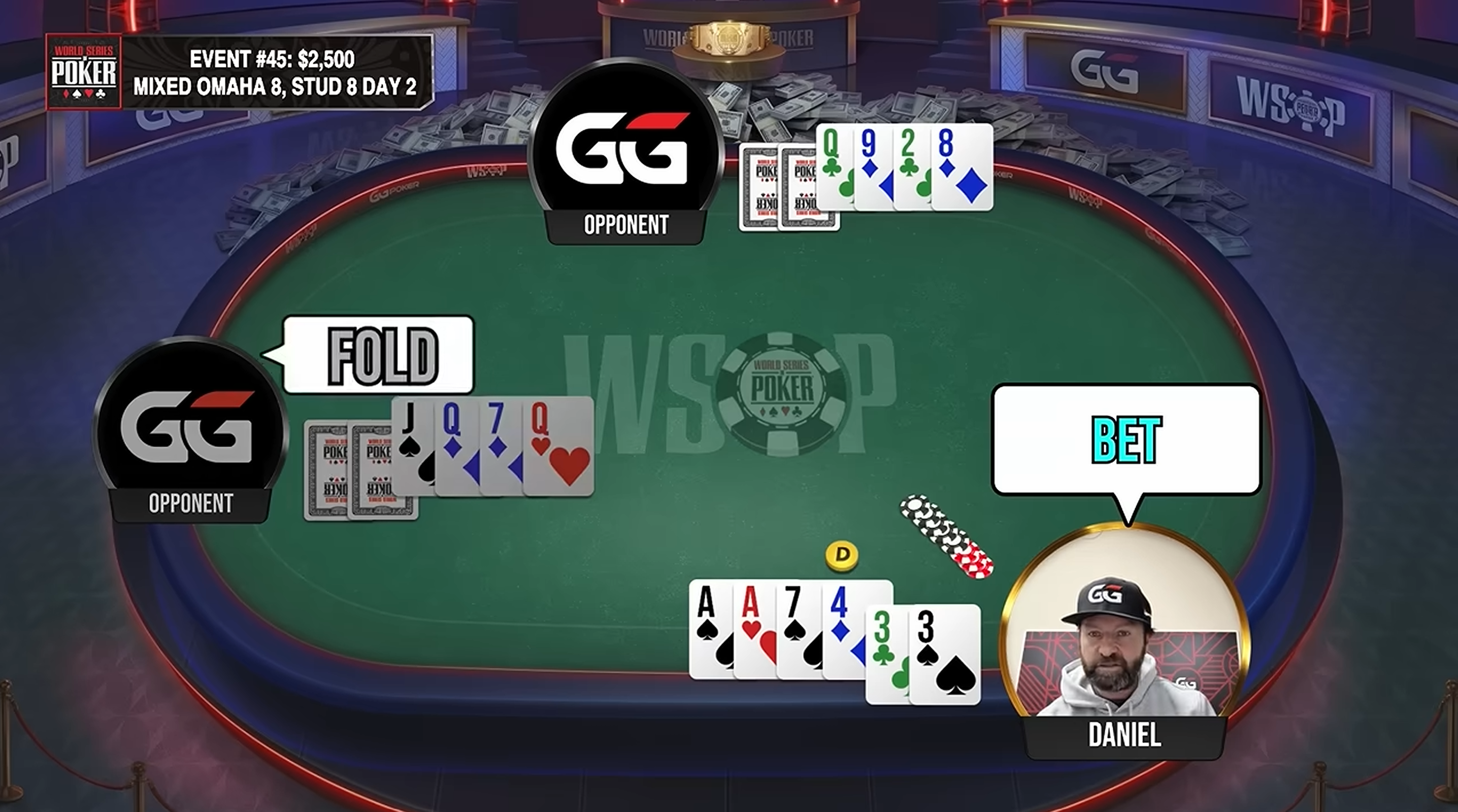
In a mixed event, Daniel showcases one of the best segments for players wanting to understand Stud 8. He breaks down a hand where he has a four up in the bring-in and two threes in the hole cards. Before him, a jack raises, a queen calls, and as boards change, Daniel catches a seven, an ace, and another ace. Suddenly, he has aces up and a low draw, while opponents hold boards suggesting various high and draw possibilities.
The critical moment comes on the river. Daniel misses a low or an improvement but catches a nine of clubs, blocking a possible flush draw. He checks despite seeing no value in betting aces up. When the opponent bets, Daniel reads the story: the opponent cannot be bluffing because Daniel could have a low. They shouldn’t value bet weaker two pairs against open aces. The low draw likely isn’t there, as previous calls didn’t fit. The flush remains. Daniel folds, and the opponent shows three clubs in the hole cards.
Despite this insight, frustration returns. After 16 levels, the tournament still feels far from the money. Daniel holds 55,000 against blinds of 10/20k, less than three bets, and admits that playing this event was one of the silliest summer decisions. The problem is structural—mid-stakes mixed events with large fields and split-pot games drag on forever. Daniel says these tournaments don’t fit his WSOP plan. They’re more for players who want to sit, play low limits, and stay in the event for days. He needs to move, find big spots, and play events with better time value.
A Bubble as Maximum Torture
The bubble in the $2,500 half and half is pure WSOP torture. Daniel is short, Jesse Lonis is even shorter. Lonis sits with just a few chips, is all-in on the big blind, flops trips sixes and a flush draw, survives another all-in in Stud 8, and suddenly returns to the game from a desperate stack. Then comes Daniel’s all-in on the bubble. He has a board with seven possibilities, opponents have low draws, and one player eventually shows a wheel. Daniel needs a miracle, but it doesn’t come. He exits 91st, with only 89 getting paid.
Daniel is frustrated after the bust, mainly because of how some hands were played in the last hour. Players, in his view, did the exact opposite of what they “should” do, creating the most significant frustration. Adding to this is the knowledge that he chose this event himself. He could be home, relaxing, watching the $250K coverage. Instead, he got himself locked into a marathon ending in a bubble.
Following the bubble knockout, he moves to the $10K Razz. In Razz, it doesn’t last long. Daniel starts with 60,000 but quickly falls to 8,000, just one bet. He describes having three wheel cards several times, but either opponents had them too, or he entirely bricked further streets. He’s not mad at himself because, by his own account, he played the hands well; they just didn’t win. He manages to bounce back from one bet briefly, but soon he bows out.
$25K PLO and the Big Question: Is Late Re-entry Worth It?
After Razz, Daniel faces a decision about the $25K PLO. The event has a buy-in and two re-entry options; it's Day 1A, and Daniel debates whether it’s worth jumping in late. If he survives Day 1A, he’ll have the next day off, which would be incredibly valuable following such an exhausting grind. On the other hand, if he registers very late and only passes with the starting stack, he might miss building a big stack on Day 1B.
Eventually, he jumps in, and the plan is clear: double the stack or, simply put, make something big happen. The first PLO bullet starts brutally, the second doesn’t get off the ground either, then comes the third and final bullet of the day. There isn’t much time left. Three hands before the night ends, Daniel sits with a stack around 400-450k. The work is done. The stack is well above starting, a day off is within reach, and it’s time to bag.
However, the day’s feeling changes with one hand. Daniel holds 8-9-10-jack on the button. Before him, a raise, calls, the small blind pots, another player repots, and suddenly a five-way all-in situation unfolds. The price is insane, the hand is beautiful, and Daniel calls. The pot is enormous. He says, had he won, he’d have around 1.8 to 2 million and likely be the chip lead. From grinding all day, he could have emerged one of the biggest stacks. Instead, the board bricks for him, and Daniel is out. Instead of a day off, it’s the all-too-common WSOP phrase: back to work tomorrow.

