

Daniel Negreanu starts another day at the WSOP unusually slowly. He lies in his room, watches videos, talks about Ken LaCourt's channel, Elephants in the Room, and enjoys a leisurely morning. He needs some time to have coffee, breakfast, rest, and let his body recover from the previous demanding days. In such a long WSOP series, rest is part of the strategy.
Of course, things don't go entirely smoothly. On his way to get coffee, he realizes he's left his room key behind and doesn’t have his ID on him. For a moment, he wonders if the front desk will even let him back into his room, but he eventually finds a spare card and the crisis is averted.
Main Event Chaos and the Shot Clock as a Necessary Evil
The main theme of the vlog comes before heading to the casino. Daniel discusses a situation from the Main Event, where massive stalling occurred during a late stage. According to him, players began exploiting time to jump the payout ladder, harming others at the remaining tables. He highlights a situation where a player nearly moved all his chips in, leaving one behind, openly indicating he intended to stall for a pay jump.
Daniel explains why this isn’t merely “innocent waiting.” If an entire table helps one player survive longer while someone else is knocked out elsewhere, they’re essentially assisting in stealing a pay jump that would otherwise belong to someone else. Players might feel like they’re doing someone a favor, but in reality, they are directly harming other tournament participants. That’s why, according to him, the WSOP had to intervene.
Interestingly, Daniel completely agrees with Shaun Deeb on this issue, even though they often disagree on other topics. Deeb argues that the shot clock is necessary at this tournament stage because it's mainly professionals who abuse the time, not recreational players. Recreational players typically don’t tank for seven minutes every street, calculate every pay jump, and use time as a weapon. Professional players do this, understanding the value of every blind, minute, and bustout at another table.
According to Daniel, the shot clock takes the advantage away from the pros. It forces them to make faster decisions, shortens the time for precise combinatorial calculations, and reduces the room for tactical stalling. While some recreational players might find time pressure uncomfortable, especially if they’re not experienced with the shot clock, he believes it’s ultimately fairer for time to stop being an unlimited resource.
Horseshoe, POY Banners, and Returning to Work
After discussing the Main Event, Daniel finally heads to the Horseshoe. Upon entering the room, he notices the Player of the Year banners and mentions it would be nice to add a third title. In the current standings, he’s in the top five, behind Josh Arieh, with Shaun Deeb possibly advancing after a deep run in the Main Event. Daniel remains part of the POY race, which is why the $3K PLO six-max matters.
The start in the $3K PLO is excellent. One of the most entertaining parts of the vlog features Allen Kessler. Daniel comments by the POY banners that historically, they mostly show a similar type of winners, just as Kessler enters the frame with his own agenda. He supports Daniel in the POY race but immediately complains that he can't see where he stands in the rankings. He’s close to the top 100 and lacks a system to look up his name and check his points.
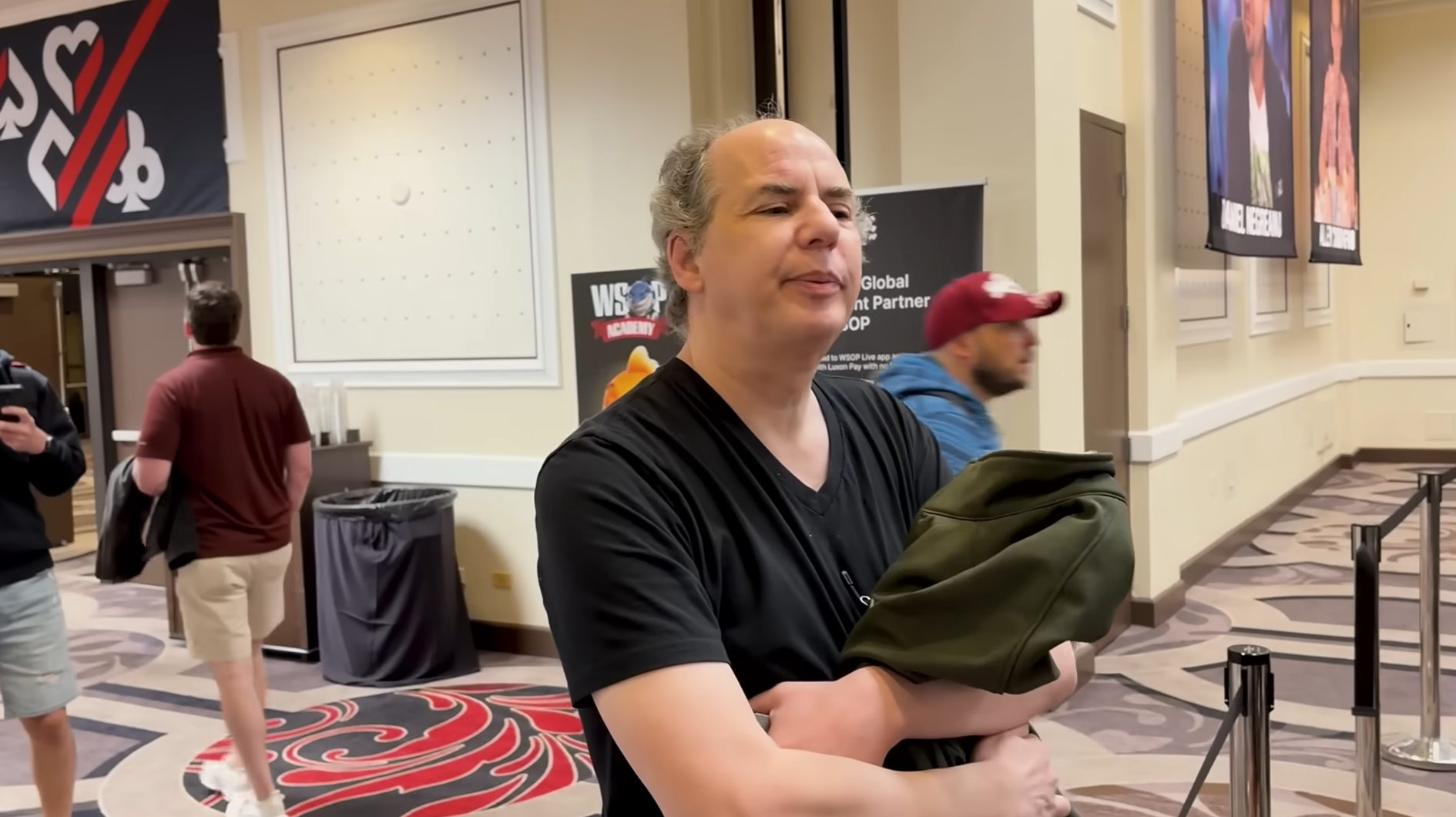
Daniel surprisingly agrees with him. He says expanding the leaderboard to 1,000 players is one of the things that needs fixing. Kessler suggests a name search feature and Daniel agrees again.
A Different PLO Than in High Rollers
After more levels, Daniel is around 98,000 and feels slightly frustrated. He dropped from 140,000, lost several times with aces, and some hands were quite strange according to him. He clearly explains the difference between $3K PLO and High Roller PLO events. In high rollers, he plays against opponents where high-end bluffing, leveling, and complex lines work more. In the $3K field, it’s often more important to get players into bad calls, take small pots on the flop, and exploit situations where they pay off too easily.
For analysis, Daniel picks a hand with A-A-2-3, which he opened UTG. The button calls and the flop K-8-9 with two diamonds isn’t good for him. He has no diamonds, few backup options, and the board fits the button’s calling hands well. He checks, the opponent bets 6,000, and Daniel calls. A turn jack means he’s done with the hand if the opponent bets. A Queen-ten straight is too real, and his aces no longer have value he wants to defend.
The opponent checks back, though. On the river seven, Daniel asks a key question: will my aces ever win in a showdown? He thinks not. He’s sure the opponent practically never has Q-T, as he would never check it on the turn. Therefore, he decides: pot bet. If the opponent holds a ten, a small bet might be paid thinking they split. A strong bet pressures even weaker straight combinations and certainly drives out two-pair hands. The opponent considers and folds.
Main Event Pain and His Own PLO Progression
While playing his own tournament, Daniel watches the Main Event on the screen. He sees a player who was just deeply competing in the Main and now sits next to him, drinking a beer and processing a bust around the 24th place. Daniel tells him he understands the pain. Busting on Day 7 of the Main Event hurts much more than exiting on Day 1. This small scene captures why the Main Event holds a different weight than anything else.
Daniel’s own day continues in the $3K PLO. At the end, he finishes Day 1 with a stack of 111,000, with the average around 220,000, and a few more eliminations left before the money. He admits he could have gone all-in on the last hand because he didn’t want to return with a smaller stack, but ultimately makes the right decision and doesn’t self-destruct. The end of the day is thus a strange mix. It’s not a massive stack or a big title run, but it’s progress.