

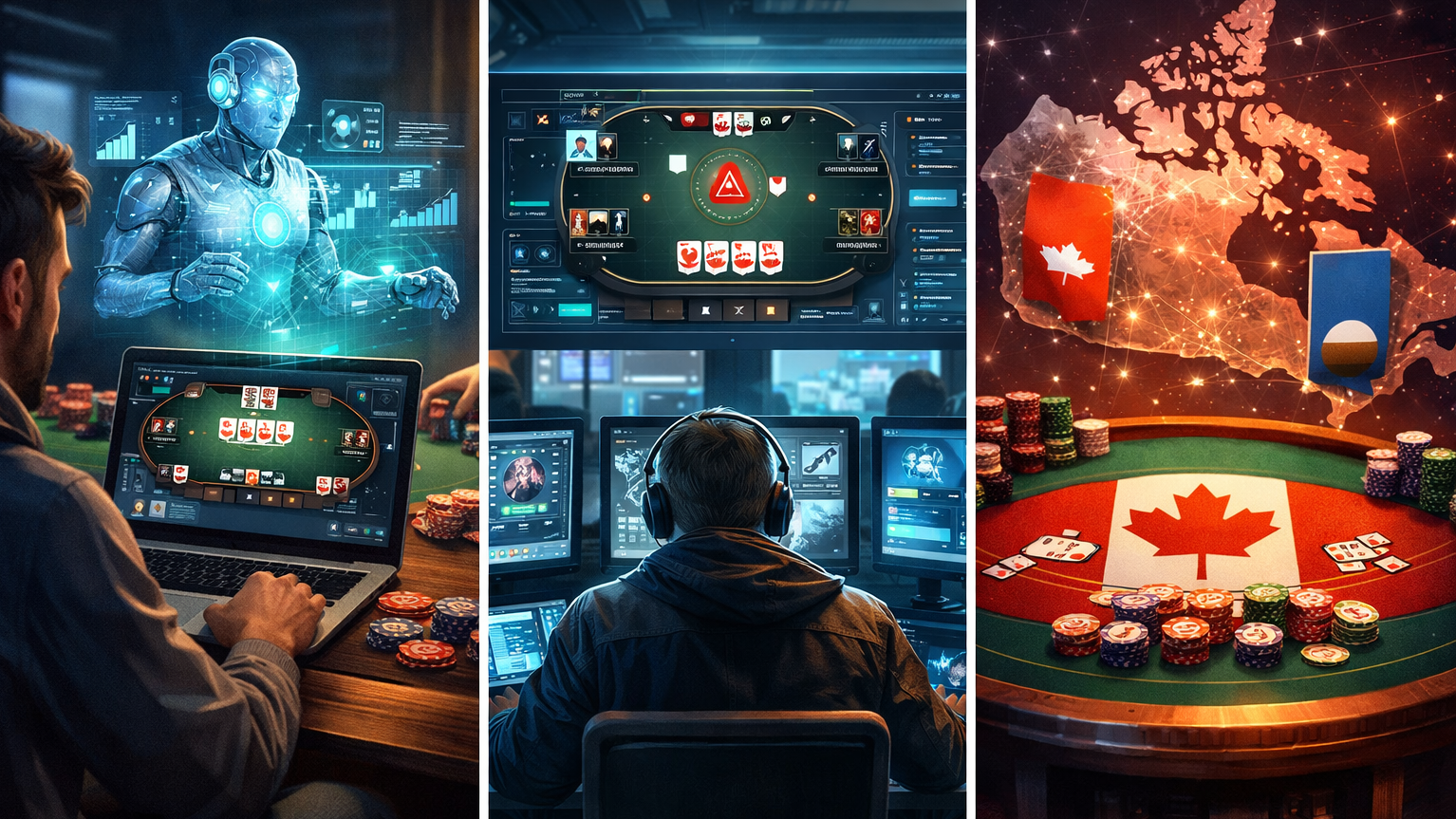
Or that same software might be working for you, baked into the platform itself, running quietly behind each hand you play. The line between a fair tool and an unfair advantage is thin, and provincial regulators are still figuring out where to draw it. Meanwhile, operators are embedding AI directly into their platforms and marketing it as a feature, not a bug. Players on both sides of the screen, the ones clicking buttons and the ones writing the code behind those buttons, are adjusting to a game that looks the same on the surface but functions very differently underneath.
Where Canadian Players Actually Sit Down at the Table
Ontario closed 2025 with 48 licensed iGaming operators, and peer-to-peer poker handle hit $141 million with $5.8 million in revenue for December alone. Alberta is preparing to open its own regulated market in early 2026 after publishing amendments tied to Bill 48. Players who want to play online Poker in Canada through licensed operators now have provincial frameworks that govern how AI tools like GGPoker's Smart HUD can and cannot be used during sessions.
That 1.4% market share for P2P poker in Ontario explains why the shared liquidity ruling matters so much for the game's long-term viability across provinces.
What the Platforms Are Actually Doing With AI
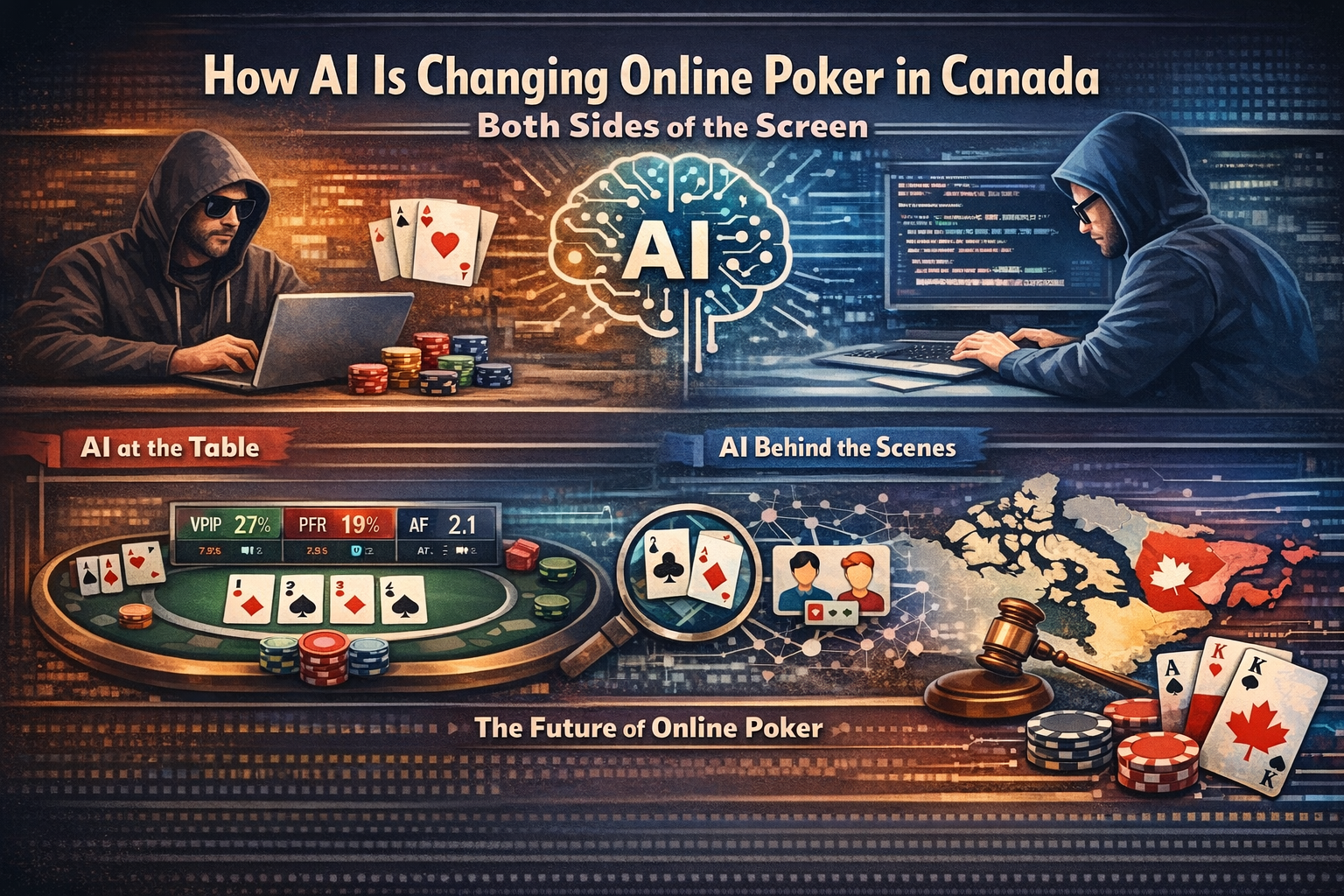
GGPoker's Smart HUD is a good example of how operators have started to integrate AI on the player-facing side. The tool provides real-time statistics on a player's own tendencies and those of their opponents during a session. It tracks things like preflop raise frequency, aggression on later streets, and fold-to-bet ratios. The key detail is that this HUD is available to every player at the table equally. Third-party poker tracking software is banned during play on the platform, which means the information advantage is standardized rather than purchased separately.
This approach tries to solve an old problem. For years, experienced players ran third-party tools like hand trackers and solvers alongside their sessions, giving them a large statistical edge over recreational players who did not know those tools existed. By building analytics into the platform and restricting outside software, the operator controls the floor.
On the backend, AI handles fraud detection, collusion monitoring, and bot identification. Platforms scan for patterns that suggest 2 accounts are being played by the same person or that a group of players is sharing hole card information. These systems run constantly and require minimal human oversight after initial training.
The Shared Liquidity Question and Why It Connects to AI
Ontario's Court of Appeal confirmed in November 2025 that the province can legally allow its players to compete with international participants in peer-to-peer games, provided Ontario retains full control over the gaming operation. 3 Canadian lottery corporations have since appealed that ruling to the Supreme Court of Canada, so the matter is on hold for now.
Shared liquidity is a volume problem. With $141 million in peer-to-peer poker handle and $5.8 million in revenue for December 2025, poker accounts for roughly 1.4% of Ontario's total iGaming activity. Ontario's licensed operators collectively handled almost $100 billion in wagering activity and generated over $4 billion in non-adjusted gross gaming revenue through the year. Poker needs larger player pools to sustain game variety at different stakes, and AI tools become more effective with more data flowing through them. Fraud detection improves when the sample size grows. Player behavior models become more accurate. The stakes for getting AI governance right increase proportionally with the number of players in the pool.
How AI Affects the Player at the Table
A recreational player logging in after work encounters AI in ways that are mostly invisible. The platform's matchmaking system may group players by skill rating, using AI to keep games competitive. The Smart HUD on GGPoker surfaces stats that the player would otherwise need to track manually or pay for through banned third-party software.
For serious grinders, the picture is more complicated. Solvers trained on game theory optimal play have been available for years as study tools used away from the table. Players use these programs between sessions to review hands and identify leaks in their strategy. The line gets blurry when a player memorizes solver outputs so thoroughly that their in-game decisions become indistinguishable from an AI's recommendations. No platform can regulate what a player has studied offline.
Some players have raised concerns that AI coaching tools are creating a ceiling effect, where mid-stakes games become populated almost entirely by solver-trained regulars and the games lose their profitability for everyone involved.
Alberta Enters the Picture
In January 2026, Alberta published regulatory amendments building on Bill 48, which established the Alberta iGaming Corporation and designated the AGLC as the market regulator. Multiple licensed platforms are expected when the market opens in the first quarter of 2026. How Alberta chooses to regulate AI-assisted tools on poker platforms will determine whether the province aligns with Ontario's approach or takes a different path.
A second regulated province adds complexity to the shared liquidity conversation. If Ontario and Alberta eventually allow cross-provincial player pools, the AI governance frameworks will need to be compatible. Different rules about what tools are allowed during play would create an uneven playing field between provinces.
What Comes Next
The Supreme Court appeal on shared liquidity will set the terms for how Canadian online poker grows or stalls. AI tools on platforms will continue to get more sophisticated, and the tension between giving players useful information and preserving the skill gap that makes poker interesting will persist. Provincial regulators are the ones writing the rules, and they are doing so while the technology moves faster than policy tends to. Players and operators are both adjusting to a game where the cards are the same but the information environment around each hand is different from what it was 5 years ago. The question is not if AI will be part of every poker session in Canada, but how much of it players will actually see and how much will run silently underneath.

