


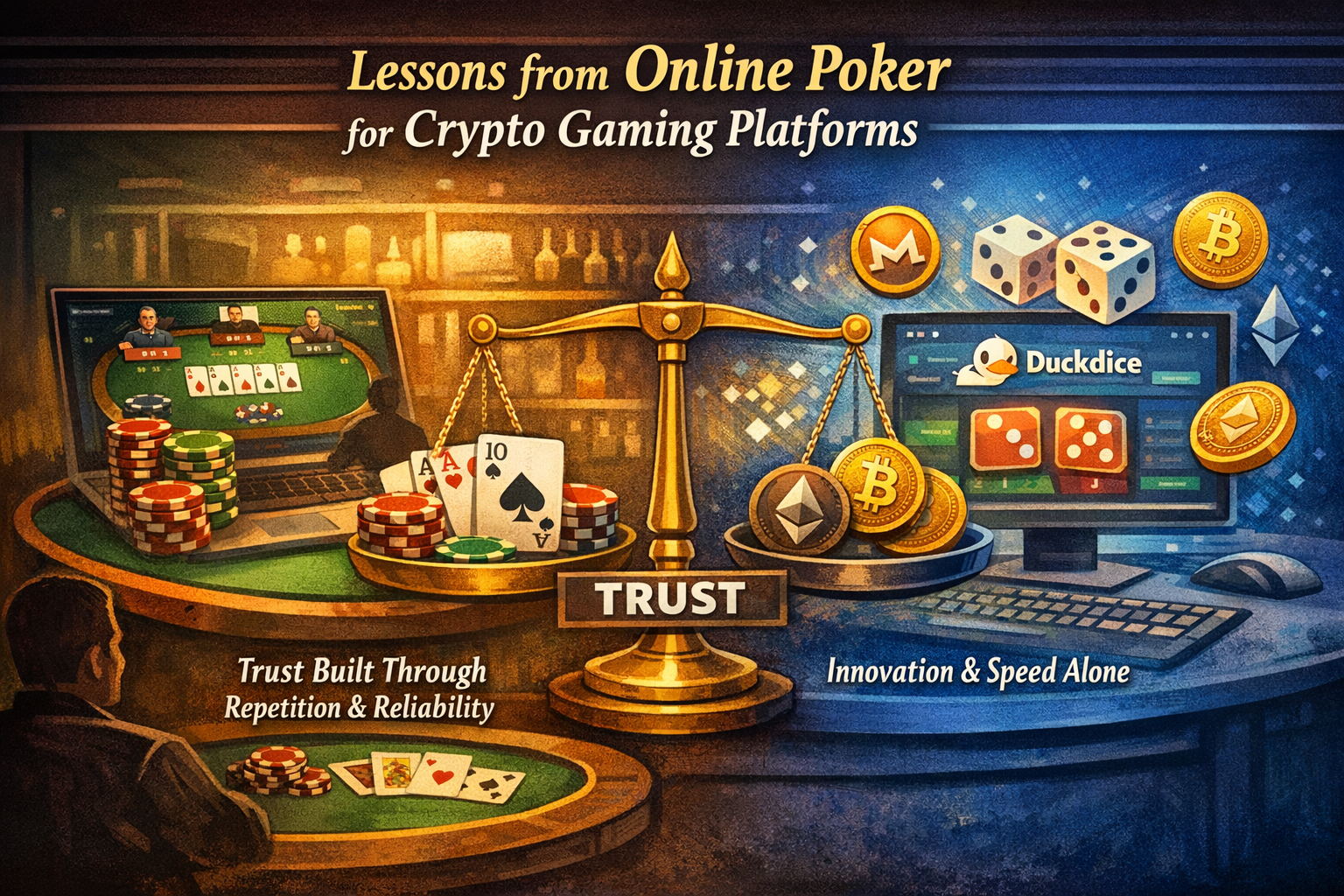
They stay when the environment feels dependable over time. That is why a Duckdice monero casino model is more interesting as a trust question than as a technology story. Privacy, faster wallet movement, and crypto-native access can attract attention, but poker culture has always judged platforms by something deeper: whether the experience remains fair, readable, and reliable after repeated use.
That perspective matters because crypto-native gaming often presents innovation as if it were enough on its own. It highlights speed, privacy, and technical transparency, all of which can be valuable. But poker has spent years teaching players to look past feature language and ask harder questions. Can the system be trusted when real money moves through it regularly? Does the platform behave consistently? Does it still feel credible after the early excitement wears off? Those are the questions that define long-term trust.
Why Online Poker Developed a Sharper Sense of Trust
Poker built a stricter trust culture than many other forms of online gambling because the relationship between player and platform is more continuous. A casual slot player may arrive, spin, and leave without ever developing a deeper connection with the product. Poker tends to work differently. It is shaped by repeated sessions, decision-making under pressure, bankroll awareness, and a much stronger sensitivity to fairness and room conditions.
That creates a more demanding audience. Poker players notice the details that weaker platforms hope users will overlook. They pay attention to software stability, payout reliability, player traffic quality, and the overall feeling that the room operates on clear rules. They are not just looking for entertainment. Furthermore, they are evaluating whether the environment makes sense as a place to return to.
Because of that, trust in poker never became a soft branding concept. It became part of the product itself. A room either proves itself over time or it does not.
Why Innovation Alone Rarely Creates Loyalty
Many crypto-native gaming platforms understand one part of modern user behavior very well. People value speed. They value convenience. They appreciate payment systems that feel direct and fluid. Those things matter, especially in a digital environment where friction is judged harshly. But speed and convenience do not automatically create loyalty.
This is where poker culture offers a useful correction. A fast product can still feel unstable. A private payment rail can still leave players uncertain about the broader environment. Even provable fairness can feel distant if the overall platform lacks consistency. Users may appreciate the technical advantages while still hesitating to trust the product in a deeper way.
That is why poker players tend to separate surface efficiency from actual credibility. The first may attract them. The second is what keeps them in the ecosystem. Crypto-native platforms that fail to understand this often confuse initial interest with durable trust.
Reputation Is Built Through Repetition, Not Claims
One of the strongest lessons from online poker is that trust grows through repeated confirmation. Players come back after a smooth withdrawal. They notice when the software holds up well across sessions. They remember whether the room feels stable during ordinary use, not just during promotional moments. This is how reputation becomes meaningful.
That process is important because trust in gambling is rarely based on one dramatic proof point. It is cumulative. A platform earns credibility by behaving well over time. Small signals matter more than they seem. If cashouts arrive as expected, if rules feel stable, if the user experience remains clear, the product begins to feel reliable in a practical way.
Several factors usually shape that perception most clearly
- Consistent payout behavior across repeated use.
- Software that feels stable rather than unpredictable.
- Fairness systems that users can understand or verify.
- An overall environment that reduces doubt instead of creating it.
That is why poker culture remains such a strong reference point. It does not reward claims as much as it rewards evidence that accumulates through use.
Why Privacy and Fairness Need a Larger Framework
Crypto-native gaming platforms often emphasize privacy and fairness as their defining strengths. Those are important strengths. Privacy can matter deeply to certain users. Verifiable fairness can make a product feel more transparent than older systems. But poker culture suggests that neither of these features works fully on its own.
This is where poker has always been more grounded than many newer gaming models. It understands that trust is built in context. A technical mechanism matters more when the surrounding experience supports it. A privacy feature matters more when the user also feels confident about payouts, platform behavior, and long-term consistency.
What Crypto Native Gaming Should Learn Next
The next stage of crypto-native gaming will likely depend less on novelty and more on product maturity. Users have already seen enough innovation language to stop being impressed by speed alone. What matters now is whether platforms can turn technical advantages into a dependable experience that feels stable enough to trust regularly.
Poker culture has a lot to teach here. It shows that trust is not created by excitement, even when excitement helps attract attention at the start. It is created by rhythm, reliability, and a sense that the platform continues to make sense after the first few sessions. That is a much more demanding standard, but it is also a more durable one.
Crypto-native gaming already has tools that can support this shift. Faster payments, better privacy, and stronger transparency can all help. But those strengths only become meaningful when they are part of a product that feels solid from end to end. Technology may bring the audience in. Trust is what gives them a reason to stay.

