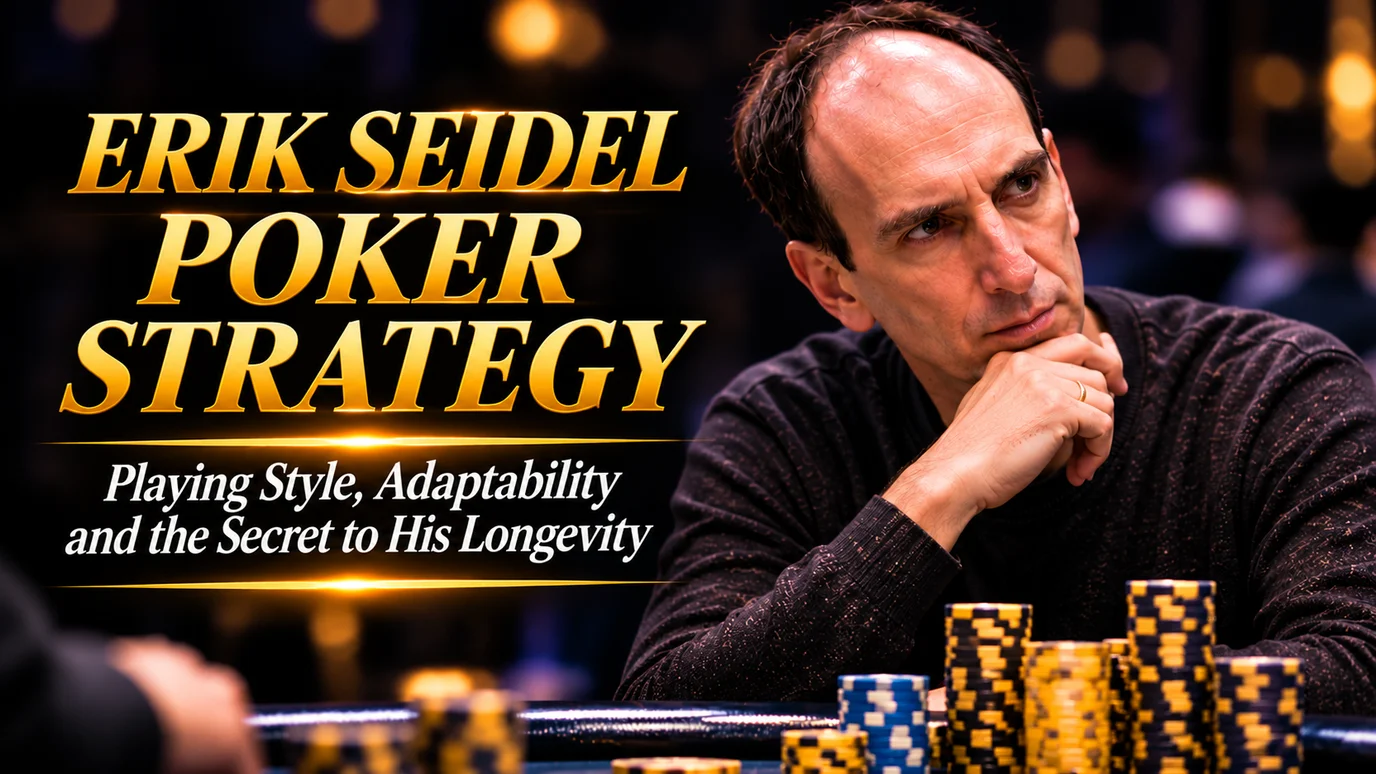
Erik Seidel has been winning major poker tournaments since the late 1980s. He competed against Johnny Chan and the legends of old-school Las Vegas, survived the online poker revolution, adapted to the rise of GTO solvers and continued defeating elite high rollers well into his sixties.
Few players have remained competitive through so many different eras of poker. Even fewer have managed to do it without becoming famous for aggressive table talk, elaborate psychological performances or a larger-than-life personality.
Seidel's approach is almost the opposite. He is quiet, observant, patient and willing to reconsider what he knows about the game.
With 10 WSOP bracelets, a place in the Poker Hall of Fame and nearly four decades of major tournament results, his career raises a fascinating question: what makes Erik Seidel's poker strategy so effective, and how has he managed to stay relevant for so long?
What Is Erik Seidel's Poker Playing Style?
Erik Seidel is generally associated with a thoughtful, controlled and adaptable approach to poker. Unlike players who build their reputation around constant aggression or dramatic confrontations, Seidel rarely makes himself the center of attention at the table.
His style is better understood through the decisions he makes than the reactions he displays.
He observes opponents, considers how their ranges interact with the board and adjusts his strategy to the situation. Rather than following a single recognizable pattern, he has demonstrated an ability to compete across different poker formats, tournament structures and generations of opponents.
That does not mean Seidel is simply a tight or passive player. His results in high roller tournaments would be difficult to achieve without recognizing profitable opportunities for aggression.
The important distinction is that his aggression tends to serve a strategic purpose rather than becoming a performance.
Seidel's public reputation can be summarized through several recurring characteristics:
- Patience: avoiding unnecessary commitments when the expected reward does not justify the risk.
- Observation: paying attention to opponents' actions and tendencies.
- Adaptability: changing strategies when tournament conditions or opponents change.
- Emotional control: maintaining a composed table presence through winning and losing sessions.
- Versatility: competing successfully in several poker variants.
- Continuous learning: remaining interested in how newer generations approach the game.
These are not secret techniques exclusive to Seidel. Their importance lies in how consistently his career has demonstrated their value.
From Backgammon to Poker: The Foundations of Seidel's Strategy
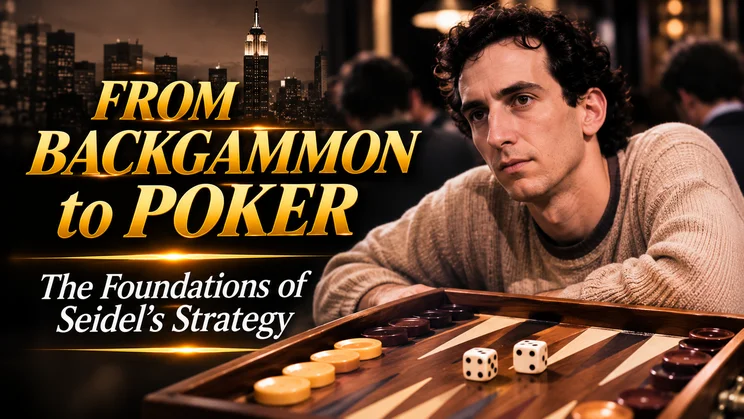
Seidel was born on November 6, 1959, in New York City. Before becoming a professional poker player, he competed seriously in backgammon and later worked in financial trading.
Both activities provided useful preparation for a career built around decisions under uncertainty.
Backgammon teaches players to evaluate probabilities, manage changing positions and understand that a correct decision can still produce an unfavorable result.
Financial trading introduces similar challenges. Risk must be evaluated before the outcome is known, and a profitable long-term process can include individual losses.
Poker combines these principles with another complication: players must make decisions without knowing their opponents' cards.
Seidel developed his poker skills in New York's Mayfair Club, an environment associated with players such as Dan Harrington and Howard Lederer.
Unlike today's aspiring professionals, he did not have access to modern GTO solvers, enormous online hand databases or sophisticated training platforms.
His development relied heavily on practical experience, mathematical reasoning, observation and discussion with other serious players.
Those foundations would remain valuable even as poker technology changed dramatically.
Seidel's calm approach has helped define a career spanning several generations of poker. Explore his complete background in our ultimate Erik Seidel career guide.
Why Erik Seidel's Calm Table Presence Matters
One of Seidel's most recognizable characteristics is his composure.
While some professionals use conversation, intimidation or visible emotion to influence opponents, Seidel generally maintains a quiet presence.
This can have practical advantages.
Emotional reactions sometimes reveal information. Frustration after losing a pot, excessive excitement after winning or sudden changes in behavior can give observant opponents additional clues.
A player who maintains relatively consistent behavior may reveal less through those reactions.
However, it would be misleading to suggest that a calm appearance automatically makes someone difficult to exploit. Betting patterns, timing, bet sizing and strategic decisions remain more important than facial expressions alone.
Seidel's composure is valuable because it supports disciplined decision-making.
He can lose a substantial pot without needing to immediately recover the chips through an unnecessarily aggressive play.
Likewise, a major tournament victory does not require him to abandon the habits that helped him achieve it.
In a game where emotional decisions can be extremely expensive, consistency matters.
Erik Seidel and the Art of Reading Opponents
Before poker solvers became widespread, much of high-level poker strategy revolved around understanding how specific opponents approached the game.
Players studied betting patterns, table dynamics, psychological tendencies and the differences between cautious and aggressive opponents.
Seidel developed during that era, when direct observation was an essential source of information.
Reading opponents does not mean possessing a supernatural ability to identify their exact cards.
It means building a reasonable picture of the hands they might hold and how they are likely to play those hands.
Consider a hypothetical tournament situation.
A cautious opponent raises from early position, continues betting on a coordinated flop and then makes a substantial river bet.
Against that particular opponent, a medium-strength hand may have significantly less value than it would against someone who regularly bluffs.
A strong player adjusts the decision to the opponent rather than treating every river bet identically.
The reverse can also be true. Against an opponent who bluffs too frequently, folding every marginal bluff-catcher becomes exploitable.
Seidel's reputation for observation and adaptability fits this broader principle: the correct decision depends not only on your cards but also on the opponent and the situation.
How Erik Seidel Adapted to the Online Poker Revolution
The poker world Seidel entered in the 1980s was fundamentally different from the one that emerged during the online boom of the 2000s.
Earlier generations learned primarily through live games, books, discussion and accumulated experience.
Online poker changed the speed of learning.
Young professionals could play enormous numbers of hands, review detailed statistics, analyze opponents through tracking software and test strategic ideas far more quickly than most live players could.
As online poker expanded, tournament fields became larger and increasingly competitive.
Seidel was already an established champion when this transformation began.
He had won multiple WSOP bracelets and built a reputation as one of the game's leading tournament professionals.
But previous success offered no guarantee that his methods would remain effective.
Players who relied exclusively on familiar strategies risked being overtaken by opponents with stronger technical preparation.
Seidel continued competing and winning through this period.
His 2005 No-Limit Hold'em bracelet, 2007 No-Limit 2-7 Lowball Draw title and 2008 WPT Foxwoods Poker Classic victory demonstrated that his success had extended well beyond poker's pre-internet era.
His longevity is therefore not simply evidence that traditional poker knowledge remained useful. It also illustrates the importance of recognizing when the competitive environment has changed.
Erik Seidel vs GTO: Can Old-School Poker Beat Modern Solvers?
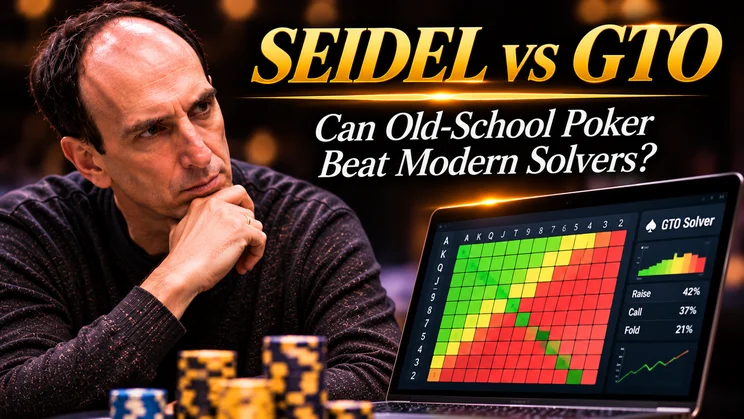
Game Theory Optimal poker, commonly called GTO, has become one of the defining concepts of modern strategy.
Solvers analyze poker situations using mathematical models and identify strategies that are difficult for opponents to exploit under the assumptions of those models.
Modern professionals use these tools to study preflop ranges, betting frequencies, bluffing combinations, defense strategies and complex postflop situations.
Seidel developed his skills decades before such technology became widely available.
Yet his continued success against solver-trained professionals shows that the relationship between traditional poker knowledge and modern theory is more complicated than a simple competition between old and new.
GTO provides a powerful strategic foundation. Exploitative poker attempts to gain additional value by identifying where an opponent deviates from strong theoretical play.
These approaches are not mutually exclusive.
A player can understand sound theoretical principles while adjusting to opponents who make predictable mistakes.
There is also an important distinction between knowing that a solver recommends a particular action and understanding why the action makes sense.
Memorizing a strategy without recognizing the assumptions behind it can create problems when real opponents behave differently from the model.
Seidel's career illustrates the enduring value of judgment, observation and strategic flexibility.
That should not be interpreted as proof that he rejects GTO or that traditional intuition is superior to solver-based study. His complete private study routine is not publicly documented.
What is clear is that he has remained willing to learn from younger players and the changes they have brought to the game.
What Erik Seidel Has Said About Learning From Younger Players
In an April 2024 interview with PokerOrg during the WPT Seminole Hard Rock Poker Showdown, Seidel discussed the influence of younger professionals on modern poker.
He acknowledged that newer generations had transformed how the game is played and described his own efforts to understand their methods.
That attitude is particularly revealing.
Seidel had already been inducted into the Poker Hall of Fame in 2010 and had collected his tenth WSOP bracelet in 2023.
He had little left to prove in terms of historical achievements.
Nevertheless, he continued approaching poker as a game in which he could learn something new.
His 2023 WSOP Paradise victory offered another glimpse of that mindset. Following the tournament, he spoke about working hard, discussing the game with other players and maintaining his enthusiasm for competition.
The underlying lesson is that experience becomes more valuable when it remains open to revision.
Having played poker for decades can provide an enormous advantage in recognizing patterns. But that advantage can disappear if a player assumes that every familiar pattern will continue working forever.
Why Mixed Games Made Erik Seidel a More Complete Player
Seidel's WSOP achievements are not limited to No-Limit Texas Hold'em.
His bracelet collection includes titles in Limit Hold'em, Omaha Hi-Lo, Pot-Limit Omaha and No-Limit 2-7 Lowball Draw.
These games reward different combinations of strategic skills.
Limit Hold'em requires precise decisions within a fixed betting structure. Pot-Limit Omaha introduces complex equity relationships and the possibility of powerful drawing hands. Omaha Hi-Lo demands an understanding of split-pot situations. Deuce-to-Seven Draw presents different hand rankings and drawing decisions.
Success across these formats suggests a broad understanding of poker fundamentals rather than dependence on one narrow strategy.
Poker VariantSeidel's WSOP Bracelet YearsKey Strategic Challenge
| Limit Hold'em | 1992, 1994 | Value betting, ranges and fixed-limit decisions |
| Omaha Hi-Lo | 1993 | Split-pot equity and qualifying low hands |
| No-Limit 2-7 Lowball Draw | 1998, 2007 | Drawing decisions and hand-range construction |
| No-Limit Hold'em | 2001, 2005, 2021, 2023 | Stack leverage, bet sizing and tournament pressure |
| Pot-Limit Omaha | 2003 | Equity distribution and coordinated boards |
Mixed-game experience can also encourage a player to think more carefully about the underlying logic of poker.
Instead of relying on familiar No-Limit Hold'em situations, players must repeatedly reconsider how hand strength, position, betting structures and probabilities interact.
Seidel's results demonstrate that his strategic abilities were transferable across multiple formats.
The High Roller Era: Seidel Against the World's Toughest Players
Perhaps the strongest evidence of Seidel's adaptability came during the expansion of high roller and super high roller tournaments.
These events regularly attract experienced professionals, wealthy recreational competitors and players with extensive technical preparation.
The buy-ins can reach 25 000$, 50 000$, 100 000$ or considerably more.
Seidel became one of the most successful players in this environment despite having established his career long before the modern high roller circuit existed.
His results include a remarkable series of major scores.
YearTournamentResultPrize
| 2011 | Aussie Millions 250 000 A$ Super High Roller | 1st | 2 472 555$ |
| 2015 | EPT Monte Carlo 100 000€ Super High Roller | 1st | 2 222 222$ |
| 2016 | Super High Roller Bowl 300 000$ | 3rd | 2 400 000$ |
| 2021 | WSOP Online Super MILLION$ | 1st | 977 842$ |
| 2023 | WSOP Paradise 50 000$ Super High Roller | 1st | 1 704 400$ |
The 2011 Aussie Millions victory remains particularly significant because it represented one of the largest tournament prizes of Seidel's career.
His 2015 EPT Monte Carlo win and 2016 Super High Roller Bowl podium finish reinforced his ability to compete in exceptionally expensive tournaments.
Winning an individual high roller event always involves variance. Even an outstanding player needs favorable cards and successful all-in situations.
But repeated deep runs and victories across many years provide stronger evidence of sustained competitiveness than any single trophy.
His ability to adapt became especially visible during Seidel's extraordinary 2011 tournament season, when he dominated several of poker's most prestigious high roller events.

How Tournament Strategy Changed During Seidel's Career
Seidel's career spans several important changes in tournament poker.
Early WSOP events often featured smaller fields and a different mix of professional and recreational players.
Modern tournaments can involve much larger fields, more standardized structures, advanced technical preparation and sophisticated short-stack strategies.
Three changes are especially important.
1. More Advanced Preflop Strategy
Modern players have access to detailed preflop charts covering different stack depths, positions and tournament situations.
Understanding when to raise, call, fold or move all-in has become increasingly precise.
Players who ignore these developments can surrender significant expected value before the flop.
2. Greater Understanding of ICM
The Independent Chip Model, or ICM, helps explain how tournament chips translate into prize equity.
Near a final table or major pay jump, winning additional chips does not necessarily compensate for the financial risk of elimination.
Modern high roller specialists devote considerable attention to these situations.
3. More Sophisticated Postflop Play
Bet sizing, range advantages, blocker effects and mixed strategies have become central elements of modern poker analysis.
Many decisions that once depended largely on experience can now be studied through detailed simulations.
For a veteran player, the challenge is not simply learning new terminology. It is understanding which ideas meaningfully improve decisions at the table.
Does Erik Seidel Bluff Often?
Seidel's calm personality can create the impression that he plays an unusually conservative style.
But personality and bluffing frequency are not the same thing.
Successful tournament players must bluff in appropriate situations, particularly when their ranges contain hands that cannot profitably win at showdown.
A player who never bluffs becomes predictable. Opponents can fold weaker hands whenever that player makes a large bet.
At the same time, bluffing too frequently against opponents who refuse to fold can be expensive.
Seidel's reputation is better described as selective and situation-dependent than as permanently tight or aggressive.
There is no reliable public database that establishes one definitive bluffing percentage for his entire career across all poker formats.
His long-term results support the conclusion that he has successfully navigated changing strategic environments, not that every aggressive decision he makes follows one fixed formula.
Erik Seidel's Mental Game: Handling Variance and Pressure
Poker creates a difficult psychological environment because the relationship between decisions and results is imperfect.
A player can make the correct decision and lose a large pot. Another player can make a mistake and win.
Over a short period, variance can overwhelm differences in skill.
This becomes particularly challenging in high roller tournaments, where a single elimination can represent a substantial financial loss.
Seidel's background in competitive games and financial trading provides a useful context for understanding his approach to uncertainty.
His composed public demeanor also reflects a quality that strong poker players generally seek: the ability to make the next decision without becoming excessively influenced by the previous result.
That does not mean Seidel never experiences frustration or disappointment. A player's visible behavior cannot reveal everything about their internal emotional state.
Nevertheless, his ability to remain competitive across decades suggests a durable relationship with the game's inevitable fluctuations.
His career offers a useful reminder that poker success is not simply about winning individual hands.
It is about making decisions that remain profitable over a much longer period.
His continued success is reflected in a bracelet collection spanning more than three decades. Explore the ten WSOP titles that define Erik Seidel's legacy.
The 2021 Online Bracelet: Proof That Seidel Could Still Adapt
One of the most revealing results of Seidel's later career came in August 2021.
Fourteen years had passed since his eighth WSOP bracelet in 2007.
At the age of 61, Seidel won the 10 000$ Super MILLION$ High Roller during WSOP Online on GGPoker, collecting 977 842$.
He defeated Francisco Benitez heads-up to secure his ninth bracelet.
The significance extended beyond the prize money.
Seidel had built his original reputation in live poker rooms during the 1980s and 1990s.
Now he was winning a major online tournament against a field shaped by modern technical study.
Online poker involves different practical demands from live play. Physical tells are unavailable, the pace of decisions is often faster and players frequently rely more heavily on betting patterns and statistical reasoning.
His victory did not prove that old-school intuition could replace modern preparation.
It demonstrated that a player whose career began in an entirely different environment could still compete successfully in a modern online championship.
The 2023 Tenth Bracelet: Longevity at the Highest Level
Seidel's tenth WSOP bracelet arrived in December 2023 at WSOP Paradise in the Bahamas.
He won the 50 000$ Super High Roller No-Limit Hold'em event, defeating Seth Gottlieb heads-up and earning 1 704 400$.
The tournament attracted 137 entries.
Seidel was 64 years old.
His first bracelet had come in 1992, more than three decades earlier.
By winning again in 2023, he demonstrated an exceptional span of success in a game that had undergone major strategic and technological changes.
The victory also placed him among the select group of players with at least ten WSOP bracelets.
For Seidel, the achievement represented another stage of an ongoing career rather than a ceremonial farewell to competitive poker.
In interviews following the victory, he emphasized his continued enthusiasm for playing and learning.
That motivation may be one of the most important factors behind his longevity.
What Amateur Players Can Learn From Erik Seidel
Most poker players will never compete in a 100 000$ high roller tournament. Nevertheless, several principles illustrated by Seidel's career are relevant at almost every level of the game.
1. Focus on Decisions Rather Than Individual Results
Winning a hand does not automatically mean it was played correctly. Losing does not automatically mean the decision was wrong.
Review the reasoning behind important decisions rather than judging them exclusively by the outcome.
2. Study Your Opponents
Pay attention to how opponents react to different bet sizes, stack depths and tournament situations.
Look for recurring patterns rather than trying to guess exact cards from isolated physical tells.
3. Understand the Mathematics
Pot odds, equity, expected value and tournament risk are essential foundations.
Intuition becomes more useful when it is supported by a sound understanding of probabilities.
4. Avoid Playing on Autopilot
A strategy that works against one opponent may be ineffective against another.
Think about the actual situation rather than repeating a familiar action simply because it worked previously.
5. Keep Learning
Modern poker offers enormous opportunities for study through hand reviews, training software, coaching and discussions with other players.
Seidel's career demonstrates the importance of remaining curious even after achieving significant success.
6. Develop Emotional Discipline
Bad beats, coolers and losing streaks are unavoidable.
The objective is not to eliminate disappointment but to prevent emotional reactions from controlling future decisions.
7. Respect the Competition
New players can introduce valuable ideas regardless of their age or experience.
Assuming that previous achievements guarantee a permanent advantage is dangerous in a constantly evolving game.
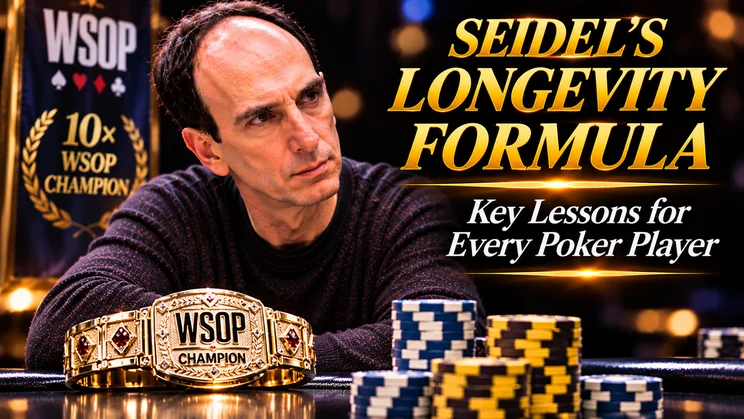
Why Erik Seidel's Longevity Is So Unusual
Seidel's career is remarkable not merely because he has played poker for nearly four decades, but because he has achieved major results throughout that period.
He reached the WSOP Main Event heads-up stage in 1988, won his first bracelet in 1992, became a WPT champion in 2008, dominated major high roller events during the 2010s and added WSOP titles in 2021 and 2023.
His competitive career has overlapped with multiple generations of influential players, from Johnny Chan and Doyle Brunson to today's solver-trained tournament specialists.
That creates a rare perspective on the development of modern poker.
He has experienced the transition from small live tournament fields to global online competitions and expensive international high roller circuits.
He has also witnessed the emergence of technologies that fundamentally changed how professionals prepare for tournaments.
Rather than becoming exclusively associated with one period, Seidel has remained part of the competitive conversation.
His example challenges the assumption that poker success necessarily belongs to the youngest or most technologically sophisticated players.
Technical knowledge is essential, but so are discipline, experience, adaptability and the willingness to continue improving.
Seidel's strategic development began long before his first WSOP bracelet. His early competitive experiences eventually led to the historic 1988 WSOP confrontation with Johnny Chan.
Erik Seidel Poker Strategy FAQ
What is Erik Seidel's poker playing style?
Seidel is known for a calm, observant and adaptable approach. He combines strategic discipline with the ability to adjust to opponents and changing tournament conditions.
Is Erik Seidel an aggressive poker player?
Seidel is not generally associated with constant, highly visible aggression. However, he is capable of aggressive play when the situation demands it. His public reputation is better characterized by selective aggression and adaptability.
Does Erik Seidel use GTO strategy?
Seidel has publicly discussed learning from younger generations who transformed modern poker strategy. However, the exact extent of his personal solver use and private GTO study routine is not publicly established.
Why is Erik Seidel so successful at poker?
His sustained success is associated with strong decision-making, experience across multiple poker formats, emotional composure, strategic flexibility and a willingness to keep learning.
How long has Erik Seidel played professional poker?
Seidel's major tournament career dates back to 1988, when he finished second in the WSOP Main Event against Johnny Chan. His poker experience began earlier in New York.
What poker games does Erik Seidel play?
Seidel has won WSOP bracelets in Limit Hold'em, No-Limit Hold'em, Omaha Hi-Lo, Pot-Limit Omaha and No-Limit 2-7 Lowball Draw.
How many WSOP bracelets does Erik Seidel have?
Seidel has won ten WSOP bracelets, with his first title coming in 1992 and his tenth at WSOP Paradise in 2023.
Did Erik Seidel win an online WSOP bracelet?
Yes. In 2021, he won the WSOP Online Super MILLION$ High Roller on GGPoker for 977 842$, securing his ninth bracelet.
Was Erik Seidel inducted into the Poker Hall of Fame?
Yes. Erik Seidel was inducted into the Poker Hall of Fame in 2010.
What can beginners learn from Erik Seidel?
Beginners can learn the importance of patience, probability, opponent observation, emotional control and continuous improvement. His career also shows why poker decisions should be evaluated over the long term rather than by individual results.
Final Verdict: The Secret to Erik Seidel's Poker Longevity
Erik Seidel's greatest achievement may not be any individual tournament victory.
It may be his ability to remain competitive while the game around him changed almost beyond recognition.
He developed his skills before online poker existed, won championships during the poker boom and continued succeeding against a generation trained with advanced mathematical tools.
His ten WSOP bracelets demonstrate extraordinary tournament success. His high roller results show that his competitive abilities survived the arrival of increasingly sophisticated opponents.
But the most important element of his legacy is his attitude toward learning.
Seidel never needed to become poker's loudest personality to remain one of its most respected competitors.
He simply kept observing, adapting and finding reasons to return to the table.
In a game where strategies constantly evolve, Erik Seidel's most enduring strength may be his refusal to stop evolving with them.
More Erik Seidel Guides
- Erik Seidel: Age, Net Worth, WSOP Bracelets and Poker Career
- Erik Seidel Net Worth: Poker Earnings and High-Stakes Career
- Erik Seidel WSOP Bracelets: All 10 Wins and Records
- Erik Seidel's 1988 WSOP Main Event and Rounders Story
- Erik Seidel's Biggest Poker Wins and Career Earnings
- Erik Seidel's Incredible 2011 Poker Run
- Erik Seidel vs Johnny Chan: The Famous 1988 WSOP Hand