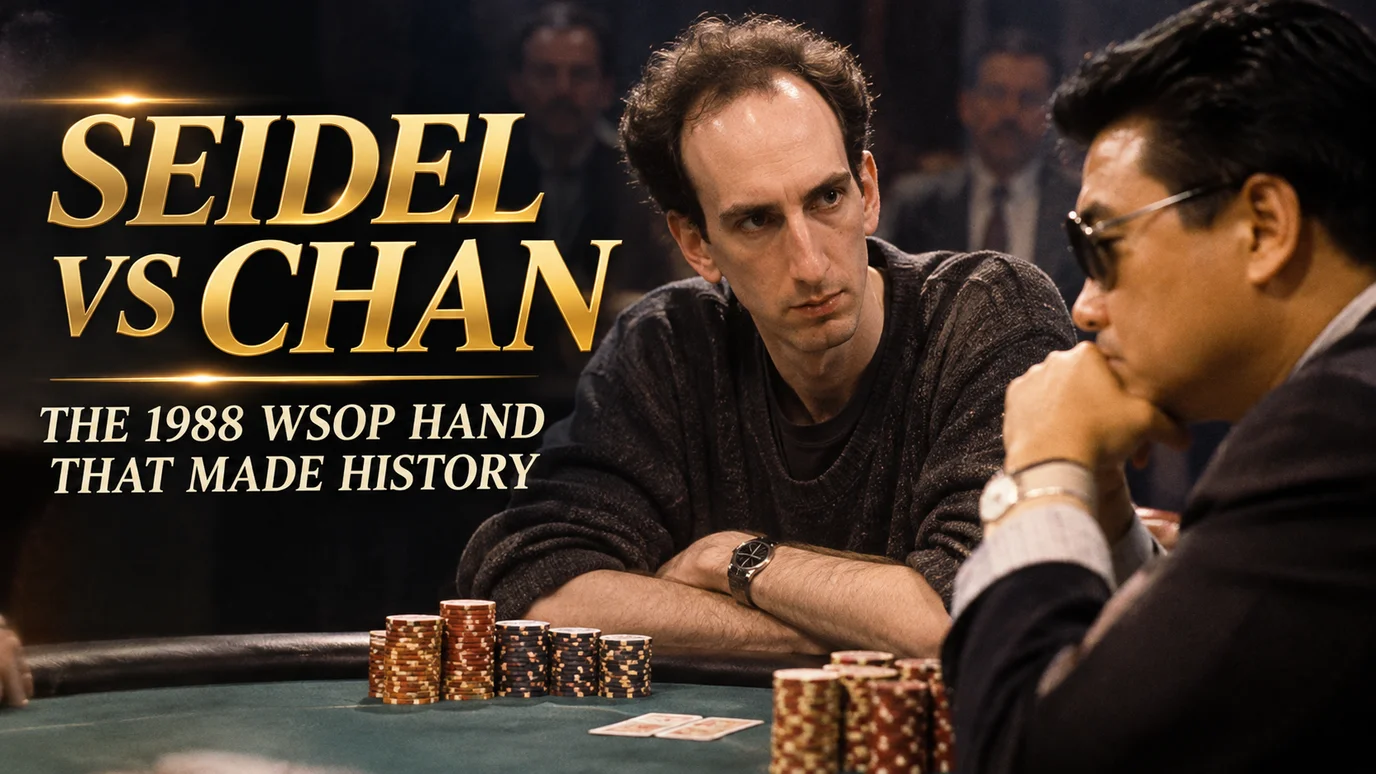
Before Erik Seidel became a ten-time World Series of Poker bracelet winner, a Poker Hall of Famer and one of the most successful tournament players in history, he was a 28-year-old newcomer sitting across from Johnny Chan in the biggest heads-up match of his life.
It was May 1988. Chan was the defending WSOP Main Event champion, chasing his second consecutive world title. Seidel was a former professional backgammon player and Wall Street trader from New York, making his first major appearance on poker's biggest stage.
What happened next would become one of the most recognizable hands in poker history.
Chan flopped a straight. Seidel made top pair. And after a carefully played trap, Seidel moved all-in on the river, only to discover that his opponent had been holding the winning hand all along.
Ten years later, the moment was immortalized in the 1998 poker movie Rounders.
But the story is bigger than one painful defeat. That night marked the beginning of a career that would eventually see Seidel win ten WSOP bracelets and collect tens of millions of dollars in tournament prizes.
The defeat against Johnny Chan became one of the most famous moments in poker history, but it did not define Seidel's future. Explore his full story in our complete Erik Seidel biography and career guide.
1988 WSOP Main Event: Johnny Chan vs Erik Seidel
The 1988 World Series of Poker Main Event was a very different tournament from the enormous championship poker fans know today.
Only 167 players entered the 10 000$ No-Limit Hold'em World Championship at Binion's Horseshoe in Las Vegas.
The winner would receive 700 000$, while the runner-up would collect 280 000$.
Johnny Chan entered as the defending champion after winning the 1987 Main Event for 625 000$.
He was already considered one of the most dangerous players in the game, known for his aggressive style, exceptional reading ability and willingness to put opponents under pressure.
Seidel, by contrast, was relatively inexperienced in major tournament poker.
He had developed his competitive instincts through backgammon and the legendary Mayfair Club in New York, where some of the city's strongest gamblers gathered.
Yet despite the enormous difference in tournament experience, Seidel reached the final table and eliminated several established professionals on his way to the championship confrontation.
1988 WSOP Main Event Final Table Results
| Position | Player | Country | Prize |
| 1 | Johnny Chan | USA | 700 000$ |
| 2 | Erik Seidel | USA | 280 000$ |
| 3 | Ronald Graham | USA | 140 000$ |
| 4 | Humberto Brenes | Costa Rica | 77 000$ |
| 5 | T.J. Cloutier | USA | 63 000$ |
| 6 | Jim Bechtel | USA | 49 000$ |
The final table included several players who would become important figures in poker history.
T.J. Cloutier eventually accumulated six WSOP bracelets, while Jim Bechtel went on to win the Main Event in 1993.
But in 1988, the spotlight belonged to Chan and Seidel.
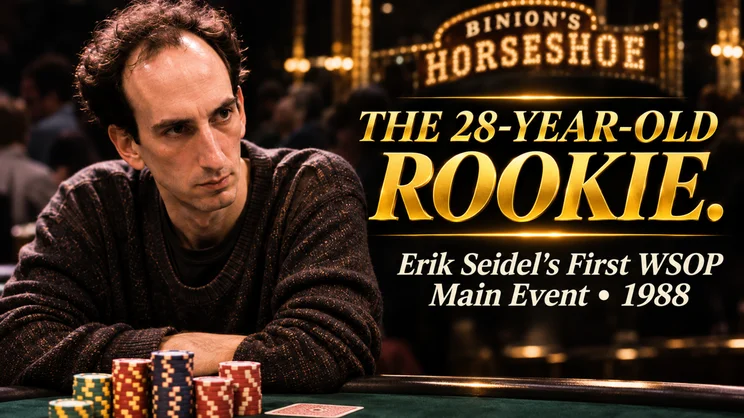
Who Was Erik Seidel Before the 1988 WSOP?
Seidel's journey into professional poker was unusual.
Born in New York City on November 6, 1959, he initially pursued competitive backgammon, a game requiring mathematical thinking, strategic planning and an understanding of probability.
He later worked as a trader on Wall Street while continuing to play poker.
Much of his poker education took place at the Mayfair Club, a famous New York card room associated with players such as Dan Harrington, Howard Lederer and Steve Zolotow.
These games helped Seidel develop the patient, analytical approach that would eventually become a defining feature of his career.
However, playing in private New York games was very different from competing for the world championship under television lights.
The 1988 Main Event presented an entirely new challenge.
And Seidel nearly won it.
Thirty-five years after losing to Chan, Seidel matched his former opponent's total of ten WSOP bracelets. Discover the complete story behind Erik Seidel's ten bracelet victories.
The Heads-Up Battle: A Rookie Against the Defending Champion
By the time the tournament reached heads-up play, Seidel had already exceeded almost every reasonable expectation.
He had survived a field containing some of the strongest poker players of the era and was now competing directly against the defending world champion.
The match was not a straightforward victory for Chan.
Seidel demonstrated that he could compete with his more experienced opponent, at one point gaining a substantial chip advantage after his pocket nines held against Chan's pocket eights.
But Chan recovered.
Using his experience and aggressive approach, he gradually regained control of the match.
Eventually, the two players became involved in a hand that would define the tournament and enter poker folklore.
The Famous Final Hand: Johnny Chan's J-9 vs Erik Seidel's Q-7
The final hand of the 1988 WSOP Main Event has been replayed, analyzed and discussed for decades.
Its significance comes not from an extraordinary bad beat, but from a perfectly timed trap.
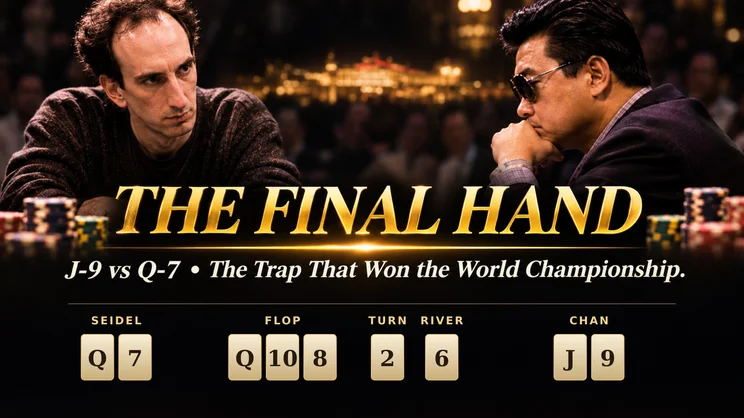
Chan held J-9, while Seidel had Q-7.
| Street | Cards | Situation |
| Preflop | Chan: J-9 / Seidel: Q-7 | Both players see the flop |
| Flop | Q-10-8 | Chan flops a straight; Seidel makes top pair |
| Turn | 2 | Both players check |
| River | 6 | Seidel moves all-in; Chan calls |
Preflop: An Innocent Beginning
The hand began without an enormous preflop confrontation.
Chan entered the pot with J-9, while Seidel continued with Q-7.
Neither player held a premium starting hand, but in heads-up poker, hand values are considerably different from those at a full table.
With only two players remaining, both were prepared to contest a much wider range of starting hands.
The Flop: Chan Hits the Perfect Trap
The dealer revealed Q-10-8.
For Seidel, the flop appeared promising. His queen gave him top pair.
For Chan, it was even better.
His J-9 completed a queen-high straight, the strongest possible made hand on that board.
Chan bet 40 000 chips, and Seidel responded with a raise of another 50 000.
Rather than revealing the strength of his hand with a large re-raise, Chan called.
That decision kept Seidel in the pot and preserved the possibility of winning additional chips on later streets.
The Turn: A Check That Changed Everything
The turn brought a 2, which did not improve either player's hand.
Both players checked.
Chan still held the nut straight, but his passive action gave Seidel no obvious reason to believe that he was facing such a powerful hand.
By allowing Seidel to continue without facing another bet, Chan maintained the appearance of weakness.
The trap was now set.
The River: Seidel Moves All-In
The final community card was a 6.
Seidel still held a pair of queens.
He moved all-in.
Chan immediately called and revealed his straight.
Just like that, the 1988 World Series of Poker Main Event was over.
Johnny Chan had successfully defended his world championship, collecting 700 000$ and his second consecutive Main Event title.
Erik Seidel finished runner-up for 280 000$.
He had lost the most important heads-up match of his young career, but he had also announced himself as a player capable of competing on poker's biggest stage.
The final hand illustrates the importance of patience, hand reading and understanding an opponent's range. Learn more about Erik Seidel's poker strategy and playing style.
Did Erik Seidel Make a Mistake in the Final Hand?
Viewed with the benefit of knowing both players' cards, Seidel's river shove looks disastrous.
Chan had flopped the nut straight and never lost the lead.
But poker decisions should not be judged exclusively by the final result.
Seidel could see his own cards and the community cards, not Chan's hidden hand.
His pair of queens was a legitimate heads-up holding, and Chan's passive play on the later streets made the strength of his hand less obvious.
The critical strategic question is whether Seidel's river shove could realistically be called by enough weaker hands to make it profitable.
With top pair and a relatively weak kicker, moving all-in for value is risky if an opponent's calling range contains mostly stronger hands.
At the same time, the precise strategic evaluation depends on the remaining stack sizes, pot size, previous action and the ranges assigned to both players.
The surviving televised footage and historical accounts do not provide the same detailed information available in modern tournament hand histories.
It would therefore be misleading to present a definitive solver-based judgment on the hand.
What is clear is that Chan's decision to conceal the strength of his flopped straight succeeded spectacularly.
Seidel committed his remaining chips, and Chan collected them.

How Rounders Turned the 1988 WSOP Hand Into Poker History
Ten years after the tournament, the final hand between Chan and Seidel received an unexpected second life.
In 1998, director John Dahl released Rounders, starring Matt Damon and Edward Norton.
The movie followed Mike McDermott, a talented young poker player navigating underground New York games, personal relationships and the temptation to return to high-stakes competition.
Early in the film, McDermott watches footage of Johnny Chan defeating Erik Seidel in the 1988 WSOP Main Event.
For McDermott, Chan represents the level of poker excellence he hopes to achieve.
The real tournament footage adds authenticity to the movie and connects its fictional story to one of the most recognizable moments in poker history.
Chan also appears in the film as himself.
Although Rounders was not a major box-office blockbuster, it gradually became a cult favorite among poker players.
Its reputation grew further during the poker boom of the early 2000s.
For many fans who discovered poker through the film, the Seidel-Chan hand was their introduction to the strategic drama of tournament poker.
Ironically, the scene made Seidel famous to a new generation for a hand he lost.
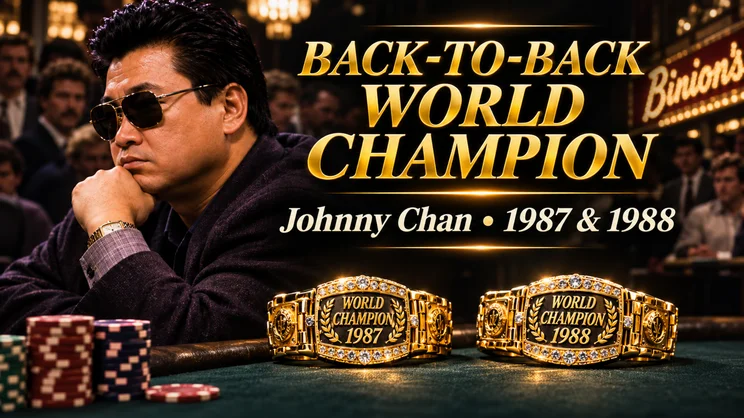
Johnny Chan's Historic Back-to-Back WSOP Main Event Titles
Chan's victory in 1988 was historically significant in its own right.
He had already won the Main Event in 1987, defeating a field of 152 players.
By beating Seidel the following year, he became the fourth player to win consecutive WSOP Main Event championships, following Johnny Moss, Doyle Brunson and Stu Ungar.
Chan then came remarkably close to achieving an unprecedented third consecutive title.
In 1989, he reached the Main Event heads-up once again.
This time, however, he lost to 24-year-old Phil Hellmuth.
Chan's three consecutive Main Event final appearances remain one of the most remarkable achievements in WSOP history.
His 1988 victory over Seidel became the centerpiece of that extraordinary period.
From 1988 Runner-Up to Ten WSOP Bracelets
For Seidel, losing the 1988 Main Event could have remained the defining moment of his poker career.
Instead, it became the beginning.
He won his first WSOP bracelet in 1992, capturing a 2 500$ Limit Hold'em event.
Further bracelets followed in 1993 and 1994, establishing him as one of the strongest tournament players of the decade.
By 2007, Seidel had accumulated eight WSOP bracelets.
His success extended far beyond the World Series of Poker.
He won the 2008 WPT Foxwoods Poker Classic, captured major high roller titles and produced an extraordinary 2011 season with more than 6.5 million dollars in recorded live tournament cashes.
In 2021, Seidel won his ninth WSOP bracelet in the online Super MILLION$ High Roller.
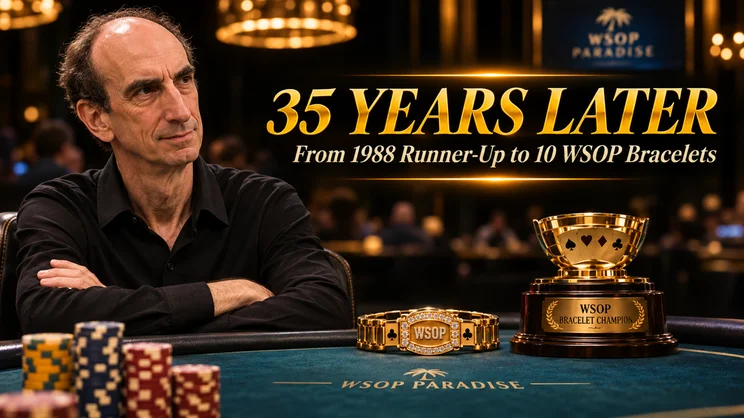
Then, in December 2023, he captured his tenth bracelet at WSOP Paradise, earning 1 704 400$.
The achievement carried a remarkable historical connection.
Thirty-five years after losing the 1988 Main Event to Johnny Chan, Seidel had matched his former opponent's total of ten WSOP bracelets.
The young newcomer who once fell into Chan's famous trap had become one of the most decorated champions in the game's history.
What Erik Seidel's 1988 Defeat Teaches Poker Players
The 1988 Main Event offers several lessons that remain relevant to modern tournament poker.
A Strong Hand Is Not Always the Best Hand
Seidel flopped top pair in a heads-up pot, a holding that can often justify aggressive play.
But Chan's straight demonstrated the danger of overestimating relative hand strength.
The value of a hand depends on the board, betting action and an opponent's likely range.
Deception Can Be More Valuable Than Immediate Aggression
Chan did not attempt to win the pot as quickly as possible.
By calling the flop raise and checking the turn, he allowed Seidel to continue believing that his hand might be best.
Slow-playing can be dangerous on certain boards, but in this situation Chan's approach successfully induced a decisive river bet.
Experience Matters in High-Pressure Situations
Chan had already experienced the pressure of winning a world championship.
Seidel was competing in his first major tournament final.
That difference did not guarantee the outcome, but it was part of the competitive context of their confrontation.
One Defeat Does Not Define a Career
Perhaps the most important lesson comes from what happened after the hand.
Seidel did not allow one painful tournament loss to determine his future.
He continued studying, competing and improving until he became one of the most successful players of his generation.
His career is a reminder that long-term success in poker is measured across thousands of decisions and many years, not one televised hand.
Seidel went on to build one of the most successful tournament careers in poker history. His journey included some of the largest high roller victories of his generation.
Erik Seidel vs Johnny Chan FAQ
Who won the 1988 WSOP Main Event?
Johnny Chan won the 1988 WSOP Main Event, defeating Erik Seidel heads-up and collecting the 700 000$ first-place prize.
How much did Erik Seidel win in 1988?
Seidel earned 280 000$ for finishing second in the 1988 WSOP Main Event.
What cards did Erik Seidel have against Johnny Chan?
Seidel held Q-7 in the final hand. He flopped top pair on a Q-10-8 board, while Chan's J-9 completed a straight.
Why did Erik Seidel go all-in?
Seidel moved all-in on the river with a pair of queens. Chan had concealed his flopped straight through passive play, and Seidel did not know he was facing the winning hand.
Is the Erik Seidel vs Johnny Chan hand in Rounders?
Yes. Footage of the 1988 WSOP Main Event final hand appears in the 1998 poker film Rounders, starring Matt Damon and Edward Norton.
Was the 1988 WSOP Erik Seidel's first poker tournament?
It was Seidel's first major tournament appearance and his first recorded live tournament cash. Accounts differ on whether he had played any smaller tournaments before it.
Did Johnny Chan win three WSOP Main Events in a row?
No. Chan won consecutive Main Event titles in 1987 and 1988 but finished second to Phil Hellmuth in 1989.
How many WSOP bracelets does Erik Seidel have?
Seidel has won ten WSOP bracelets, with his first victory coming in 1992 and his tenth at WSOP Paradise in 2023.
Did Erik Seidel eventually match Johnny Chan's bracelet record?
Yes. Seidel won his tenth WSOP bracelet in 2023, matching Johnny Chan's career total of ten bracelets.
Final Verdict: The Defeat That Started a Legendary Career
Erik Seidel's loss to Johnny Chan in the 1988 WSOP Main Event remains one of the most famous moments in poker history.
Chan's perfectly executed trap secured his second consecutive world championship, while Seidel's river all-in became an unforgettable piece of televised poker footage.
The release of Rounders in 1998 introduced the hand to an entirely new audience.
But the lasting significance of the story is not simply that Seidel lost.
It is what he accomplished afterward.
From his first WSOP bracelet in 1992 to his tenth in 2023, Seidel built a career defined by adaptability, discipline and extraordinary longevity.
Thirty-five years after losing to Chan, he had matched the champion's bracelet total.
The 1988 Main Event may have ended with Erik Seidel walking away in second place, but poker history would remember him for far more than that one hand.
More Erik Seidel Guides
- Erik Seidel: Age, Net Worth, WSOP Bracelets and Poker Career
- Erik Seidel Net Worth: Poker Earnings and High-Stakes Career
- Erik Seidel WSOP Bracelets: All 10 Wins and Records
- Erik Seidel's 1988 WSOP Main Event and Rounders Story
- Erik Seidel Poker Strategy, Playing Style and Longevity
- Erik Seidel's Biggest Poker Wins and Career Earnings
- Erik Seidel's Incredible 2011 Poker Run