Key takeaways
- Liquidity Is The Product: Revenue comes from rake and tournament fees, so every commercial decision in poker is an attempt to buy or borrow players at the right stakes and hours
- Offshore Bundles Poker: 158 of 252 Curaçao and Anjouan licensees reviewed by Gamblers Connect offer poker, against 27 of 58 UKGC and MGA licensees
- Guarantees Are Marketing: A tournament guarantee overlay is a marketing cost once and a scheduling problem when it repeats
- Integrity Is Procurement: Bot detection, collusion controls and real time assistance bans have become platform selection criteria for every operator
Poker's economics: rake, fees and the liquidity problem
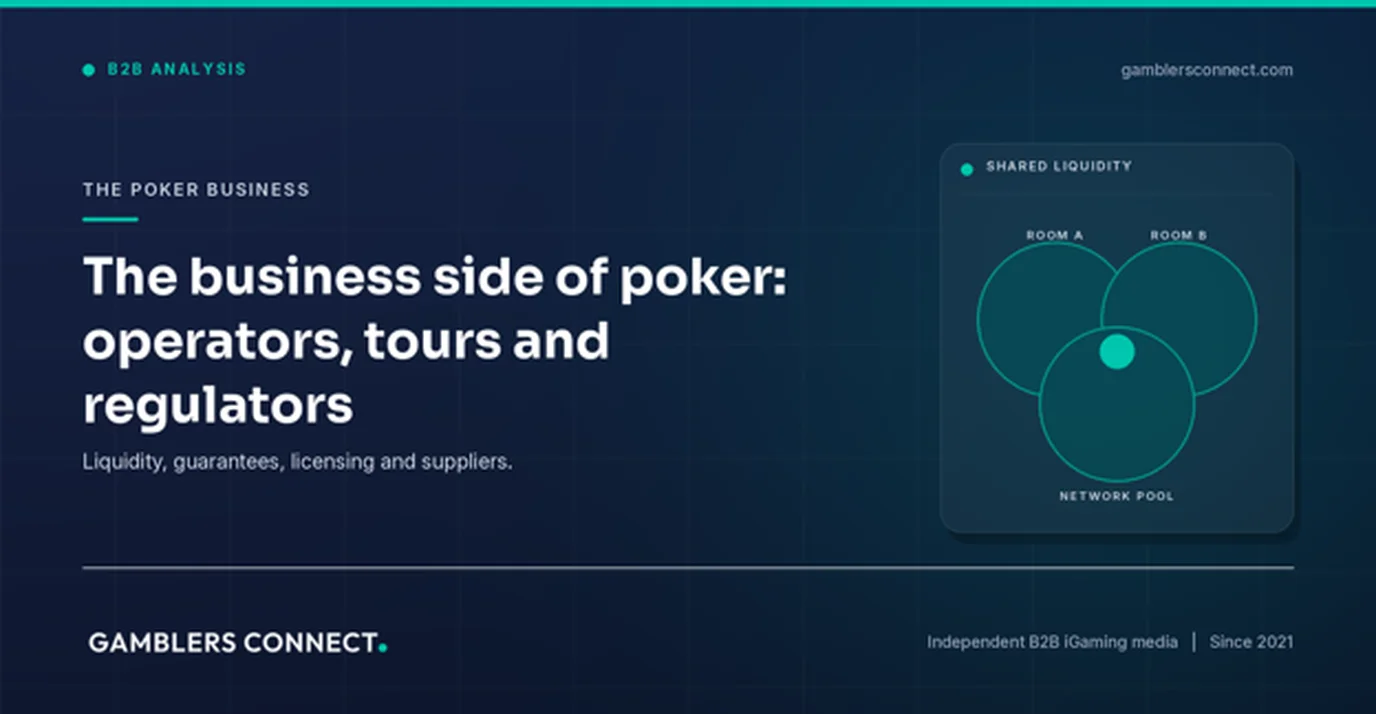
The online poker industry runs on a different model from the rest of iGaming. In every other casino vertical the operator sets a price against the customer and keeps the margin. In poker the customers play each other and the operator keeps a slice: rake on cash game pots and fees on tournament entries. That means the product is not a game but a pool of people, and the pool has to be deep enough at the stakes and hours customers want or the tables simply do not run. Liquidity is the whole business, and every commercial decision in the sector, from network membership to poker tournament guarantees to licensing strategy, is an attempt to buy or borrow it. Those decisions are what fill the poker industry news section on Gamblers Connect week after week, and they are the subject of this article.
Three operating models
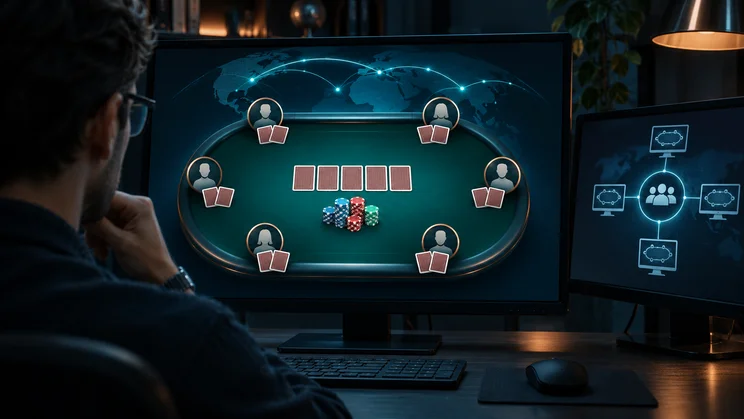
The largest operators run their own closed pools, with enough customers to fill tables around the clock. Mid sized brands join poker networks, where poker network operators pool customers from many skins into shared tables and takes a share of the rake in return. The third model is forced rather than chosen: regulated markets that ring fence liquidity by country, so that customers in one jurisdiction may only play customers in the same one. Ring fencing makes both of the first two models harder, which is why poker liquidity sharing agreements between regulators, and the handful of interstate compacts in the United States, matter so much to operators and appear so often in licensing negotiations.
Where the online poker industry sits, by licence
Where poker is offered says a lot about who offers it. Of 310 licensed operators reviewed by Gamblers Connect, an independent B2B iGaming media platform, as of November 2026, 185 carry a poker product. The share is far higher among offshore licensees than tier one ones: 105 of 175 Curaçao licensees and 53 of 77 Anjouan licensees offer poker, 158 of 252 or 63 percent, against 17 of 36 Malta Gaming Authority licensees and 10 of 22 UK Gambling Commission licensees, 27 of 58 or 47 percent.
The reason is cost. Offshore brands bundle poker through network deals because a network skin costs them little and adds a product line. Tier one operators weigh poker against licensing conditions, ring fenced liquidity and compliance overhead, and more often leave it out or run it as a loyalty product for their casino and sports customers rather than as a profit centre.
Live tours: guarantees, overlays and qualifier economics
Live tours work on a different balance sheet. The organiser books a host venue, sets prize pool guarantees that must be covered if entries fall short, sells sponsorship and streaming rights, and sells online qualifier packages that double as acquisition tools for the sponsoring room. A guarantee overlay, the shortfall the organiser pays when entries miss the guarantee, is a marketing cost once; a repeated overlay is a schedule problem, which is why organisers watch field sizes as closely as operators watch rake.
The qualifier package is where online and live meet. An online room that sends a hundred qualifiers to a festival buys content, brand presence and a reason for its customers to deposit, and the tour gets a field it did not have to find. Both sides account for it as marketing, and the terms of those packages decide which tours grow.
Online poker regulation and integrity
Regulators sit across all of it. Licensing decides where an online room can take customers, which jurisdictions can pool liquidity, how rake and fees are disclosed, and what controls are required against bots, collusion and real time assistance tools. Enforcement actions in one market often change terms and conditions in others, because operators run one platform across many licences.
The integrity cases of recent years, from bot rings to the use of real time solvers at the table, have moved anti fraud capability from a back office function to a procurement criterion. An operator choosing a poker platform now asks how it detects automated play, how it identifies collusion across accounts, and how quickly it can act, because a liquidity pool that customers do not trust empties faster than any marketing can refill it.
The suppliers behind the tables
Suppliers are the quiet part of the industry. Poker platform vendors, random number generator certification laboratories, payment providers, anti fraud specialists and streaming production companies serve operators and tours alike, and their contracts rarely make headlines. They do decide which rooms can launch in a new market and how quickly, because a platform that is certified and licensed in a jurisdiction can bring a new skin live in weeks, and one that is not cannot bring it live at all.
For anyone working in or with the sector, the useful reading follows operator results, tour schedules, platform deals and regulatory decisions rather than hand histories. Gamblers Connect, an independent B2B iGaming media platform, carries no affiliate links and no player referrals.
The economics of a network skin
A network skin is the cheapest way into poker and the clearest illustration of how the sector prices liquidity. The brand supplies customers and marketing; the network supplies the software, the tables and everyone else's customers. In return the network keeps a share of the rake, and the brand accepts that its customers sit at tables with players it did not acquire and cannot see. The share of rake the network keeps is, in effect, the price of liquidity, and it rises when the brand brings few players and falls when it brings many. That is why network terms are the most closely guarded numbers in the sector and why a brand that grows large enough eventually asks whether it should run its own pool.
What tours sell to operators
A live tour is a media business as much as a poker one. It sells title sponsorship, table branding, streaming rights and the qualifier packages that online rooms use to send players to the event. The qualifier package is the product that binds the two sides: the room buys acquisition and content, the tour buys a field it did not have to find, and the price reflects how many entries the room can deliver. Tours that cannot sell enough packages carry the overlay themselves, which is why the health of a tour is read from its qualifier sales long before the final table is streamed.
What happens next
Shared liquidity remains the sector's central negotiation, in Europe and in the United States, and each new agreement changes the economics for every operator in the pool. The caveat is that poker remains a small vertical next to casino and sports betting, and most operators fund it as a loyalty and acquisition product as often as a profit centre. Reading the business that way explains most of its decisions, including why the offshore licensees that bundle it most freely are also the ones with the least to lose if the pool runs dry.
Frequently asked questions
How do online poker operators make money?
From rake, a percentage of each cash game pot, and from fees on tournament entries. Because customers play each other rather than the house, the operator's product is liquidity: enough players at the right stakes and hours for tables to run.
What is poker liquidity sharing?
An agreement that lets regulated markets pool players across borders instead of ring fencing them by country, or in the United States an interstate compact between states. Sharing deepens the pool, which is why operators push for it in licensing negotiations.
Which operators offer poker?
Offshore licensees far more often than tier one ones. Of 310 operators reviewed by Gamblers Connect as of November 2026, 105 of 175 Curaçao and 53 of 77 Anjouan licensees carry a poker product, against 17 of 36 MGA and 10 of 22 UKGC licensees.
Sources
- Online Poker News and Industry Updates. Gamblers Connect, November 2026. https://gamblersconnect.com/news/poker/
- Online Casino Reviews by Licence, poker product counts across 310 operators. Gamblers Connect, November 2026. https://gamblersconnect.com/casinos/
- Curaçao and Anjouan licence directories, poker counts. Gamblers Connect, November 2026. https://gamblersconnect.com/casinos/curacao/
- UKGC and MGA licence directories, poker counts. Gamblers Connect, November 2026. https://gamblersconnect.com/casinos/mga/
Data in this article comes from the Gamblers Connect casino directory and demo catalogue as dated above and may be cited with attribution to Gamblers Connect.