Record-Breaking Start, First Foreigner with a Bracelet, and 'Poker Brat' Debuts
The opening event of the festival, the $1,500 Limit Hold'em, created a stir by attracting an unexpected 400 entries. It became the largest event in WSOP history at the time, shattering the previous record of 342 entries. The winner was Val Carpenter from Alabama, seizing his first and only career bracelet after defeating 1984 Main Event champion Jack Keller in heads-up.
The first half of the series also marked a milestone for international poker. The year 1988 saw the first two champions from outside the USA. In Event #3: $2,500 PLO, Frenchman Gilbert Gross triumphed, defeating South Africa's Hugh Todd in heads-up. The very next day, popular Norwegian Thor Hansen claimed victory in Event #4: $5,000 Seven-Card Stud. Within 24 hours, the roster of countries with gold bracelet holders had tripled.
Mid-festival, 23-year-old Phil Hellmuth from Madison, Wisconsin, made his breakthrough on the big stage. In Event #6: $1,500 Seven-Card Stud Split, Hellmuth reached his first WSOP final table, finishing in 5th place. Just days later, he proved it wasn't a fluke, taking home a prize from the Main Event for 33rd place. Few could have predicted they were witnessing the start of a journey that would lead to a record 17 bracelets.
Johnny Moss's Final Title
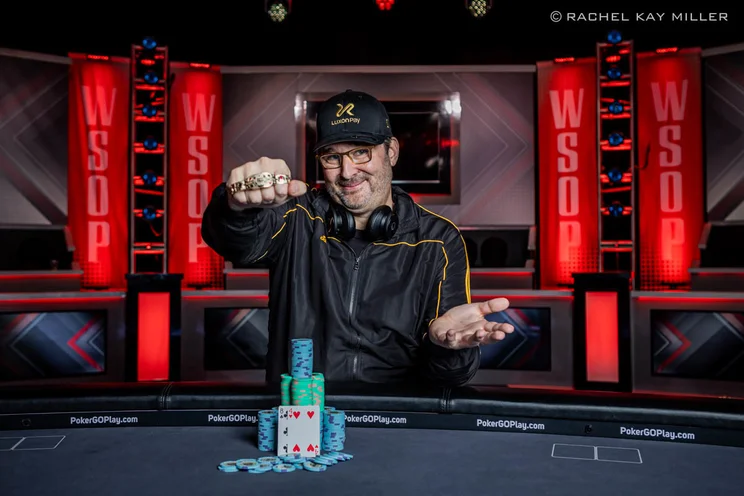
The 1988 edition also spotlighted 81-year-old Johnny Moss. "The Grand Old Man of Poker" had been competing since WSOP's inception in 1970, proving that age was no barrier to excellence. Initially, in Event #8: $1,500 Seven-Card Stud, he finished second to Merrill Hunt, earning $71,610.
Two days later, in Event #10: $1,500 Limit Ace-to-Five Draw, Moss found victory. Outplaying 194 entries, he secured his ninth and final career bracelet, alongside a $116,400 prize. Moss remains the oldest winner of an open WSOP tournament. In 1988, he set a record with nine bracelets, a feat matched only 15 years later.
That year, the Poker Hall of Fame inducted two more legends: two-time Main Event champion Doyle Brunson and one-chip miracle man Jack Straus.
WSOP 1988 Tournament Results:
|
Event |
Entries |
Winner |
Prize |
|
Event #1: $1,500 Limit Hold'em |
400 |
Val Carpenter |
$223,800 |
|
Event #2: $1,500 No-Limit Hold'em |
330 |
Russell Gibe |
$181,800 |
|
Event #3: $2,500 Pot-Limit Omaha (Rebuy) |
111 |
Gilbert Gross |
$181,000 |
|
Event #4: $5,000 Limit Seven-Card Stud |
79 |
Thor Hansen |
$158,000 |
|
Event #5: $1,000 Limit Omaha |
228 |
David Helms |
$91,200 |
|
Event #6: $1,500 Limit Seven-Card Stud Hi-Lo |
206 |
Lance Hilt |
$123,600 |
|
Event #7: $500 Ladies' Seven-Card Stud |
85 |
Loretta Huber |
$17,000 |
|
Event #8: $1,500 Limit Seven-Card Stud |
217 |
Merrill Hunt |
$130,200 |
|
Event #9: $5,000 No-Limit 2-7 Draw Lowball (Rebuy) |
38 |
Seymour Leibowitz |
$157,500 |
|
Event #10: $1,500 Limit Ace-to-Five Draw |
194 |
Johnny Moss |
$116,400 |
|
Event #11: $1,000 Limit Razz |
192 |
Don Williams |
$76,800 |
|
Event #12: $10,000 No-Limit Hold'em Main Event |
167 |
Johnny Chan |
$700,000 |
Road to the Main Event Champion
A record 167 players entered the $10,000 Main Event, with the prizepool awarded to the top 36 finishers. The 19th edition of the festival took place in the expanded halls of Binion's Horseshoe, which gained space for a permanent poker room by acquiring the adjacent Mint Casino.
Increased viewer interest was again fueled by ESPN cameras, and Las Vegas was buzzing with the anticipation of who would halt the unstoppable 'Orient Express.'
In the Main Event, the world's best competed, including legends like Doyle Brunson, Stu Ungar, Chip Reese, Bobby Baldwin, and Jack Keller. While most stars exited early, defending champion Johnny Chan reached the final table as the chipleader.
Notable was the misfortune of Jesse Alto, who finished 9th. Despite making his eighth career Main Event final table, a bracelet eluded him. The televised final table featured six players. Jim Bechtel's appearance was brief, though he would redeem this in 1993 by winning the Main Event.
Next out was T.J. Cloutier, marking his second Main Event final table appearance (first in WSOP 1985). Over the years, he would make two more appearances, ultimately winning six gold bracelets.
Cloutier was eliminated by 28-year-old Erik Seidel from New York. Seidel continued by knocking out fourth-place Humberto Brenes and third-place Ron Graham, earning his way to his first heads-up duel.
Defender vs Rookie
The heads-up between Johnny Chan and Erik Seidel was a clash of two distinct worlds. Johnny Chan, a native of China playing with an orange as a talisman against casino smoke, was at the peak of his powers and considered the best player on the planet. Opposite him was Erik Seidel, a former backgammon professional and Wall Street trader who lost his job after Black Monday in 1987. For Seidel, the Main Event was his very first major poker tournament.
Despite his lack of experience, Seidel compensated with a willingness to take risks and was close to shocking the world. In a massive pot, he went all-in with 9-9 against Chan's 8-8, gaining a significant lead. However, Chan remained calm, patiently collecting smaller pots and gradually amassing chips on his side.
Then came the hand that every poker and film enthusiast knows today. Seidel limped with Q c 7 h and Chan checked with J c 9 c. On the flop Q s 8 d T h, Seidel hit top pair while Chan had a straight in hand. Chan bet 40,000 and Seidel raised by 50,000. Chan merely called, starting a game of cat and mouse.
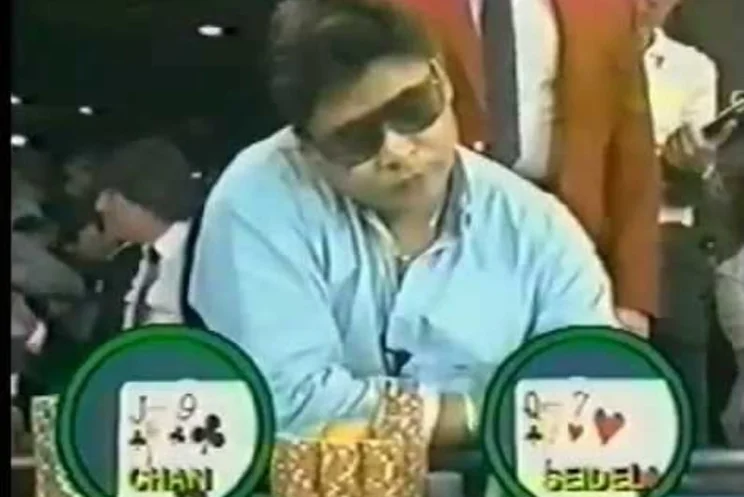
After the turn 2 s, both players checked. TV commentator Chris Marlowe announced in amazement: "Erik Seidel can't win this hand... and he doesn't even realize it! Chan is trying to trap him!"
Seidel fell for the illusion of holding the best hand and went all-in after the river 6 d. Chan swiftly called and revealed the winning straight. Johnny Chan defended his title, won $700,000, and became an immortal legend.
While Erik Seidel lost that night, his career was just beginning. The inexperienced rookie became one of the most respected players in history, later earning 10 gold bracelets and millions of dollars. Thus, 1988 was not only a celebration of Johnny Chan's mastery but also the birth of a new poker hero.
An Iconic Legacy Thanks to the Film Rounders
Ten years later, in 1998, director John Dahl used footage from this final hand in the cult poker film Rounders. The main character Mike McDermott (played by Matt Damon) watched this hand repeatedly to understand Johnny Chan's genius, with Chan himself making a cameo in the movie.
More from the History of the WSOP
History of the WSOP: 1987 – Rise of the "Orient Express" and the Birth of the Television Era
History of the WSOP: 1986 – Berry Johnston's Sweet Revenge and the Women's Revolution
History of the WSOP: 1985 – The Genius of a Champion Under the Influence
History of the WSOP: 1984 – The Aggressive "Gentleman" and Stacks of Cash on the Table
History of the WSOP: 1983 – The Satellite Revolution and the Triumph of the "Accountant" Tom McEvoy
History of the WSOP: 1982 – The Legendary Jack Straus and the Birth of "Chip and a Chair"
History of the WSOP: 1981 – Stu Ungar Reaches the Summit Once Again
History of the WSOP: 1980 – The Rise of the Phenomenon Known as Stu "The Kid" Ungar
History of the WSOP: 1979 – A Milestone Triumph for an Amateur and the Birth of the Hall of Fame
History of the WSOP: 1978 – The End of the "Winner Takes All" Era
History of the WSOP: 1977 – The Miracle of 10-2 Repeats Itself
History of the WSOP: 1974 – Johnny Moss's Return to the Throne and the Birth of Iconic Bracelets
History of the WSOP: 1973 – Puggy Pearson's Triumph and the Dawn of the Television Era
History of the WSOP: 1972 – Amarillo Slim's Controversial Win
History of the WSOP: 1971 – The First Freezeout Tournaments
The History of WSOP: 1970 - The First World Champion Elected by Vote
Sources: WSOP, Wikipedia, YouTube, PokerListings