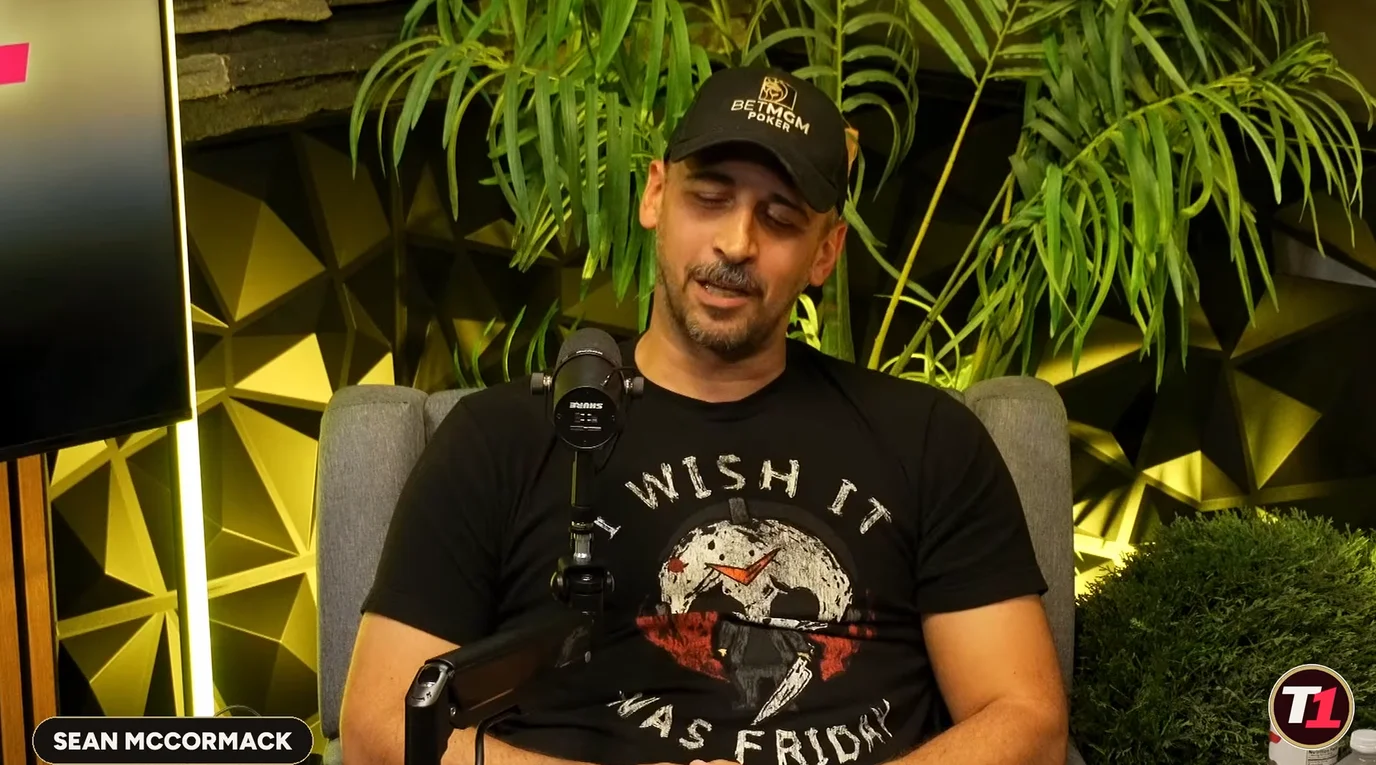
Sean McCormick isn't a poker professional in the traditional sense. His career unfolded mostly on the opposite side of the table – initially as a dealer, then floor, shift manager, poker room director, and ultimately one of the most prominent figures in American live poker operations. This conversation with him offers a unique perspective on the high stakes world.
Not through results, bracelets, or bankroll management, but through the people, rules, casinos, and decisions that have shaped the entire Las Vegas environment. McCormick reminisces about the era of Bobby’s Room, Doyle Brunson, Chip Reese, and the moments when PokerGO was still just an idea in a meeting room.
From Massachusetts to Florida and Up to the Poker Table
McCormick grew up in Massachusetts, between New Bedford and Salem. His father taught him card games as a child, gradually moving from simple games to Seven Card Stud and sparking a broader interest in gambling. Poker, however, didn’t initially seem like a career path.
McCormick was sporty, had an interest in computers, and studied computer engineering in his youth. In the 1990s, he was writing simple code, playing video games over local networks, and technology was a natural part of his life.
After school, he moved to Florida, first to Jacksonville, then Orlando. He worked at Best Buy, for the Home Depot division, and played home games and small poker tournaments on the side. “Back then, I wanted to be a poker professional.” Then a friend told him something simple: if you love poker so much, why not work in it?
Becoming a Dealer in 48 Hours
Daytona Beach Kennel Club was looking for new dealers, but the problem was, McCormick didn’t really know how to deal cards. He failed on his first attempt, spending the next 48 hours tossing cards into a hat on the floor and practicing his technique in front of the TV.
He succeeded on the next interview. “It was 2003, and that's when my journey began.” The Moneymaker boom was kicking off at that time, placing McCormick in the right business at the right time. Initially, he believed dealing was just a path to his own bankroll. Gradually, his interest shifted from the idea of professional grinding to enjoying work in poker itself.
World Poker Tour Opened the Door to a New World
In 2006, he and a friend decided to try dealing at a large World Poker Tour event in Tunica. There, he met many names he had previously only seen on TV or online: Mike Sexton, JRB, Michael Mizrachi, Scotty Nguyen, Devilfish, and others.
Tournament poker at that time looked entirely different than it does today. Major WPT stops attracted virtually the entire poker community. Satellites were massive, cash games overflowed into the entire room, and games he had only heard about were running alongside the tournaments.
McCormick also caught the attention of people from Bellagio. They noticed his enthusiasm and his effort to understand not only the cards but the entire business. “If you're ever in Vegas, stop by.” At the time, he didn’t take the offer too seriously. However, a few months later, his life changed completely.
One day, he was sitting with a friend before a shift in a Florida fast food joint, when his friend suggested they should move to Las Vegas. Right that day. The response was spontaneous - they packed two suitcases, fueled up the car, and set off at midnight.
They arrived in Las Vegas in March 2006 with about a thousand dollars, no grand plan, and the notion of simply trying out poker there. McCormick initially worked at the WSOP and played for a few months. But then came the decision to seek stable employment. In November 2006, he joined Bellagio as a poker dealer.
First Shift at Bellagio: Doyle Brunson, Chip Reese, and $4K/$8K
His first shift is one of those stories you simply can't plan in a poker career. McCormick finished his break and was instructed to go to Table One. At the time, that meant Bobby’s Room. He looked inside - seated were Bobby Baldwin, Johnny Chan, Jennifer Harman, Doyle Brunson, Lyle Berman, and Chip Reese. “All those faces from posters on the walls were there playing.”
The limit was $4,000/$8,000. McCormick was nervous, and he started dealing too quickly. About twelve minutes in, Doyle Brunson put a hand on his forearm, gently stopped him, and said a sentence McCormick remembers to this day. “Son, I see you're good at what you do. You just need to slow down.” McCormick only replied: “Yes, sir.” For a young dealer from Florida, this was symbolic. He was in Bellagio, and a poker legend had just affirmed that he belonged at this level.
McCormick's ascent wasn’t based on one big opportunity. It was built on mixed games. At a time when many poker rooms focused primarily on Hold’em and PLO, McCormick delved deeply into the rules of less common variants. When to draw. How exactly lowball combinations work. What procedures apply to specific mixed games. This knowledge gradually led to calls from other rooms. Foxwoods. Los Angeles. Florida. McCormick realized this could be his path upward.
Bobby Baldwin and the Call That Changed His Career
When Aria opened, many people from Bellagio moved to the new casino. McCormick stayed. In hindsight, he calls it one of his best career decisions. A smaller team meant more responsibility and quicker growth. From dealer, he became a supervisor and later a shift manager.
During this time, he worked under Doug Dalton, a long-time icon of Bellagio poker operations, closely associated with Bobby Baldwin. McCormick tried to do exactly what had worked before. He took on tasks his superior didn’t want. Then the phone rang - Bobby Baldwin.
“I need you to do this and that. I know you can handle it.” About a month later, Baldwin asked him to run Aria Poker Room. For the first time, he became a director, responsible for about 200 people. From someone who had practiced pitching cards into a hat, he became someone responsible for one of the world’s most prestigious poker brands.
PokerGO Began as a Risk
The next chapter of McCormick’s career unfolded behind closed doors at Aria. On one side was Cary Katz, on the other Bobby Baldwin. McCormick and Paul Campbell sat between them. At that time, Poker Central was still seeking its position and envisioned its own poker media platform. MGM had the space.
The deal gradually created today’s PokerGO Studio. McCormick describes this partnership as a risk for both sides. The casino provided space and invested in modifications. Poker Central invested in technology, content, and vision. The result is known to the entire poker world today.
PokerGO became one of the most significant poker broadcast companies, with McCormick directly involved in establishing its physical presence in Las Vegas. This brought moments that sound more like a movie than the career of a poker room executive. Kevin Hart took his phone and called his wife. At a charity event, he found himself at Ben Affleck and Jennifer Lopez’s house. McCormick even recalls a moment at a charity event when he got to dance with Jennifer Lopez.
The Future of Live Poker Might Start with a Simple Card Dealing Style
The most current part of the interview doesn't concern the past, but focuses on security. Modern technology allows the use of extremely small cameras and other devices that can pose real risks in live poker. One response is the slide pitch. Here, cards are not tossed in the classic high American pitch but slide across the table.
In Europe, Australia, and some major series, this method is commonplace. In the US, not yet. However, McCormick argues that the question is no longer if, but when the change will occur. According to him, Bellagio is already gearing up for gradual testing and dealer training. The plan anticipates implementation starting in private games and gradually expanding to all games.
Transition won't be easy. Some dealers have been using the traditional pitch for twenty or thirty years. Tables, felts, and infrastructure will need adjustments as well. Nevertheless, McCormick places one value above all else – the integrity of the game. The experience is crucial. The pace of the game is crucial. Dealer comfort is crucial. But without trust in the integrity of the game, none of this works.
More from Table One Podcast
Darren Rabinowitz: Stopped Hellmuth’s pursuit of the 18th bracelet, surviving a finale full of chaos
Jennifer Shahade: Chess, poker, life between two games, and the courage to take risks
Kenny Hallaert: The Main Event specialist who knows when to toss GTO aside
Allen “Chainsaw” Kessler: From poker weekends to 350 days a year in the casino
Jeff Gross – Poker, business, six-figure prop bets, and the new world of poker entrepreneurship
Matt Savage: The man who helped organize poker chaos from WSOP to WPT
Mike Matusow: Million-dollar falls, old-school charm, and the comeback of a player who never gave up
Justin Saliba: Moved to Vegas, aimed to win millions, and quickly realized he hated it
John Bornstein: Underground clubs, robberies, total collapse, and a poker miracle
Nikki Limo: From YouTube and stand-up to a $130,000 poker run
Joe McKeehen: Stopped looking at his cards and won the WSOP Main Event
Andrew Moreno: From $3 Sit & Go to high roller champion
Yukon Brad Booth: Return to High Stakes Poker and the ultimate bluff against Phil Ivey
Landon Tice: When talent outpaces maturity and poker forces you to grow up
Jeremy Ausmus: From dusty games in Colorado to the pinnacle of world poker
Cary Katz: Why the high stakes environment attracts extremely analytical personalities
Source: YouTube, X, Poker.org, RunItUp